Terminally ill man enjoys final visit with German sherperds and shares his dying wish
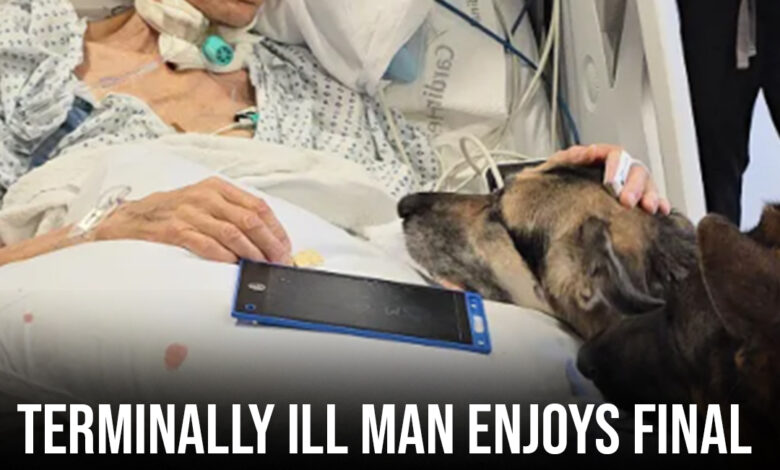
In the clinical quiet of Columbia University Irving Medical Center, a profound argument was made this week for the restorative power of the human-animal bond. It is a veteran journalist’s observation that dogs often possess an intuitive grasp of the ephemeral—they sense the thinning of a voice, the heavy stillness of a room, and the gravity of a final departure. For a terminally ill New Yorker known to his community as Mr. Spencer, that intuition provided the only closure that mattered.
Mr. Spencer, a resident of the Bronx battling an undisclosed but aggressive illness, faced his final hours with a singular, deeply personal mandate: he needed to look into the eyes of his two German Shepherds, Bowie and Nikki, one last time.
The Logistics of Mercy
The path to this reunion was fraught with the kind of red tape that usually defines institutional healthcare. With no surviving family members to intervene, Bowie and Nikki had already been transitioned into the custody of NYC Second Chance Rescue during Mr. Spencer’s hospitalization. Recognizing that these dogs were not merely pets but the entirety of the dying man’s familial structure, Jennifer Brooks, the founder of the Long Island City-based rescue, worked in tandem with hospital administrators to authorize a bedside visit.
The resulting footage captures a scene of devastating tenderness. Upon entering the room, the two large Shepherds bypassed the humming machinery and the gathered medical staff, moving directly to the bedside. They did not bark or strain; they approached with a quiet recognition.
“It was a tearjerker, seeing them get so excited to see their owner,” Brooks recalled in an interview with WCBS. “They laid near his bed. We stayed for quite a while.”
“The Only Family He Had”
The weight of the moment was not lost on the hospital’s professional staff. Reports indicate that approximately ten doctors stood witness to the meeting, a demographic typically hardened to the realities of the ICU. According to Brooks, “literally, there was not a dry eye in the room.”
For Mr. Spencer, the dogs were his North Star. He spoke of them daily to the nursing staff, framing his identity through his role as their guardian. Only hours after the dogs were led from his room—and after he had reached out to feel the familiar texture of their fur—Mr. Spencer passed away.
Brooks believes the dogs understood the finality of the encounter. “I believe that seeing him in that state, [Bowie and Nikki] knew they had to move on now,” she reflected.
A Deathbed Promise
Before his passing, Mr. Spencer extracted one final promise from Brooks: that his loyal companions would not be separated. Because they are a “bonded pair,” their psychological well-being depends on their proximity to one another.
NYC Second Chance Rescue has since launched a high-priority adoption campaign to fulfill that vow. Their adoption profile paints a picture of two dogs who are not only loyal to their late owner but are “therapy dog material”—friendly, affectionate, and resilient despite the upheaval of their lives.
“They’re big dogs, so being out of the city would be nice for them,” Brooks noted, suggesting a suburban or rural environment would best suit their stature.
The Legacy of a Goodbye
In the high-stakes environment of a major New York medical center, this act of kindness stands as a testament to the evolution of compassionate care. For Mr. Spencer, the reunion brought a discernible peace to his final hours. For Bowie and Nikki, it provided the closure necessary to begin a new chapter.
The story concludes not just with a loss, but with a transition. As Mr. Spencer rests, the focus shifts to the two living legacies he left behind, waiting for a home that mirrors the devotion they displayed at a hospital bedside in the Bronx.