Jesse Jackson’s son slams Obama and Biden for using father’s funeral to ‘take shots at Trump’
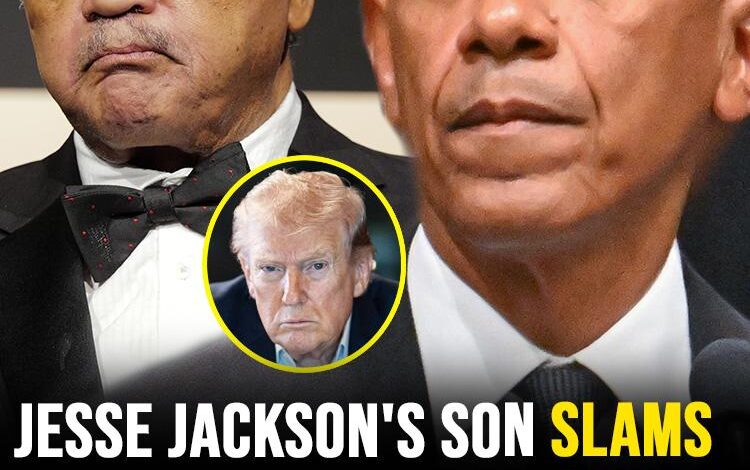
In the vaulted stillness of Chicago’s House of Hope, the nation gathered Friday to bid a final farewell to the Reverend Jesse Jackson, a titan of the civil rights movement who spent over half a century agitation for the “dispossessed and the disrespected.” Yet, the solemnity of the occasion has been eclipsed by a sharp public rebuke from the late icon’s son, Jesse Jackson Jr., who accused former Presidents Barack Obama and Joe Biden of hijacking the memorial to wage a political war against Donald Trump.
The civil rights leader passed away on February 17 at the age of 84, following a decade-long battle with progressive supranuclear palsy (PSP). According to the Rainbow PUSH Coalition, Jackson had lived with the debilitating brain disease—which severely impairs mobility and swallowing—since at least 2017, when he first publicly disclosed a Parkinson’s diagnosis.
Jackson’s legacy is inextricably linked to the American conscience. A lieutenant to Dr. Martin Luther King Jr., he famously stood on the balcony of the Lorraine Motel during King’s final moments and later broke electoral glass ceilings with his own historic Democratic presidential runs in 1984 and 1988.
Eulogies or Campaign Stumping?
The Friday memorial saw a rare gathering of American political heavyweights, including former Presidents Bill Clinton, Barack Obama, and Joe Biden, alongside former Vice President Kamala Harris. However, as the afternoon progressed, the focus shifted from the life of the deceased to the current occupant of the White House.
Barack Obama, while never uttering Donald Trump’s name, delivered a thinly veiled indictment of the current administration that brought the Chicago crowd to its feet. “Each day we wake up to some new assault on our Democratic institutions, another setback to the idea of the rule of law, an offense to common decency,” Obama told the mourners. “Every day you wake up to things you just didn’t think were possible.”
He continued the critique, stating, “We’re told by those in high office to fear each other and to turn on each other… everywhere we see greed and bigotry being celebrated, and bullying and mockery masquerading as strength.”
Joe Biden was more direct in his assessment of his former rival. “We’re in a tough spot, folks,” Biden told the assembly. “We’ve got an administration that doesn’t share any of the values that we have. And I don’t think I’m exaggerating a little bit.”
“They Do Not Know Jesse Jackson”
While the partisan rhetoric resonated with many in the pews, it drew a blistering response from Jesse Jackson Jr. during a private service at the Rainbow PUSH Coalition headquarters on Saturday. Per the NY Post, the younger Jackson did not mince words regarding the “political spectacle” he witnessed the day prior.
“Yesterday, I listened for several hours to three United States presidents who do not know Jesse Jackson,” he told the gathering.
Jackson Jr. argued that his father’s “prophetic voice” existed outside the traditional Democratic or Republican frameworks. “[My father] maintained a tense relationship with the political order, not because the presidents were white or black, but because the demands of our message… demanded not Democratic or Republican solutions, but demanded a consistent, prophetic voice that at no point in time ever sold us out as people.”
A Legacy of Tensions
Neither the Obama nor Biden camps have issued a formal response to the criticism. However, the friction between the Jackson family and the Democratic establishment is a long-running narrative in American politics.
On the day of Jackson’s passing, President Donald Trump touched upon these historical tensions in a post on Truth Social: “Jesse was a force of nature like few others before him. He had much to do with the Election, without acknowledgment or credit, of Barack Hussein Obama, a man who Jesse could not stand,” Trump wrote, while still offering his “deepest sympathies” to the family.
As the nation reflects on the passing of a civil rights giant, the debate over his final send-off serves as a stark reminder of the deep divisions currently defining the American landscape—divisions that, for one afternoon in Chicago, even death could not bridge.
Jesse Jackson Jr.’s comments highlight a growing debate over whether funerals for public figures should remain strictly personal or serve as a platform for current national issues. Where do you draw the line? Share your thoughts in the comments below.