I Buried My Son 10 Years Ago – When I Saw My New Neighbors Son, I Could Have Sworn He Looked like Mine Would If He Were Alive Today!
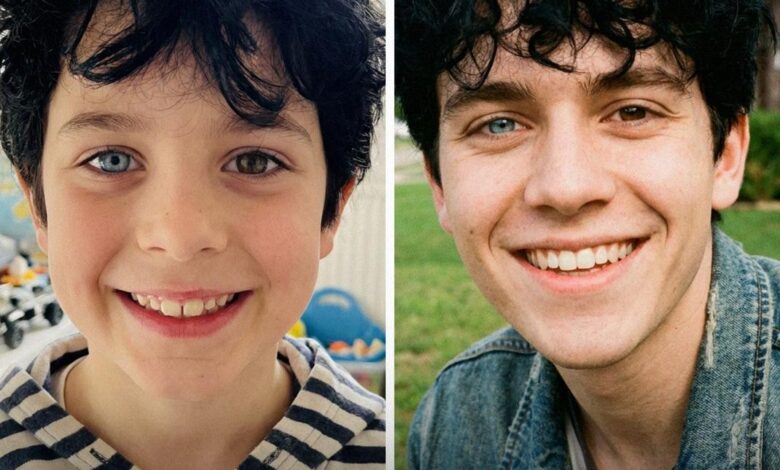
The architecture of grief is a complex and enduring structure, one that I have inhabited for exactly ten years. My son, Daniel, died when he was nine years old—a casualty of a split-second decision by a driver who turned too fast onto a side street. In an instant, the vibrant, noisy reality of his existence was replaced by a crushing, permanent silence. Grief of that magnitude does not simply vanish; it becomes a phantom limb, a presence defined entirely by its absence. For a decade, my husband, Carl, and I became quiet people living in a quiet house, navigating a world where every ball bouncing in a neighbor’s driveway felt like a personal affront to our loss.
I had learned to live with the scabs over my heart, but everything changed on the day a moving truck pulled up to the house next door. Carl watched from the window with a stoicism that had become his trademark since the accident. To maintain a sense of normalcy, I decided to bake an apple pie to welcome the new residents. It was a practiced, hollow gesture of neighborly goodwill. Carrying the warm dish across the lawn, I knocked on the front door, expecting a polite exchange with a stranger. Instead, when the door opened, the pie slipped from my hands and shattered on the porch.
Standing before me was a nineteen-year-old young man who possessed the exact face I had spent a decade mourning. He had the same slightly curly hair, the same sharp chin, and most strikingly, the same rare heterochromia—one blue eye and one brown—that Daniel had inherited from his grandmother. I was looking at a ghost who had dared to grow up. When I asked his age and he replied that he was nineteen, the exact age Daniel would have been, my reality fractured. A woman appeared behind him, looking at me with a terror that surpassed my own shock. She pulled the boy, whom she called Tyler, back into the house and slammed the door, leaving me standing amidst the broken shards of my pie and my sanity.
I ran back to Carl, my voice trembling as I described the boy next door. I expected him to share my disbelief, to perhaps suggest it was a cruel trick of the light or a coincidental resemblance. Instead, Carl went deathly still. He covered his face with his hands and let out a sob that sounded like stone breaking. “I thought I buried this secret along with our son,” he whispered.
The truth he finally confessed was a betrayal of such profound proportions that it made the initial loss of Daniel feel like only half the tragedy. Nineteen years ago, I hadn’t given birth to one son; I had given birth to twins. While Daniel was healthy, the second twin had struggled to breathe and was rushed to the NICU. I had been unconscious, hemorrhaging and fighting for my own life, leaving Carl to face a nightmare alone. A social worker had approached him during that chaotic night, speaking of a neonatal placement program for infants with uncertain survival odds. Overwhelmed by fear and the belief that I couldn’t handle losing a child twice if the baby didn’t make it, Carl signed the papers. He told me only one boy had survived. He erased a human life from my history to “protect” me, effectively giving our second son away to a couple who were willing to take the risk on a fragile life.
“You weren’t protecting me, Carl,” I told him, the weight of a decade of lies settling between us. “You were protecting yourself from the pain of the truth.”
We walked back to the neighbors’ house together, the silence between us heavy with the ghosts of the past nineteen years. When the woman opened the door again, the color drained from her face. She knew. We were invited inside, where the history of the boy named Tyler was laid bare. He had spent months in intensive care before his adoptive parents took him home, believing his biological parents had simply moved on. Tyler sat in the center of the room, a living testament to resilience, listening as his entire origin story was rewritten in a single afternoon.
“So I had a brother?” Tyler asked, his voice soft. When I told him Daniel had died at nine, Tyler looked at his adoptive parents and then back at me. “It seems unfair,” he mused. “He was the healthy one, and I wasn’t, but I’m still here.” Watching him lean into the woman who had raised him, I realized with a stabbing clarity that while he carried my son’s DNA and his grandmother’s eyes, he was not mine. I had lost him twice: once to a father’s fear and once to a mother’s love that wasn’t my own.
The days that followed were a blur of complicated emotions. Carl sought a forgiveness that I wasn’t yet ready to grant. The bridge of trust we had built over twenty years had a gaping hole in its center. However, the healing began from an unexpected source. That evening, a knock came at our door. It was Tyler. He stood on the porch, looking young and profoundly uncertain. “I don’t know what to call you,” he admitted. I told him he could call me Sue, acknowledging that I hadn’t earned the title of mother in his life.
He stepped inside and asked the one thing that mattered: “Can you tell me about my brother?”
For the first time in ten years, pulling out the boxes of Daniel’s drawings and kindergarten awards didn’t feel like an exercise in self-torture. As I showed Tyler the photos of the boy who shared his face, the atmosphere in the room shifted. I spoke of Daniel’s laugh, his love of his tattered soccer ball, and the way he looked when he was thinking hard. Tyler listened with a quiet intensity, absorbing the history of a life that had been lived parallel to his own. I cried, but for the first time since the accident, the tears didn’t feel like they were coming from a wound. They felt like they were coming from a well that was finally being cleared of its silt.
We are neighbors now, living in the strange, bittersweet reality of a family divided by history but united by a shared fence. There is no simple resolution to a secret kept for nineteen years, nor is there a way to reclaim the decade I missed of Tyler’s life. But as I watch him move through the yard, a living reminder of what might have been, I am no longer looking at a ghost. I am looking at a son who found his way home, even if “home” looks different than I ever imagined. The silence in our house has been replaced by the stories of two brothers—one who lives in memory and one who lives next door.