Billie Eilish’s Comments on Her Mansion Land Draw Response from Local Native Tribe
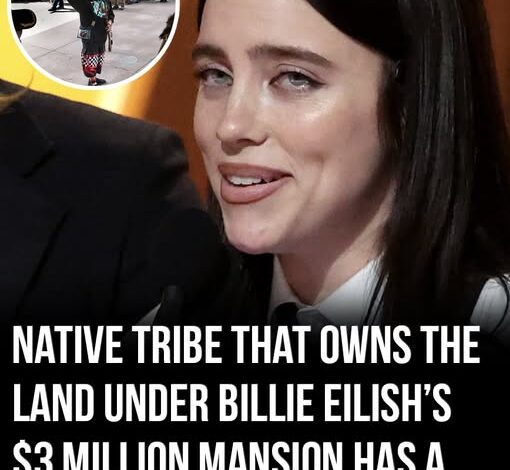
Billie Eilish, the 24-year-old Grammy-winning singer-songwriter, made headlines not only for her music but also for her political and social commentary during the 65th Annual Grammy Awards on February 1, 2026.
While accepting the Song of the Year award for Wildflower, Eilish used her acceptance speech to address issues surrounding immigration, ICE, and the broader history of European colonization in North America.
Her comments immediately captured global attention, sparking both praise and criticism. She declared: “As grateful as I feel, I honestly don’t feel like I need to say anything but that no one is illegal on stolen land.”
She added, emphatically, “And f**k ICE, that’s all I’m gonna say, sorry!”
These words, delivered alongside her brother and co-writer Finneas O’Connell, reflected Eilish’s long-standing advocacy on social issues. However, the speech also reignited debates over the relationship between wealth, property ownership, and social justice — particularly in the context of Native American land rights.
The Tongva Tribe Responds
Eilish’s Los Angeles mansion, valued at roughly $3 million, is located on land historically inhabited by the Gabrieleno Tongva people, the Indigenous community that has lived in the greater Los Angeles basin for thousands of years.
In the wake of Eilish’s remarks, the Tongva tribe issued a statement acknowledging her comments while providing clarity on the historical context.
A tribal spokesperson told The Daily Mail: “We appreciate the opportunity to provide clarity regarding the recent comments made by Billie Eilish. As the First People of the greater Los Angeles basin, we do understand that her home is situated in our ancestral land.
Eilish has not contacted our tribe directly regarding her property, but we do value the instance when public figures provide visibility to the true history of this country.”
The spokesperson also emphasized the importance of explicitly naming the Gabrieleno Tongva people in public discussions about Los Angeles. “It is our hope that in future discussions, the tribe can explicitly be referenced to ensure the public understands that the greater Los Angeles basin remains Gabrieleno Tongva territory.”
The tribe also reported that they had reached out to Eilish’s team to “express appreciation for her comments,” highlighting a mutual acknowledgment, albeit indirect, of the historical and ongoing significance of the land.
Public Reaction: Praise and Criticism
Eilish’s comments drew immediate praise from certain social justice advocates who lauded her willingness to confront uncomfortable truths about American history.
Many supporters emphasized the importance of bringing attention to colonization, land theft, and the experiences of Indigenous peoples. Social media was flooded with reactions applauding her for using a high-profile platform to raise awareness about these issues, particularly in a mainstream event watched by millions worldwide.
However, not everyone received Eilish’s remarks positively. Critics pointed out an apparent contradiction: her advocacy for justice and anti-ICE policies contrasted with her ownership of a multi-million-dollar mansion on ancestral Tongva land.
Some suggested that her acknowledgment of “stolen land” required tangible action, such as returning property or using it for charitable purposes.
Political commentator Eric Daugherty wrote on X (formerly Twitter): “Americans are calling on Hollywood elitist Billie Eilish to RETURN her $14M LA mansion to the Tongva tribe after she claimed, ‘no one is illegal on stolen land.’ She could also graciously host illegal aliens in her mansion. After all, she has the moral high ground. Put up or shut the F up.”
Similarly, Senator Mike Lee (R-Utah) commented: “Any White person who does a public ‘stolen land’ acknowledgment should immediately give his or her land to Native Americans. Otherwise, they don’t mean it.”
Minnesota state Representative Walter Hudson added: “No one ever expounds on this ridiculous talking point. ‘No one is illegal on stolen land.’ Okay. So… the states and the union they created, along with every deed to property on the continent, is illegitimate. Why aren’t you acting accordingly? Donate everything and leave.”
These statements reflect a broader debate over the relationship between historical injustices and contemporary actions, raising questions about what it means to acknowledge historical wrongs while living comfortably on the land in question.
Other Political Responses
The controversy also drew comments from high-profile figures. Conservative commentator Greg Price quipped: “Wow! I really care about what people who live in multi-million-dollar mansions, with gates and walls, and security guards to keep out intruders — living a life completely detached from normal Americans — think about illegal aliens being deported.”
Florida Governor Ron DeSantis weighed in, expressing skepticism about Eilish’s public acknowledgment: “Oh, gee, this ‘stolen land’ nonsense again? Maybe she should step up and forfeit her southern California mansion since it is supposedly on ‘stolen land.’”
Even Elon Musk, CEO of Tesla and SpaceX, responded with a single word: “Exactly.”
These reactions underscore how celebrity political commentary — particularly when it intersects with personal wealth — can ignite national debate, often becoming a proxy for broader cultural conflicts around land, immigration, and history.
Eilish’s History of Activism
Eilish has long been vocal about her political views and social justice causes, particularly regarding immigration enforcement and the treatment of undocumented individuals in the United States.
She has criticized ICE for actions she characterizes as violent or coercive, including the agency’s role in high-profile raids that have, in some cases, resulted in the deaths of U.S. citizens or permanent residents, such as Renee Good and Alex Pretti in Minneapolis. “ICE has been involved in kidnappings, raids, and acts of violence against immigrants,” Eilish has stated in interviews over the past several years.
Her Grammy speech reinforced this stance, linking historical injustice — the colonization and theft of Indigenous land — with contemporary immigration issues. She argued implicitly that the moral authority of the United States is complicated by both its history and present-day policies.
The Legacy of Tongva Land
The Gabrieleno Tongva people are the original inhabitants of the Los Angeles basin, with a history stretching back thousands of years. Before Spanish colonization, the Tongva had a rich culture of trade, agriculture, and community organization.
With the arrival of European settlers in the 18th century, the Tongva experienced displacement, disease, and systemic cultural erasure.
Today, while the Tongva lack federal recognition as a sovereign tribe — a status that complicates land claims and legal authority — they continue to advocate for recognition, cultural preservation, and acknowledgment of historical injustices.
The Tongva tribe’s response to Eilish’s comments reflects this dual role: acknowledging the visibility that her platform provides, while asserting the importance of explicitly naming the Gabrieleno Tongva people in public discourse about Los Angeles and its history.
Social Media Response
Eilish’s Grammy speech generated intense debate on social media platforms. Supporters praised her courage and awareness:
“It’s about time someone in Hollywood acknowledged the history of stolen land in the U.S.,” tweeted one fan.
“Billie Eilish speaking truth on stage. Love that she uses her voice for justice,” wrote another.
Others criticized her perceived inconsistency:
“She should donate her mansion if she believes no one is illegal on stolen land,” wrote a conservative commentator.
“Nice speech, but actions speak louder than words. Let’s see how she plans to reconcile owning land that doesn’t belong to her,” added another user.
These online debates highlight how celebrity activism can amplify historical and political conversations while also attracting scrutiny, particularly in the age of social media where millions weigh in instantly.
Historical Context: “Stolen Land”
Eilish’s reference to “stolen land” is rooted in centuries of colonization. European settlers arrived in North America in the 16th and 17th centuries, often displacing Indigenous peoples through warfare, treaties, and coercion.
Lands that were traditionally inhabited and stewarded by Native American tribes, like the Gabrieleno Tongva, were claimed under European legal frameworks and later formalized by U.S. property law.
While much of this history is widely documented, popular culture rarely confronts it in public forums like awards shows. Eilish’s acknowledgment, therefore, brought this conversation to the forefront for millions of viewers, raising awareness about the continued impacts of historical colonization.
The Intersection of Wealth and Morality
Eilish’s critics argue that public acknowledgment of historical injustice is insufficient when not accompanied by tangible actions. The conversation raises questions that go beyond the singer herself:
If one acknowledges the theft of Indigenous lands, what moral or ethical responsibility follows?
Can acknowledgment alone serve as a form of reparative justice, or are concrete steps, like land restitution or financial support, necessary?
How do contemporary property laws intersect with historical claims, particularly when Indigenous tribes lack full federal recognition?
These questions have fueled debates not only around Eilish’s comments but also broader discussions about the responsibilities of public figures and wealthy individuals in addressing historical and systemic injustice.
Conclusion: A Cultural Moment
Billie Eilish’s Grammy speech illustrates the power and peril of celebrity activism. By connecting historical injustices with modern political issues, she prompted a nationwide conversation about land, wealth, and immigration enforcement.
While her comments drew both praise and criticism, they also created an opportunity for increased visibility of the Gabrieleno Tongva people and the history of Los Angeles.
The dialogue surrounding Eilish’s mansion, her political stance, and the responses from public figures, social media, and the Tongva tribe itself highlights the complex intersections of fame, morality, and history.
In an era when celebrity platforms can shape public discourse, her speech serves as a reminder that words have power — and that recognition of past injustices, however symbolic, can resonate far beyond the walls of Hollywood stages.
As the debate continues, the Tongva tribe’s emphasis on explicit acknowledgment of their people ensures that history remains at the center of the conversation, urging both celebrities and the public to reckon with the realities of America’s past and the moral questions that continue to resonate today.
Categories: News