A Courtroom Falls Silent as Final Judgment Is Delivered!
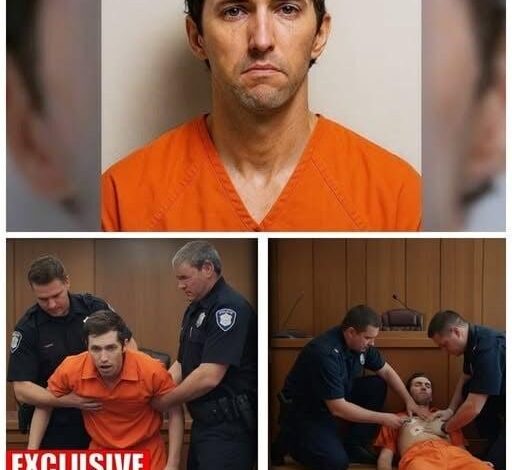
The mahogany-paneled walls of Courtroom 4B had seen a century of human desperation, but they had never absorbed a silence quite like the one that fell on that Tuesday afternoon. It was not the expectant hush that precedes a verdict, nor the respectful quiet of a memorial; it was a physical weight, a sudden vacuum of sound that seemed to pull the very oxygen from the room. The headline in the next morning’s paper would speak of “Final Judgment” and “Legal Closure,” but the ink on the page could never capture the sensory reality of the collapse. The news cycle would focus on the sentence, the statutes, and the cold arithmetic of justice, yet it would entirely miss the sound of a human life breaking under the pressure of accountability.
It wasn’t a scream that signaled the end. There was no cinematic outburst, no defiant final word. Instead, there was only the dull, sickening thud of a body meeting the industrial carpet—a sound so out of place in a room governed by the scratching of fountain pens and the rustle of legal bond paper that it felt like a tear in the fabric of reality. For a several breathless heartbeats, the machinery of the state ground to a halt. The judge, a man who had spent thirty years armored in the black silk of his robes, leaned forward, his face losing its practiced neutrality. In that singular moment, the bench ceased to be a symbol of an institution and became, quite simply, a witness.
The human cost of the legal system is usually a ghost, a specter that haunts the margins of filings, motions, and formal declarations. It is buried under Latin phrases and the sterile precision of “Petitioner” versus “Respondent.” But in that stunned hush, the ghost took form. It surfaced in the shaking shoulders of the defense attorney, who stared down at his shoes as if the floor might swallow him next. It was visible in the averted eyes of the bailiffs, men hardened by years of dealing with the volatile and the violent, who now found themselves unable to look at the heap of charcoal-gray wool on the floor.
Accountability is a righteous concept, the cornerstone of a civilized society, yet when it finally settles upon a single soul, it possesses a devastating physical mass. To the gallery, it felt as though the air had turned to lead. The realization rippled through the room: justice can be entirely necessary and simultaneously unbearable to behold. The law is a blunt instrument, designed to measure actions and assign consequences, but it has no mechanism for the grace required to watch a man realize his life is over.
Then, as if a “pause” button had been released, the institutional machine began to reset itself. It was a reflex, a systemic immune response to the intrusion of raw emotion. Protocol reasserted its dominance with a chilling efficiency. The court clerk, a woman whose face was a mask of bureaucratic indifference, reached for a fresh sheet of paper. The scratching of pens resumed, filling the void left by the fallen man. The court reporter’s fingers danced over the stenotype machine, translating the tragedy into a series of coded taps that would eventually become a cold, clinical transcript.
“All rise,” the bailiff eventually croaked, his voice cracking slightly before he regained his professional cadence. The judge stood, his movements stiff, and retreated through the door behind the bench. The heavy oak doors at the back of the courtroom swung open, admitting the muffled roar of the city outside—sirens, footsteps, the mundane chatter of a world that didn’t know the gravity of what had just occurred.
Those who were present that day have found that they carry a private, unedited version of the event. It is a version that refuses to be archived or filed away alongside the case number. They don’t remember the specific statutes cited or the exact wording of the final judgment. Instead, they remember the temperature of the room—how it seemed to drop ten degrees in an instant. They remember the smell of floor wax and old paper that suddenly felt suffocating. They remember the haunting juxtaposition of a man on the floor, broken and still, while the system remained on its feet, indifferent and immortal.
Years later, the case file is a thick, yellowing stack of paper in a basement archive, bound by a fraying rubber band. To a researcher, it is a closed matter, a settled point of law. But for the witnesses, the silence of that courtroom never fully dissipated. It follows them into other rooms, a lingering reminder of the moment the law stopped being an abstract concept and became a visceral, crushing weight. They learned that afternoon that while the scales of justice may eventually balance, the act of weighing a life leaves a mark on everyone who watches the needle move.
The machine of the law is designed to survive the individuals who pass through it. It is built to endure the outbursts, the lies, and the occasional collapses. It processes tragedy into data and converts grief into precedent. Yet, for those few minutes in Courtroom 4B, the machine was forced to acknowledge the humanity it usually keeps at arm’s length. The silence was the only honest response to a moment where the law was perfectly right and perfectly cruel at the exact same time. Long after the lights were dimmed and the heavy doors were locked, that stunned, breathless hush remained, trapped in the corners of the room like a secret that no one dared to speak aloud. It is the sound of the world continuing to turn while one person’s world has come to a definitive, silent stop.