Bill Gates says only these 3 jobs are safe from AI takeover
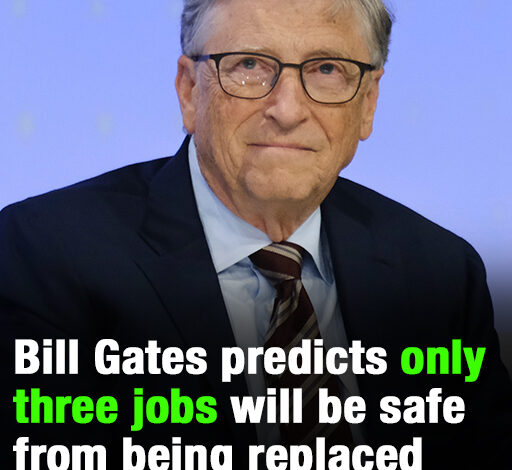
In the burgeoning age of the algorithm, the definition of human expertise is facing an existential deadline. Bill Gates, the Microsoft co-founder who once put a computer on every desk, is now warning that the very machines he helped pioneer are poised to become “superior to humans,” triggering a seismic reorganization of the global workforce.
The 70-year-old philanthropist has intensified his rhetoric in recent months, painting a picture of a near-future where AI doesn’t just assist the professional class—it replaces it “for most things.” It is a forecast that suggests entire career paths are currently standing on a fault line, with only a select few sectors likely to remain on solid ground.
The Death of Rarity
Speaking during a recent appearance on The Tonight Show with Jimmy Fallon, Gates deconstructed the current value of human skill. Today, we prize a “great doctor” or a “great teacher” precisely because their high-level expertise is a rare commodity. However, Gates argues that the next decade will witness the commoditization of brilliance.
“With AI, over the next decade, that will become free, commonplace—great medical advice, great tutoring,” Gates told Fallon.
This shift toward what he calls “free intelligence” implies a world where elite knowledge is no longer cordoned off behind years of schooling or high professional fees. Instead, it becomes instantly accessible and virtually cost-free, effectively decoupling the concept of “expertise” from the individual human professional.
The No-Limit Machine
The scale of this transition is what Gates finds most unsettling. In a candid dialogue with Harvard professor Arthur Brooks, Gates bypassed the usual corporate optimism to address the sheer velocity of the AI trajectory.
“It’s very profound and even a little bit scary—because it’s happening very quickly, and there is no upper bound,” Gates remarked.
He contends that we are approaching a threshold where human cognition simply cannot compete with the “breadth of knowledge” required to manage complex global systems. As AI moves from a digital assistant to a primary decision-maker, the fundamental question shifts from how humans will work to if they will be required at all in traditional roles.
The Exposure Map: Who is at Risk?
Contrary to early industrial-era fears, the AI revolution isn’t coming for the manual laborer first. It is coming for the cubicle. A landmark Microsoft study released in December 2025 identified a broad spectrum of “at-risk” positions, unified not by industry, but by the nature of the tasks: pattern recognition, information processing, and predictable communication.
The list of high-exposure roles includes:
- Media & Communication: News analysts, reporters, journalists, public relations specialists, and broadcast announcers.
- Analysis & Data: Data scientists, market research analysts, mathematicians, and political scientists.
- Content & Quality: Technical writers, editors, proofreaders, and authors.
- Professional Services: Web developers, management analysts, and advertising sales agents.
- Support Roles: Customer service representatives, travel clerks, and brokerage clerks.
Conversely, roles that demand physical presence and real-time adaptability—such as bartenders, mechanics, cooks, and lifeguards—remain “pseudo-safe” for the time being, largely due to the current limitations of robotics in unstructured physical environments.
The Survival Triad
Despite the sweeping nature of his warnings, Gates identifies three specific pillars he believes will remain essential to the human experience:
- Biology: Where the nuances of discovery and experimentation still require a uniquely human brand of insight.
- Energy: Particularly as the global community navigates the high-stakes complexity of sustainability and infrastructure.
- Programming: Software development remains a critical frontier, even as AI becomes the primary tool used by those developers.
Beyond these functional necessities, Gates suggests humanity will “reserve” certain spaces for itself—not because machines can’t do them, but because we won’t want them to.
“You know, like baseball. We won’t want to watch computers play baseball,” Gates told Fallon. He envisions a future where the logistics of “making things, moving things, and growing food” are essentially solved problems handled by automation, leaving humans to decide what value remains in their own labor.
The Final Inventory
The arrival of widely accessible intelligence challenges every long-held assumption about work, value, and societal contribution. We are no longer debating whether the landscape will change, but rather assessing our own readiness for a world where being “smart” is no longer a human monopoly.
Are we standing on the precipice of an era of unprecedented human freedom, or are we engineering a problem that will eventually outpace our ability to solve it? Weigh in with your thoughts in the comments below and share this report to see where your colleagues stand on the future of work.