Every country that has rejected Donald Trump’s call to join the war against Iran – and one surprising country that agreed
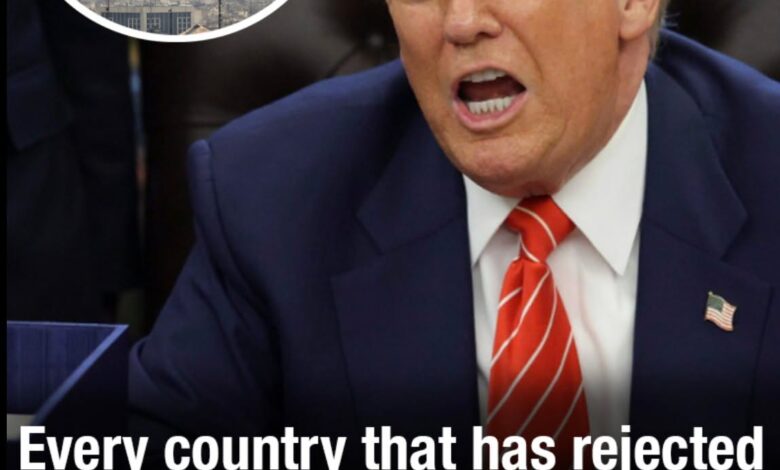
President Donald Trump is facing a steep uphill battle in his efforts to galvanize international support for “Operation Epic Fury,” his administration’s latest strategic offensive aimed at Iran. Despite a direct appeal for a united front, the global response has been characterized by a profound lack of enthusiasm, leaving the White House increasingly isolated in its hawkish stance.
As the administration pushes for a coordinated military presence, a chorus of caution from traditional partners has sparked growing concerns over a potential regional conflagration. Across Europe, the refusal to engage has been both swift and explicit, signaling a significant rift in Transatlantic security cooperation.
A Fractured European Front
The United Kingdom, historically the most reliable pillar of American military endeavors, has officially distanced itself from the operation. Prime Minister Keir Starmer has signaled that while London remains open to diplomatic frameworks, it has no appetite for kinetic involvement.
“Britain won’t be drawn into the wider war,” Starmer emphasized, effectively shutting down any expectations of a British deployment.
The Prime Minister also moved to quash rumors of an institutional Western intervention, telling VT: “Let me be clear: that won’t be, and it’s never been envisioned to be, a NATO mission.”
This sentiment echoed across the continent. In Rome, Italian Foreign Minister Antonio Tajani confirmed that military participation is not on the table. Meanwhile, in Berlin, the German government has been even more pointed in its rejection.
Chancellor Friedrich Merz clarified that Germany was never part of the initial planning phase, stating: “There was never a joint decision on whether to intervene. That is why the question of how Germany might contribute militarily does not arise. We will not do so.” While Merz acknowledged that the current Iranian regime “must end,” he warned that “bombing it into submission is, in all likelihood, not the right approach.”
German Defense Minister Boris Pistorius was even more blunt, questioning the tactical logic of the American request. “This is not our war, we have not started it,” Pistorius said. “What does Donald Trump expect from a handful of European frigates in the Strait of Hormuz that the mighty US Navy cannot manage alone? This is the question I find myself asking.”
Further North and East, the skepticism continues:
- The Netherlands, Lithuania, and Estonia have all expressed deep uncertainty regarding the operation’s endgame.
- Greece has officially confirmed through a government spokesperson that it will not participate in any military missions related to the operation.
Hesitation in the Pacific and the “China Factor”
The reluctance is not confined to Europe. Key Indo-Pacific allies—Australia, South Korea, and Japan—have all signaled they have no plans to join the fray at this time.
Australian Transport Minister Catherine King was transparent about Canberra’s refusal to send assets to the Strait of Hormuz. “We won’t be sending a ship… that’s not something we’ve been asked or we’re contributing to,” King stated. South Korea has been more measured, noting they will “continue to communicate” with Washington, though they have stopped short of any commitment.
The administration is also eyeing Beijing. U.S. Energy Secretary Chris Wright expressed hope that China would act as a “constructive partner,” a sentiment shared by Trump himself, who pointed to China’s economic stakes in the region.
“I think China should help, too, because China gets 90% of its oil from the straits,” the President noted, attempting to pivot the burden of maritime security toward the world’s second-largest economy.
An Unexpected Offer from Kyiv
In a striking departure from the general trend of avoidance, Ukraine has emerged as a vocal supporter. Despite being embroiled in a defensive war against Russia, President Volodymyr Zelenskyy has offered assistance, particularly in neutralizing Iranian-manufactured drone threats.
“We reacted immediately,” Zelenskyy said, framing the move as a reciprocal gesture of defense. “Whenever it is possible for us to help defending civilians or US nationals, without second thought we sent our teams.”
“We Will Remember”
The prevailing hesitation has clearly agitated the Oval Office. In recent remarks, President Trump suggested that the reluctance of long-term allies would have future diplomatic consequences.
“Whether we get support or not… I said to them: We will remember,” Trump warned.
As the administration continues to lobby for “Operation Epic Fury,” the empty chairs at the briefing table suggest that for many nations, the risk of a new Middle Eastern war far outweighs the pressure of Washington’s expectations.