“Only the Lucky Can Find the Odd One Out — Are You One of Them?”
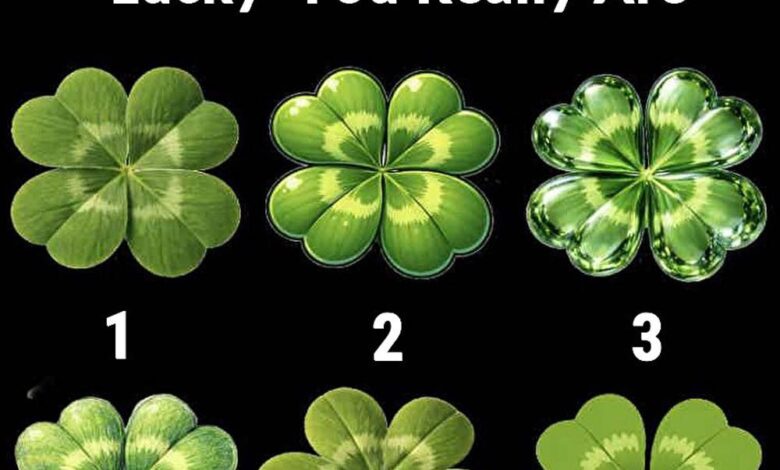
At first glance, the task is deceptively elementary—a minimalist collection of six clovers, each subtly distinct, with a singular directive: identify the one that doesn’t belong. It appears to be nothing more than a playful digital diversion, yet this visual exercise serves as a sophisticated probe into the hidden mechanics of human perception. It challenges the observer to move beyond passive seeing and engage in active pattern recognition, a fundamental pillar of human intelligence.
This visual simplicity is a strategic mask for a deeper psychological inventory. As an observer begins to scan the cluster, they inadvertently begin a process of hierarchical sorting. The brain starts noticing minute discrepancies in leaf curvature, color saturation, texture density, or axial symmetry. These subconscious priorities reveal far more about an individual’s internal thought patterns than any singular “correct” answer ever could. In the realm of cognitive psychology, there is no objective outlier; there is only the outlier your brain is wired to find first.
The cultural weight of the clover further complicates this mental landscape. The four-leaf clover, a global shorthand for rare fortune, creates a powerful “illusion of rarity” that primes the viewer to look for a “special” or “lucky” variant. However, in this specific array, every specimen is unique in its own right. This parity transforms the concept of the “odd one out” from a factual observation into a purely subjective interpretation.
The Millisecond Verdict: How We Sort Reality
Human perception is, by its very nature, a relentless search for order amidst entropy. Yet, the cues we prioritize vary wildly from person to person. While one individual may immediately lock onto color variations (chromatic bias), another may gravitate toward geometric symmetry or sheer physical scale. The human brain evaluates these environmental cues in mere milliseconds, synthesizing interpretations that are a complex cocktail of hardwired survival instincts and learned cultural behaviors.
- The First Clover (The Grounded Instinct): Those who reflexively select the first clover often demonstrate a preference for “Type 1” thinking—fast, instinctive, and grounded. This choice suggests a personality that trusts natural intuition over exhaustive data analysis, favoring the “Occam’s Razor” approach to life’s puzzles.
- The Second Clover (The Methodical Analyst): Choosing this option often signals a highly analytical temperament. These individuals are likely weighing balance, proportion, and subtle structural irregularities. It reflects a “Type 2” cognitive style: slow, deliberate, and methodical in its approach to problem-solving.
- The Third Clover (The Creative Iconoclast): This selection typically resonates with observers who value boldness and the unconventional. Picking this clover reveals a mindset that prizes originality and is comfortable embracing choices that defy the expected norms of standard pattern recognition.
- The Fourth Clover (The Nuanced Observer): Resonating with those attentive to texture and depth, this choice suggests a high level of “detail-orientation.” It highlights an ability to see past superficial traits into the more complex, layered patterns that others might overlook.
- The Fifth Clover (The Intuitive Empath): If this selection is made purely on “gut feeling,” it points to a reliance on subconscious assessment. These individuals often allow their internal compass to guide them, trusting that their brain has processed the data correctly without needing a conscious breakdown of the “why.”
- The Sixth Clover (The Pragmatic Decider): This option draws those who value clarity and executive efficiency. It reflects a pragmatic worldview that seeks straightforward evaluation over ambiguity, prioritizing a decisive resolution to the task at hand.
Beyond Luck: The Science of Decision-Making
This exercise does not measure “luck” in any literal or mystical sense. Instead, it serves as a microcosm of how humans process information, navigate ambiguity, and arrive at conclusions in high-stakes environments. It highlights the cognitive tendencies—biases, filters, and shortcuts—that influence our daily choices far beyond the confines of a simple puzzle.
Perception in this context is radically subjective. Two observers can select entirely different clovers for equally valid, logically sound reasons. This proves that decision-making is not a vacuum; it is shaped by an individual’s unique cognitive framework, past experiences, and personal priorities. Interestingly, this mirrors “real-world” scenarios where there is rarely a single, objectively correct answer. We spend our lives navigating the “gray space” of incomplete information, acting on judgment calls that we often incorrectly attribute to “chance” or “fate.”
The symbolism here extends deep into the heart of human psychology. What society often labels as “good fortune” is frequently just a high-functioning level of attentiveness—the ability to interpret and act on subtle environmental cues that others miss. It isn’t randomness; it’s a refined cognitive awareness.
The Biological Pulse of the Puzzle
From the perspective of cognitive science, even a minor visual test like this is a “full-body workout” for the brain. It activates multiple neural regions simultaneously, including the primary visual cortex for initial detection, the parietal lobe for spatial reasoning, and the prefrontal cortex for executive function and final decision-making.
Furthermore, the task provides a unique window into our tolerance for ambiguity. How quickly a person decides—and how comfortable they feel with that decision—reflects their internal “ambiguity threshold.” Some react instantly, relying on “thin-slicing” (making quick inferences from limited data), while others must pause, illustrating the constant friction between our intuitive and deliberate cognitive systems.
A Lesson in Hidden Biases
By emphasizing subjective interpretation, the clover puzzle underscores a fundamental truth: meaning is a product of perspective. Just as no clover is inherently “wrong,” our experiences in life are rarely absolute; they are framed by our own cognitive lens. The exercise also offers a subtle critique of unconscious bias. We may favor a certain clover because it is brighter or more symmetrical, revealing hidden preferences that dictate our judgments in the real world without our conscious consent.
In the end, the act of deciding which clover “doesn’t belong” becomes a mirror reflecting the observer’s inner architecture. It proves that judgment is a function of personal priorities rather than absolute correctness. It celebrates cognitive diversity, demonstrating that human thought is a rich, messy, and deeply personal tapestry.
In our everyday lives, the lesson is profound: what appears straightforward often contains a multitude of valid interpretations. The clovers serve as a metaphor for the human condition—reminding us that in a world of uncertainty, meaning is not something we find, but something we create through awareness, judgment, and the courage to act on what we observe.