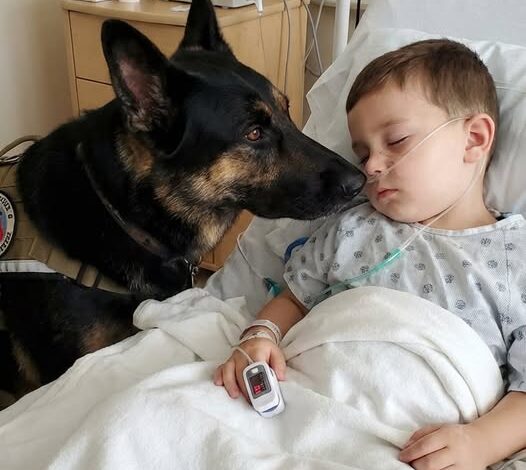
The b0y was being kept alive solely by machines, and the doctors had already given up hope but the moment his dog entered the room, everything changed.
The mother no longer slept—not truly, not in any way that could restore her strength.
She sat beside her son day and night, her body present but her mind caught somewhere between hope and fear. Sometimes her eyes would close for a moment, but even then her hand never let go of his. Her fingers remained wrapped around his small, fragile hand as if that single connection could anchor him to the world.
She whispered to him often—soft, trembling words no one else could fully hear. Stories from when he was younger. Little memories. Promises about the future. She spoke as though he could hear everything, as though her voice alone might guide him back.
The father was different.
He stayed close, but quieter. He stood near the window or sat a few feet away, his hands clasped tightly together, his jaw set. It wasn’t that he didn’t feel—he felt too much. He just didn’t dare to say it out loud. It was as if speaking his fears might make them real.
Sometimes he would look at his son and then quickly look away, like the sight was too heavy to hold for too long. Other times, he would rest his hand gently on the boy’s shoulder, then pull it back, unsure if he was comforting his child or himself.
The room itself had grown heavy over time.
Even the doctors—people trained to remain calm, steady, and controlled in the face of the worst situations—began to change. Their voices softened. Their explanations became shorter. Their eye contact didn’t last as long.
They still did their jobs, still checked the machines, still adjusted treatments—but there was something unspoken in their behavior. A quiet understanding that things were not going the way they had hoped.
The monitors beeped in steady, predictable rhythms.
Nothing changed.
Day after day, the lines remained almost the same—flat in spirit, if not entirely in form. Just enough life to hold on, but not enough to improve.
It felt like hope itself had been slowly drained out of the room, leaving behind only routine, waiting, and quiet fear.
But outside that room, just beyond the hospital doors—
Someone refused to give up.
The boy’s dog, a German Shepherd named Rico, had been coming to the hospital every single day.
No one had brought him there. No one had trained him to wait. He simply came.
He sat near the entrance, just off to the side, where the doors opened and closed with a constant flow of people. Nurses passed him. Visitors stepped around him. Security noticed him but didn’t move him along.
There was something about the way he waited.
He didn’t bark. He didn’t run around or cause trouble. He just sat there, alert but quiet, his eyes fixed on the doors as if he believed—completely—that the one he was waiting for would walk through them at any moment.
The parents noticed him, of course. Every time they entered or left, Rico was there.
Sometimes his tail would move slightly when he saw them. Other times, he would let out a soft, low whimper—barely a sound, but enough to be felt.
It was the kind of sound that didn’t demand attention, but quietly asked for it.
As the days passed, Rico began to look more tired.
He would lower his head to the cold floor, resting it there for long stretches. His eyes would close, not in comfort, but in exhaustion. Still, he never truly left. Even when someone tried to lead him away, he would return, drawn back by something stronger than instinct.
He was waiting.
One afternoon, a nurse stopped and watched him for longer than usual.
She had seen him every day, just like everyone else. But that day was different. Rico’s body seemed heavier, his movements slower. When he rested his head on the floor, he didn’t lift it for a long time.
She looked at him, then toward the hallway that led to the intensive care unit.
Then she quietly approached one of the doctors.
“He’s suffering too,” she said gently. “He’s been here every day. He’s waiting for that boy.”
The doctor hesitated. Rules were rules. Animals weren’t allowed in intensive care. There were protocols, hygiene concerns, procedures that couldn’t simply be ignored.
But the nurse didn’t look away.
“At least let them say goodbye,” she added softly.
The words lingered.
For a moment, the doctor didn’t respond. Then, slowly, something in his expression changed. Not entirely professional. Not entirely clinical. Something more human.
He nodded.
When Rico was finally brought inside, the atmosphere shifted immediately.
The mother looked up in shock, her eyes wide. She hadn’t expected this—not now, not after everything.
“Rico…?” she whispered, her voice breaking.
The dog stepped into the room slowly, cautiously, as if he understood that this was not a place for noise or sudden movement.
He didn’t run. He didn’t jump.
He walked.
Step by step, straight toward the bed.
When he reached it, he rose onto his hind legs, placing his front paws gently on the edge. He leaned forward, careful not to disturb anything, his eyes fixed entirely on the boy.
There was no barking.
No whining.
Just a deep, quiet focus.
Recognition.
Connection.
He looked at the boy the way only someone who truly knows you can look—like he saw beyond the stillness, beyond the silence, beyond the machines.
Then, very gently, Rico lowered his head and licked the boy’s hair.
Once.
Slowly.
As if trying to warm him. As if trying to remind him of something familiar.
He pressed closer, his paws resting lightly against the boy’s chest, careful, controlled—almost like he was afraid of hurting him.
It looked like a farewell.
A quiet, loyal goodbye.
And then—
Something happened.
Something no one in that room was prepared for.
The monitor, which had been steady and unchanged for days, suddenly let out a sharper, more urgent sound.
The mother gasped, her heart jumping to the worst conclusion immediately.
“No—no—!” she cried, stepping forward.
But the doctor didn’t move the way she expected.
He froze.
His eyes locked onto the screen.
“Wait…” he said under his breath.
The heart rate—
It had changed.
Not drastically. Not dramatically. But enough.
Enough to matter.
Enough to notice.
Rico didn’t pull away.
If anything, he moved closer.
He lowered his head again, pressing his nose gently against the boy’s cheek, breathing softly against his skin.
And then—
The smallest movement.
So slight it could have been missed if anyone had looked away.
The boy’s fingers… moved.
Just a fraction.
But they moved.
The mother covered her mouth, her entire body trembling.
The doctor rushed forward, calling for assistance, checking the monitors again, adjusting settings, watching every detail.
One by one, the readings began to shift.
Slowly.
Steadily.
As if something—something unseen, something impossible to measure—had reached into that moment and changed its direction.
Later, the doctors would talk about it for hours.
They would go over charts, timelines, medical data. They would search for explanations—neurological responses, delayed reactions, statistical anomalies.
They would try to understand it in the language they knew best.
But there was one detail none of them could ignore.
Every record pointed to the same exact moment.
The moment Rico entered the room.
From that day forward, everything changed.
Rico was no longer just a dog waiting outside. He became part of the routine.
He was allowed to visit every day.
And each time he came, something small improved.
A stronger response. A steadier rhythm. A longer movement.
Progress that had once seemed impossible began to unfold, little by little.
Until one morning—
The boy opened his eyes.
The room was quiet when it happened.
No alarms. No urgency. Just a slow, natural return.
And the first thing he saw—
Was Rico.
The dog’s nose rested close to his face, warm and slightly damp, his eyes watching, alert, unwavering.
Waiting.
Just as he always had.
The doctors called it a miracle.
They had no other word for it.
The parents called it something else.
They called it a rescue.