She Hid a Secret Room Under Her Barn, Then a Deadly Blizzard Made It Her Only Chance to Survive!
The residents of Dry Creek spent the entire summer whispering about Emily Carter. Since her father’s passing in the spring, she had become a fixture of curiosity, seen daily hauling buckets of dirt from the family barn into the fading Wyoming light. The barn itself was a weathered monument to generations of Carters—stubborn wood held together by even more stubborn hands—and many assumed Emily’s grief had simply taken a strange, industrious turn. They watched her salvage beams from abandoned grain silos and carry rolls of insulation into the shadows, but no one suspected the sanctuary she was carving into the earth beneath the floorboards.
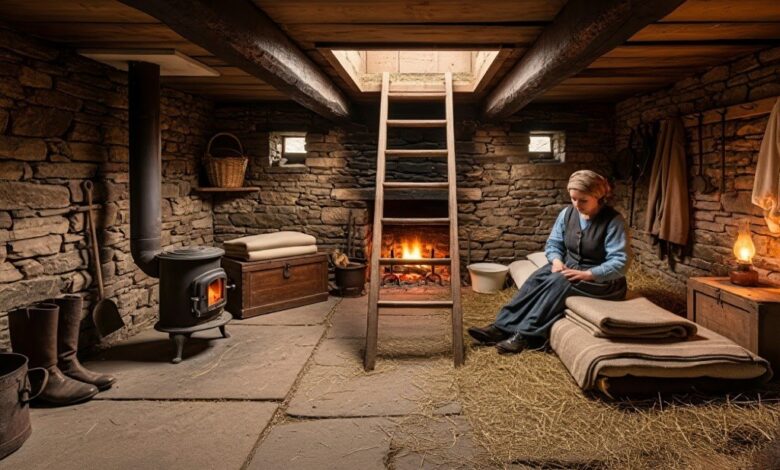
Emily’s project was a labor of both memory and foresight. She remembered her father’s voice, a steady anchor against the howling plains: “You prepare before the storm, not after it starts.” Following that ancestral wisdom, she constructed a small, low-ceilinged room beneath a trapdoor hidden under layers of loose hay. It wasn’t a place of luxury, containing only a twin mattress, a propane heater, and shelves of canned goods, but it represented the only thing Emily felt she had left: control over her own survival. By November, the trapdoor was sealed, the animals wandered above it unaware, and the farm appeared unchanged to the casual observer.
Winter arrived not with a whimper, but with a verdict. In late December, a blizzard of historic proportions descended upon the plains. The radio crackled with warnings of negative thirty-degree temperatures and whiteout conditions that turned the world into a lethal, featureless void. As the power flickered and died in her farmhouse, Emily felt the structure groan under the weight of the ice. The house, while beloved, felt fragile against the “hungry” cold. Clad in heavy layers and clutching an emergency bag, she stepped into the gale.
The thirty-yard trek from the house to the barn became a fight for her life. The snow climbed past her thighs, and the wind slammed into her chest with the force of a physical blow. She navigated by instinct and muscle memory, reaching the barn with numb fingers and a face burning from the frost. Inside, the livestock huddled together, their panicked breath misting in the freezing air. Emily moved to the center of the floor, cleared the hay, and wrenched open the trapdoor. Descending into the earth, she pulled the door shut, and the world went silent.
For three days, Emily lived in the soft, battery-powered glow of her lantern. Above her, the storm roared like a freight train, and the barn creaked so violently that dirt trickled from her ceiling. She rationed her food and listened to the muffled thuds of debris hitting the roof, her mind wandering to the animals above and the house she had left behind. On the third day, the howling finally softened into an eerie, absolute stillness.
When Emily finally pushed against the trapdoor, it wouldn’t budge. The barn had been buried. Panic flared briefly, but she took up her shovel and began the grueling work of digging upward through the packed snow. When she finally broke through to the surface, she emerged into a world she barely recognized. The fences were gone, swallowed by white dunes, and her farmhouse—the home of her childhood—had partially collapsed under the weight of the ice. Had she stayed in her bed, she likely wouldn’t have survived the night.
In the aftermath, the town gathered to help Emily rebuild, marveled by her survival but never quite learning the full truth. She kept the secret of the room to herself, understanding that some things are only meant for the person who needs them most. Emily knew the storms would always return to Wyoming, but she no longer feared them. She had learned that survival isn’t just about weathering the wind; it’s about having the quiet strength to build a foundation that the world cannot see.