My Critically Ill Daughters $140,000 Hospital Bill Was Anonymously Paid – Four Years Later, a Stranger Approached Me and Said, I Owed You This
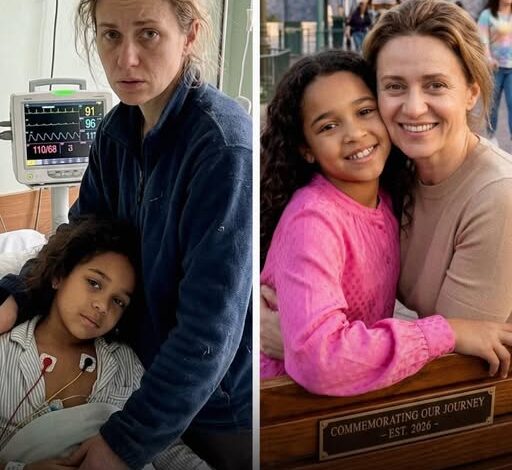
Grief has a strange way of reshaping memory. Some moments become painfully clear, etched into your mind with impossible precision, while others fade until they feel like they belonged to someone else’s life. When my husband died, everything in my world narrowed down to one single purpose: keeping our daughter, Jenny, alive and safe. Nothing else mattered. Not the house, not the future I had once imagined—just her.
By the time Jenny turned seven, that fragile sense of stability shattered again. Her congenital heart condition had worsened, and doctors told me she needed surgery—urgent, complex, and impossibly expensive. The cost was $140,000. I remember sitting at the kitchen table late at night, rereading the insurance denial letter for the third time. The light above the stove flickered softly, and the clock read 2:00 a.m. The words didn’t change no matter how many times I looked at them. Denied. Final.
It felt like a door closing that I didn’t know how to reopen.
With no other options left, I made the only decision I could. I put our house on the market. It was the last thing I had, the only place that still felt like home after losing my husband. But none of that mattered if it meant saving Jenny. I told myself walls could be replaced. A home could be rebuilt. But a life couldn’t.
A few days later, I went to the hospital to arrange the initial deposit, preparing myself for another difficult conversation, another reminder of everything I couldn’t afford. I stood at the billing counter, rehearsing what I would say, trying to hold myself together.
Then the clerk looked at her screen, paused, and said something I couldn’t process at first.
“The balance is zero.”
I blinked, certain I had misunderstood. “I’m sorry… what?”
“It’s been paid,” she repeated. “In full. There was a wire transfer this morning.”
The words didn’t make sense. Not right away. I stood there, frozen, waiting for her to correct herself, to realize there had been a mistake. But there wasn’t.
Someone—completely unknown to me—had paid the entire amount.
Jenny had her surgery. It was successful. Her recovery wasn’t easy, but she made it through. And for the first time in a long time, I allowed myself to breathe again.
But even as life slowly moved forward, there was always that unanswered question lingering in the background.
Who had done it?
For four years, I lived with that mystery. I thought about it in quiet moments—while making dinner, while watching Jenny sleep, while sitting alone with thoughts that never fully settled. It felt like carrying an invisible debt, one I didn’t know how to repay or even acknowledge. Someone had stepped into my darkest moment and changed everything, then disappeared without a word.
The answer came when I least expected it.
It was an ordinary Monday afternoon at the park. Jenny was playing on the monkey bars, laughing as she hung upside down, her hair brushing the air beneath her. I was watching her, as I always did, when a man approached me.
He was well-dressed, wearing a navy suit that stood out in the casual setting of the park. There was something calm and composed about him, but also something intentional—like he had come there with a purpose.
“My name is Brad,” he said.
I nodded, unsure where the conversation was going.
Then he looked at me and said, simply, “I paid the hospital bill.”
For a moment, I couldn’t speak. The world seemed to pause around me.
Before I could even respond, he added, “I owed you that. You saved someone once.”
His words didn’t make sense—not yet. I searched his face for recognition, for some connection I might have missed, but found nothing.
“I don’t understand,” I said.
And that was exactly what I needed to find out.
A few days later, I went to his company’s headquarters, determined to hear the full story. But instead of sitting me down in an office, Brad suggested we go somewhere else.
He drove me to a quiet cemetery.
Standing there, beside a simple headstone, the tone of everything shifted. This wasn’t just an explanation—it was something deeper. Something personal.
“This is my father,” he said.
And slowly, he began to tell me the story.
Four years earlier, during the same time Jenny was in the hospital, his father had been there too. Brad’s mother had been admitted for a serious cardiac episode, and his father had spent long hours in the waiting room. That’s where he had seen me—talking to other families, offering comfort, trying to hold others together even while my own world was falling apart.
But that wasn’t the first time he had seen me.
A year before that, there had been another moment. One I had completely forgotten.
As Brad described it, the memory came rushing back, hitting me with unexpected force.
A park. A little girl on a red bicycle. A car appearing suddenly from a blind spot. And instinct—nothing more than instinct—pulling me forward before I even had time to think.
I had grabbed her, pulling her out of harm’s way just in time.
I remembered the fear, the quick rush of adrenaline, the relief when she was safe. I remembered handing her back to her grandfather, brushing off his gratitude, and walking away before he could even ask my name.
At the time, it had felt like a small moment. Something anyone would have done. And then life moved on—until Jenny got sick, and everything else faded into the background.
But for someone else, that moment had never faded.
“That was my daughter,” Brad said quietly. “Maisie.”
His father had never forgotten the woman who saved his granddaughter’s life. And when he saw me again in that hospital—exhausted, desperate, standing at the billing counter with nowhere left to turn—he recognized me immediately.
“He told me,” Brad said, his voice softer now, “‘Find out what she needs… and fix it.’”
To them, the money had never been a gift.
It was something else entirely.
“A repayment,” Brad explained. “Because when someone saves your child… you don’t forget that. You don’t just move on. You make sure their child is safe too.”
Hearing that changed something inside me.
For years, I had carried the feeling that I had been alone in that moment—that I had been abandoned by a system that couldn’t help me when I needed it most. But the truth was different.
Someone had been watching.
Someone had remembered.
Someone had acted—not out of obligation, but out of gratitude.
And I had never even known.
Today, that connection still exists. Our lives, once strangers passing through the same place at different times, are now quietly intertwined. Our daughters—both survivors in their own way—have become close, their laughter filling the same park where everything first began.
Brad and I remain connected too, not out of obligation, but through a shared understanding of how deeply lives can intersect without warning.
I’ve come to realize something I didn’t understand before: even the smallest act, done without expectation, can travel further than we ever imagine. It can move through time, through other lives, and return to us when we need it most.
Kindness doesn’t disappear.
It waits.
And sometimes, when everything feels lost, it finds its way back—stronger, deeper, and more meaningful than you ever thought possible.