Aviation expert reveals ‘critical mistake’ made before Air Canada crash at LaGuardia Airport
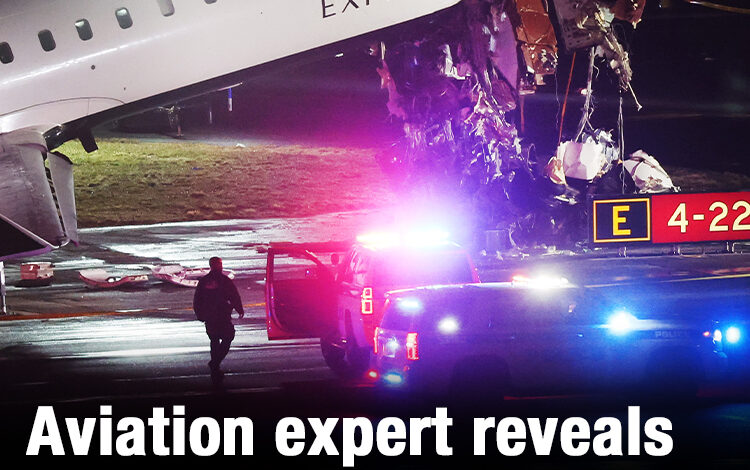
The harrowing collision involving an Air Canada regional jet at LaGuardia Airport on Sunday night was a preventable tragedy, according to a leading aviation specialist. As investigators begin to piece together the final moments of the flight, new theories are emerging that point to a catastrophic failure in the system designed to keep runways clear.
What was intended to be a routine passenger flight transformed into a scene of carnage on the runway when a plane carrying dozens of travelers struck a vehicle during its landing roll. Officials have confirmed that two pilots lost their lives in the collision, a grim outcome for an incident that experts say should never have occurred.
A Journey Interrupted
The aircraft, a Bombardier CRJ-900 twin-jet operating as Jazz Aviation Flight 8646, was completing its journey from Montreal to New York. On board were 76 passengers, many of whom were likely bracing for a standard arrival at one of the nation’s busiest hubs. However, before the aircraft could safely exit the strip, the mission turned fatal.
Flight tracking data reveals that the aircraft was traversing Runway 4 at approximately 24 miles per hour when it slammed into a Port Authority vehicle. Aviation analysts are quick to note that the Air Canada jet maintained the right of way at the time of impact. Under standard operating procedures, once a flight is cleared, that runway is intended to be an exclusive and sterile environment.
The Theory of Internal Confusion
Mary Schiavo, the former Inspector General of the U.S. Department of Transportation, believes the evidence points toward a systemic error in communication within the air traffic control infrastructure.
“Once that aircraft was cleared to land… it owned that runway,” Schiavo told the NY Post, emphasizing the absolute nature of landing priority.
Schiavo’s analysis suggests that the crash was the result of a “critical mistake” involving a lack of coordination between the control tower and ground control. The accident, which saw the jet slam into the truck, resulted not only in the deaths of the flight crew but also in injuries to dozens of others on board.
Breakdown Between Tower and Ground
The crux of the investigation likely lies in the audio recordings from the night of the crash. Schiavo suggests that the root of the problem may be found in the division of air traffic control responsibilities.
“There are two parts here — there’s the control in the tower, also called local control, and there’s ground control,” Schiavo explained. “And those two air traffic control entities are supposed to coordinate with each other.”
In a high-functioning airport environment, these two roles operate in a state of constant, seamless contact to ensure runway integrity. On Sunday night, that link appears to have severed.
“So clearly they either did not coordinate, or they did and were just wrong,” Schiavo continued. “But giving a fire truck clearance to cross the runway after an aircraft has been cleared to run in this final is a clear error. There’s just no way around that.”
Seeking Accountability in the Aftermath
As the National Transportation Safety Board (NTSB) and local authorities descend on the wreckage, the primary question remains: who authorized the vehicle to enter an active runway?
“Who gave the final clearance for that fire truck across the runway?” Schiavo asked. “It should have been the tower, but clearly… someone made a very critical mistake in allowing a fire truck clearance to cross the runway when an aircraft had been given a landing clearance. That’s my take on it.”
While investigators continue to sift through the data and cockpit voice recordings, the early consensus among specialists is that this disaster was not the result of mechanical failure, but a human error that has left a permanent scar on the aviation community.