Fighter Pilot Vanished in 1944, 70 Years Later, Her Plane Was Found in a Forest!
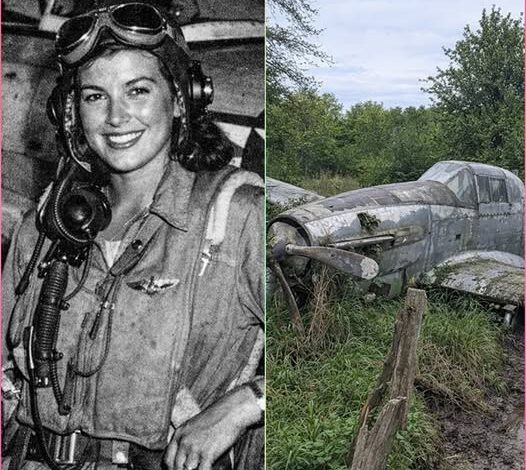
The saga of Evelyn Whitmore is far more than a cold case of a missing aviator; it is a sprawling, three-generation chronicle of a family’s search for truth against a wall of systematic bureaucratic silence. For eighty years, the official record was a lie. Today, that lie has finally collapsed under the weight of a shallow grave in a Belgian forest and a letter that was never meant to be read.
The deception began in November 1944. Evelyn Whitmore took off from a military airfield in Delaware, ostensibly tasked with a routine ferry mission to the West Coast. She never arrived. Three weeks later, the Army Air Forces issued a terse telegram to her family: she had been lost over the English Channel during a transatlantic transit. There was no wreckage, no recovery, and, according to the military, no grounds for further investigation.
Her three-year-old son, Robert, grew up in the hollow space left by that disappearance. He spent sixty years petitioning the War Department, chasing shadows and filing FOIA requests that were met with redacted lines and flat denials. Robert died in 1998, leaving behind boxes of rejection letters and a single, brittle photograph of a smiling woman in a flight suit—a mother he never knew, lost to a sea that, as it turns out, she never touched.
The Forest Yields Its Secrets
The silence was finally shattered in 2014, not by a researcher, but by nature. A violent winter storm tore through the Ardennes Forest in Belgium—4,000 miles away from the English Channel where Evelyn was allegedly lost.
Forestry workers clearing debris discovered the mangled remains of a P-47 Thunderbolt buried under seven decades of growth. Its serial number was an exact match for the aircraft the military claimed had vanished at sea. Thirty meters from the bullet-riddled fuselage, beneath a hand-placed stone cross, investigators found a shallow grave.
Inside a flight jacket wrapped around the remains, recovery teams discovered a document that would force the Pentagon to acknowledge a classified program so sensitive it had remained buried for eight decades: a covert operation that deployed American women into active combat over Nazi-occupied Europe, then systematically erased their existence when they failed to return home.
A Grandson’s Discovery
Special Agent Daniel Whitmore was at his desk in Virginia when the past finally caught up to the present. As an investigator for the Air Force Office of Special Investigations (AFOSI), “Dany” was professionally trained to find things people wanted hidden. He was not, however, prepared for the message from Colonel Marcus Webb:
“The remains belong to a woman… We believe she may be your grandmother.”
The discovery in the Ardennes—the site of the infamously bloody Battle of the Bulge—contradicted every official record his father had spent a lifetime chasing. Dany flew to Belgium to meet with Dr. Paul Hendrickx of the Defense POW/MIA Accounting Agency (DPAA). At the crash site, he found a scene of haunting preservation. The Thunderbolt hadn’t plummeted in a death spiral; it had been a controlled descent. Evelyn Whitmore had survived the landing.
The Final Letter
The heart of the mystery was unlocked by Henrik Caron, the 86-year-old son of a local Belgian resistance fighter. Caron’s father had been the one to find the wreckage in the winter of 1944.
“She was thirty meters from the aircraft, sitting against a tree,” Henrik explained, recalling his father’s account. “My father said she looked peaceful, but she had been wounded by ground fire. She had dragged herself from the cockpit and sat down to rest.”
In her lap, the resistance fighters found a pen and a letter addressed to her son, Robert. In the freezing quiet of the forest, Evelyn had spent her final moments writing to the child she would never see again.
The OSS and the “Bureaucracy of Silence”
Armed with his grandmother’s dog tags and the oil-cloth-wrapped letter, Dany began digging into the archives of the Office of Strategic Services (OSS)—the wartime predecessor to the CIA. He uncovered a requisition for female pursuit pilots for “special duty.”
Evelyn was one of five women recruited for these high-stakes, covert combat missions. All five died within a four-month window. To avoid the political fallout of admitting women were being used in unauthorized combat roles, the military scrubbed their records, falsified their crash sites, and lied to their grieving families.
For eighty years, the truth waited in the Belgian soil. Looking at the photograph of the woman who shared his eyes, Dany described the sensation of a “stone in the chest” finally dissolving. He wasn’t just repatriating a fallen pilot; he was completing the mission his father had started—pulling Evelyn Whitmore out of the shadows of a state secret and placing her firmly back into the pages of history.