The Cosmic Near, Fragile Shield of Planetary Defense!
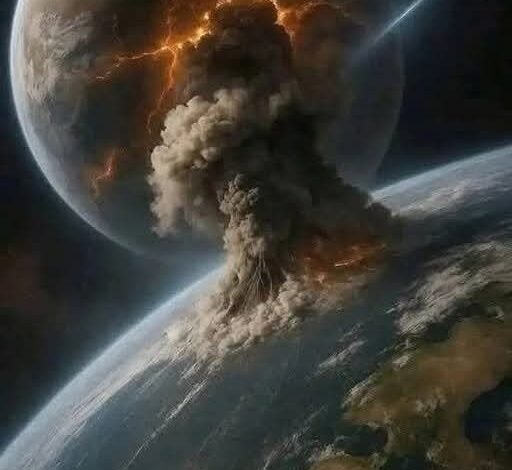
The vast, silent vacuum of space is rarely as empty as it appears to the naked eye. Beneath the serene tapestry of distant stars and familiar constellations, a complex mechanical dance of celestial debris is constantly in motion. On March 26, 2026, the scientific community began circulating a series of updates that, while couched in the measured, dispassionate language of astrophysics, carried a profound weight for the inhabitants of Earth. The subject of this scrutiny is a massive mountain of primordial rock, a relic from the dawn of our solar system known formally by the numerical designation 52768, or 1998 OR2. As Size estimates and orbital trajectories were refined and released to the public, the narrative shifted from a routine astronomical observation to a sobering meditation on our planet’s place in a high-stakes cosmic shooting gallery.
Asteroid 1998 OR2 is not a typical “near-Earth” object. It belongs to a rare and formidable category of celestial bodies whose sheer scale demands respect and constant vigilance. With a diameter estimated between 1.5 and 4 kilometers, it is an object of truly global proportions. To put its size into a terrestrial perspective, if this asteroid were placed on the surface of the Earth, it would stand taller than many of the world’s most famous mountain peaks. In the context of planetary impact science, an object of this magnitude is categorized as a “global killer.” Should a rock of this size ever intersect with the Earth’s orbit, the result would not be a localized disaster, but a cataclysmic event capable of altering the very chemistry of our atmosphere, collapsing global ecosystems, and reshaping the coastlines of entire continents through massive, multi-oceanic tsunamis.
Currently, NASA and other international space agencies are tracking the asteroid with a suite of sophisticated instruments, ranging from ground-based radar to space-borne infrared telescopes. Moving through the void at a staggering velocity of 8.7 kilometers per second, 1998 OR2 is performing a high-speed flyby of our orbital neighborhood. The latest calculations confirm that the asteroid is expected to make its closest approach on June 2nd. The messaging from the world’s leading experts remains consistent and reassuring: based on decades of observational data and the laws of orbital mechanics, there is zero probability of an impact during this pass. The trajectory has been mapped with extreme precision, showing that the object will clear our planet by a margin that, while small in astronomical terms, is millions of miles in human terms.
Despite these categorical assurances of safety, the approach of 1998 OR2 serves as a stark reminder of a deeper, less comfortable reality regarding our species’ long-term survival. Our safety is currently maintained by a thin veil of technological vigilance. While our ability to detect and track these “Potentially Hazardous Objects” (PHOs) has improved exponentially since 1998 OR2 was first discovered nearly thirty years ago, our planetary defense systems are still in their infancy. We are living in a historical window where we have the scientific capability to see the danger coming, but we have yet to fully master the technologies required to redirect or neutralize a threat of this scale if the calculations were to ever fall against us.
The discovery and monitoring of such objects rely on a delicate web of global coordination. Programs like NASA’s Planetary Defense Coordination Office work in tandem with the European Space Agency and other international partners to maintain a “Sentry” list of objects that could pose a threat in the next century. However, this vigilance is subject to the ebbs and flows of political will and fluctuating research budgets. The arrival of a massive asteroid like 1998 OR2 highlights the fact that space is an active environment, and our security is a matter of constant active engagement. A small delay in detection, a gap in satellite coverage, or a simple error in initial size estimation could be the difference between an interesting astronomical event and an existential crisis for human civilization.
There is a psychological weight to these “near-miss” events that transcends the hard data of physics. For the general public, the mention of a four-kilometer asteroid inevitably evokes the imagery of deep-impact scenarios from science fiction. The scientific community faces the daunting task of balancing transparency with the need to prevent unnecessary panic. By classifying 1998 OR2 as “no real danger” for the June 2nd pass, NASA is performing a vital act of public service—grounding the conversation in fact while acknowledging the magnitude of what is passing by. The asteroid is a silent messenger from the deep past, reminding us that the Earth does not exist in a vacuum-sealed bubble, but is a passenger on a journey through a debris-strewn cosmic sea.
As 1998 OR2 continues its approach, it provides an invaluable opportunity for the scientific community to refine its “Intervention” protocols. Every time a large asteroid passes near enough for high-resolution radar imaging, scientists can better understand its composition, its rotation, and its gravitational nuances. This data is the raw material from which future defense strategies will be built. Projects like the DART mission, which successfully demonstrated our ability to alter an asteroid’s path through kinetic impact, are the first steps toward a future where we are no longer passive observers of our cosmic fate. But the scale of 1998 OR2 reminds us that redirecting a four-kilometer mountain of rock would require energy and technology far beyond our current operational capacity.
The real story of June 2nd is not the asteroid itself—which will pass silently and harmlessly through the dark—but the mirror it holds up to humanity. It forces us to ask if we are prepared to act as a unified species should a “one-in-a-million” event occur within our lifetimes. The asteroid doesn’t care about national borders, political ideologies, or economic cycles; it is governed solely by the cold, impartial math of gravity. Our response to its presence is a measure of our maturity as a spacefaring civilization. Are we investing enough in the telescopes that act as our eyes? Are we developing the propulsion systems that act as our hands?
In the weeks leading up to the June encounter, the world will likely see a surge in headlines and speculation. Amidst the noise, it is important to hold onto the core facts: the math is solid, the path is clear, and the planet is safe. But the vigilance must remain. The asteroid 1998 OR2 is a reminder that the safety margin we enjoy is maintained only through the tireless work of the men and women who stare into the dark every night, tracking the ghosts of the solar system. Their work ensures that when we look up at the night sky, we can see the stars as symbols of wonder rather than harbingers of doom.
As June 2nd approaches, we should view 1998 OR2 not as a threat, but as an invitation to look outward. It is a prompt to continue the essential work of planetary defense, to fund the next generation of infrared surveyors, and to maintain the international treaties that allow for the sharing of vital astronomical data. We are the first generation of humans in history with the potential to prevent a natural disaster of cosmic proportions. The asteroid passing by this summer is a signal that our time to prepare is now. It is a quiet, cold, numerical label—1998 OR2—that speaks volumes about the fragility and the resilience of our home in the stars.