China’s “Nostradamus” Claims to Know How the US‑Iran War Will End After Two Predictions Came True, Sparking Viral Debate Online, Bold Forecasts, and Global Curiosity About What His Third Prophecy Could Reveal About Future Conflict Outcomes and Global Power Shifts Amid Rising Tensions Between Washington and Tehran
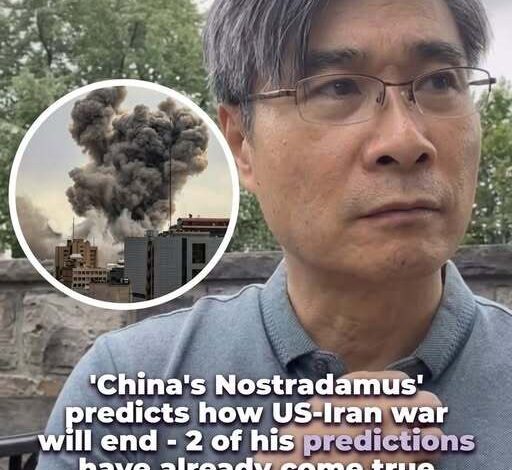
A quiet professor has unexpectedly stirred a storm across the internet. His message isn’t wrapped in mystery or dramatic prophecy—it’s grounded, analytical, and, for many, deeply unsettling. There’s no mysticism in his tone, no attempt to shock for attention. Instead, there’s a calm, almost clinical clarity that makes his warning feel even more serious. He suggests that the next major conflict involving global powers may not unfold the way many Americans expect—or hope. What makes people pause isn’t just what he’s saying now, but what he’s said before. He previously pointed to the possibility of Trump’s political return when others dismissed it, and he warned of rising tensions between the United States and Iran before they became headline news again. Now, as parts of those earlier observations seem to align with reality, his latest prediction is igniting fear, debate, and intense disagreement across audiences who can’t quite decide whether to dismiss him or listen more closely.
Professor Xueqin Jiang does not present himself as someone who can see the future. Instead, he frames his perspective as an ability to recognize patterns—patterns that, in his view, are often overlooked or underestimated. His work is rooted in history, geopolitics, and long-term strategic thinking. He studies how powerful nations behave when they reach moments of confidence that border on overconfidence, and how those moments often lead them into conflicts that are far more complex and prolonged than initially anticipated. In his analysis, empires don’t typically collapse overnight. They erode gradually—through miscalculations, drawn-out wars, and the slow draining of resources, morale, and global influence.
From this perspective, he argues that the United States, despite its immense power, is not immune to the same historical dynamics that have shaped other great powers before it. At the same time, he emphasizes that Iran should not be underestimated or simplified into an easy opponent. Rather than a conventional adversary, Iran operates through layered strategies—regional alliances, asymmetric tactics, and a deep familiarity with its own terrain and political landscape. In Jiang’s view, this combination creates the conditions for a conflict that could become prolonged and exhausting, rather than decisive and clear-cut. What might be framed politically as a quick or controlled confrontation could, under the wrong circumstances, evolve into a stalemate—one where victory is difficult to define and even harder to achieve.
Part of what makes his argument resonate—and divide opinion—is its refusal to offer a comforting narrative. Many people are accustomed to viewing global conflicts through a lens of clear winners and losers, where strength guarantees success. Jiang challenges that assumption, suggesting that modern conflicts, especially those involving regional complexity and global stakes, rarely follow such simple scripts. Instead, they tend to unfold unpredictably, shaped by factors that extend far beyond military capability alone—economic strain, public opinion, international alliances, and internal political pressures all play critical roles.
Unsurprisingly, his statements have triggered strong reactions. Some critics argue that he is overstating risks, fueling unnecessary fear, or underestimating the capabilities and resilience of the United States. They see his analysis as overly cautious, even pessimistic. Others, however, view his perspective differently. To them, he represents a voice willing to confront uncomfortable realities—someone pointing out vulnerabilities not to weaken confidence, but to encourage more careful thinking. They argue that dismissing such warnings outright can be just as dangerous as blindly accepting them.
Beneath the debate, there is a deeper message that goes beyond any single country or potential conflict. Jiang’s core argument is less about predicting a specific war and more about highlighting a recurring human pattern: the tendency of powerful actors to misjudge their own limits. History, he suggests, is filled with examples of nations that believed they were acting decisively, only to find themselves trapped in situations they could neither control nor easily exit. These lessons are not hidden—they are well documented—but they are often overlooked in moments of urgency or confidence.
In that sense, his warning is not just strategic—it is philosophical. It asks whether societies and their leaders are truly willing to learn from the past, or whether they are destined to repeat its mistakes in new forms. The fear, then, does not come solely from the possibility of conflict, but from the possibility that the same patterns of overreach, miscalculation, and delayed realization could unfold once again.
Ultimately, the conversation sparked by Professor Jiang reflects something larger than one man’s analysis. It reveals a tension between reassurance and realism, between the desire to believe in control and the recognition that global events are often far more complicated. Whether his predictions prove accurate or not, the reaction to them underscores an important truth: people are searching for ways to understand an uncertain future, and they are grappling with how much weight to give to voices that challenge what they think they know.
His final point, perhaps the most unsettling, is also the simplest. The greatest danger may not lie in any single adversary, but in the quiet confidence that prevents nations from seeing risk clearly. And if history has shown anything, it is that ignoring those lessons often comes at a cost far higher than anyone expects.