She Called His Late Wifes Memory Trash, Seconds Later, He Exposed Her Secret and Everything Changed
Grief doesn’t leave when a person dies.
It lingers. It settles into corners, hides in quiet spaces, and waits for the moment someone tries to move on too quickly. I’ve lived long enough to know that grief doesn’t shout—it changes the air in a home, the way people speak, the way they don’t.
My name is Ruth, and I’ve seen grief take many forms. But I never imagined it would unravel right in front of me, in my own living room, over something as small—and as meaningful—as a handful of handmade toys.
My grandson Liam is nine.
Two years ago, he lost his mother, Emily, to cancer. She wasn’t just my son Daniel’s wife—she was the kind of woman who made everything feel warmer just by being there. When she died, something inside Liam didn’t break loudly.
It dimmed.
At first, no one else noticed. Kids are resilient, people said. He’ll adjust. He’ll bounce back.
But I watched him closely.
The laughter faded. The energy drained. He stopped running to the door when someone knocked. He stopped asking for things. He stopped being… loud in the way children are supposed to be.
He didn’t cry often.
He just went quiet.
The only thing he held onto were his mother’s sweaters. Emily used to knit them herself—soft, warm, always carrying that faint lavender scent she loved. Liam kept them folded carefully in a box in his room.
Sometimes he would sit with them.
Not playing. Not crying.
Just sitting.
A year later, Daniel remarried.
Her name was Claire.
I tried—truly tried—to give her a fair chance. But from the beginning, there was tension. Not loud arguments, not obvious cruelty. Just small things. Subtle comments. A tone that suggested those sweaters, those memories, didn’t belong in what she liked to call “her” home.
Daniel brushed it off.
“She’s adjusting.”
“She’s not used to kids.”
“Give her time.”
So I stayed quiet—for Liam.
I didn’t want to add more weight to a child who was already carrying too much.
Then one afternoon, everything shifted.
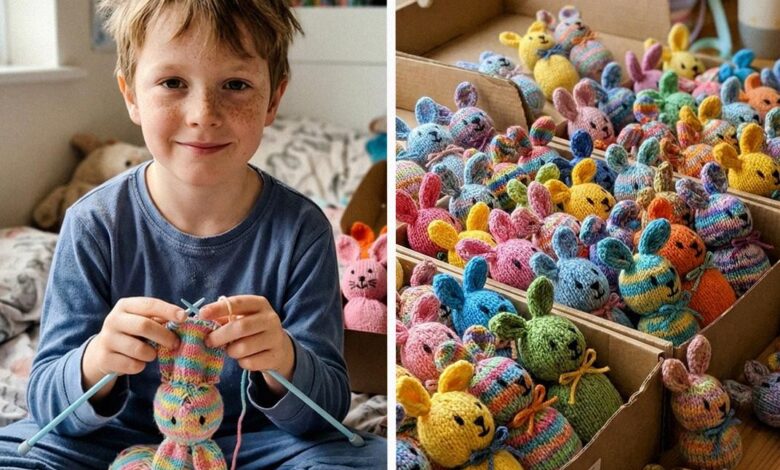
Liam walked into the kitchen holding something carefully in both hands, like it might fall apart if he moved too fast. It was a small bunny, uneven and slightly crooked, with one ear longer than the other.
“I made this,” he said softly. “For kids in the hospital… so they don’t feel lonely.”
My chest tightened.
“Why a bunny?” I asked gently.
He gave a small smile—the first real one I’d seen in months.
“Mom used to call me her bunny.”
That was all it took.
From that moment on, Liam changed—not back to who he was, but into something new. Something steadier. Something driven.
He started working every day.
After school. Before dinner. Even late at night when he thought no one noticed. He carefully unraveled his mother’s sweaters, turning them back into yarn. Then, with quiet determination, he began knitting.
One bunny became five.
Five became twenty.
And before long, there were boxes lined up along the wall.
Each bunny had a tag tied around its neck.
“You are not alone.”
“You are brave.”
“Keep fighting.”
When I asked how many he planned to make, he said, like it was nothing, “One hundred.”
And somehow, he did it.
For the first time since losing his mother, Liam had something that gave him purpose.
Something that made him proud.
The day everything fell apart, we were packing the last of the bunnies. We planned to take them to the children’s cancer ward the next morning.
Liam was excited.
Not loud, not overwhelming—but quietly hopeful.
Then Claire walked in.
She stopped when she saw the boxes.
“What is all this?”
Her tone wasn’t curious.
It was sharp.
“Liam made them for the hospital,” I said.
She picked one up, turning it in her hand, examining it like it was something unfamiliar.
Then she laughed.
“This? This is trash.”
The word hit like a slap.
Before I could react, she grabbed a box and walked straight out the door.
“Claire—” I started.
Too late.
She dumped the entire box into the dumpster outside.
Then she came back for another.
And another.
I stood frozen.
Liam didn’t move.
He just stood there, shaking, his face crumpling slowly before the tears came—quiet, broken, worse than any scream.
I pulled him into my arms, but there was nothing I could say to undo what had just happened.
And then Daniel walked in.
Earlier than expected.
Liam ran to him, trying to explain through sobs.
Daniel didn’t interrupt.
He didn’t react right away.
He just listened.
Then, quietly, he said, “Wait here.”
And walked into the house.
When he came back, he was holding something small—a worn wooden box.
Claire saw it.
And everything about her changed.
Her face drained of color.
“No… you weren’t supposed to have that,” she whispered.
Daniel didn’t look at her.
He looked at Liam.
“This,” he said calmly, “is something she cares about. Just like you care about your bunnies.”
He opened the box.
Inside were letters. Photos. Memories.
Claire, younger. Smiling. Standing beside another man.
“Who is that?” I asked.
“The love of her life,” Daniel said. “The one she couldn’t let go of.”
The silence that followed was heavy.
Daniel stepped forward.
“You called Liam’s memories trash,” he said. “Should I treat yours the same way?”
Claire panicked.
“No—wait!”
“Then go,” he said, nodding toward the dumpster. “Get every single one back.”
For a moment, I thought she would refuse.
Then he turned slightly, as if he might toss the box.
That was enough.
She ran.
No hesitation.
No pride.
She climbed into that dumpster and started pulling everything out—boxes, bunnies, scraps—one by one.
Some were crushed. Some were dirty. Some barely held together.
But she didn’t stop until every last one was back inside.
Hours later, she sat in the kitchen, quietly cleaning them. Drying them. Reshaping them.
No one told her to.
She just did.
That night, Daniel handed her the box back.
“I’m not throwing this away,” he said. “But this is the last time I stay quiet.”
The next day, Claire called us all into the living room.
For a moment, she said nothing.
Then, softly, “I’m sorry.”
She looked at Liam.
“I didn’t understand what they meant,” she said. “I thought… if I pushed hard enough, maybe you’d let go of your mom.”
She swallowed hard.
“I was wrong.”
Then she walked outside.
When she came back, she was holding the empty wooden box.
She had emptied it.
She held it out to Liam.
“Can we start again?”
He hesitated.
Then he took it.
And hugged her.
Weeks later, the bunnies were ready again.
Cleaned. Restored. Still imperfect.
But still his.
Claire went with him to deliver them.
She didn’t lead.
She didn’t interrupt.
She just stayed beside him.
On the way home, Liam leaned his head against the window and said quietly, “Mom would’ve liked that.”
Claire didn’t speak.
She just nodded.
And for the first time since she walked into our lives, I believed she finally understood what it meant to stay.
Not by replacing what was lost.
But by respecting it.