My Son Fell Into a Coma After a Walk with His Father—In His Hand Was a Note: “Open My Closet for the Answers, but Don’t Tell Dad”
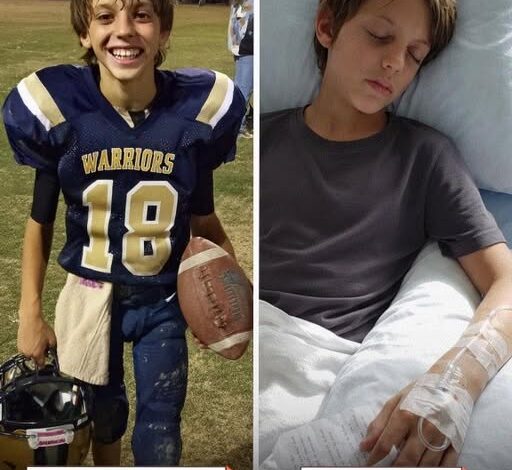
When my thirteen-year-old son fell into a coma after what should have been a simple walk with his father, it felt like my entire world had collapsed in an instant. I thought there was nothing left to hold onto—until I discovered a hidden note and a message I almost ignored, one that forced me to confront a truth that could tear everything apart… and decide how far I was willing to go to protect my child.
There are things you never forget.
For me, it’s the smell of the hospital—sharp, sterile, unforgettable. And the blinding lights that make night feel like day, especially at three in the morning when everything feels heavier.
Just hours before, my son Andrew had walked out the front door beside his father. He was full of life, restless and loud, the kind of kid who couldn’t sit still for more than five minutes. By the time the night ended, he was lying motionless in a hospital bed, surrounded by machines that were doing what his body suddenly couldn’t.
Andrew had always been that energetic spark in our home. Shoes worn out too fast, laughter echoing down hallways, water bottles left half-finished in every corner like proof he had just been there moments ago.
As he left that evening, I called after him like I always did, reminding him, “Take your inhaler, just in case.”
He gave me that familiar look—half annoyance, half love—and rolled his eyes before smiling.
I didn’t know that would be the last time I’d hear his voice.
The next time I saw him, he was silent.
When I rushed into the emergency room, pushing through the doors, my hands were gripping my bag so tightly they hurt. I barely noticed. All I could think about was Andrew.
But I was already too late.
He was in a coma.
Brendon—my ex-husband—sat nearby, hunched over, pale and shaken. His eyes were red, his expression distant. When he looked at me, it didn’t feel like I was looking at the man I once knew. It felt like someone else entirely.
“I don’t know what happened,” he kept saying, over and over. “We were just walking. He was fine, and then he collapsed. I called for help immediately. I didn’t leave his side.”
I wanted to believe him. I truly did.
But something inside me refused to settle.
This wasn’t the first time he had dismissed Andrew’s health. He had always treated his asthma like a minor inconvenience, something exaggerated. He skipped appointments, brushed off symptoms, told Andrew not to make a big deal out of it.
And now my son was lying unconscious.
A doctor approached me while I stood beside the bed. Her voice was calm, but there was something guarded behind it.
“Your son is stable for now,” she explained gently, “but his condition is serious. We’re still trying to understand what caused this.”
“Was it asthma?” I asked quickly. “Did he have an attack?”
She paused—just for a moment, but it was enough.
“There are signs of breathing distress,” she said carefully, “but there are also… things that don’t quite match. We’re continuing tests.”
The way she looked at me said more than her words.
Something wasn’t right.
I turned back to Andrew. His face looked too peaceful, unnaturally still. Machines beeped steadily, filling the silence his voice once occupied.
I reached for his hand.
That’s when I felt something.
A small, folded piece of paper, tucked between his fingers.
My heart began racing as I carefully pulled it free. Even before opening it, I felt dread creeping in.
Inside, in Andrew’s uneven handwriting, were words that froze me:
“Open my closet for the answers… but don’t tell Dad.”
I read it again. And again.
There was no misunderstanding it.
This wasn’t random.
Andrew had been trying to tell me something.
And whatever it was… he didn’t trust his father with it.
I looked across the room at Brendon. He was watching me—too closely.
“What’s that?” he asked.
I quickly folded the note and slipped it into my pocket. “Nothing.”
He didn’t argue, but I saw the suspicion in his eyes.
In that moment, something shifted inside me.
I knew—without a doubt—that he wasn’t telling me everything.
The next morning, once I was sure Andrew was stable, I left the hospital and went straight home.
The house felt empty without him. Quiet in a way that made everything feel heavier.
I went directly to his room.
His closet door was slightly open, just like he always left it. Everything looked normal—clothes hanging unevenly, shoes scattered, nothing out of place.
But now I knew better.
I started searching.
At first slowly, carefully.
Then faster. Desperately.
Drawers, pockets, boxes—until finally, hidden behind old board games on the top shelf, I found it.
A small metal box.
Locked.
My hands trembled as I held it.
There was no key. But I wasn’t stopping.
After struggling with it for a few minutes, I managed to force it open.
Inside were papers—receipts, documents, medical forms.
And another note.
I unfolded it, my breath unsteady.
“If anything happens to me, it wasn’t an accident.”
My chest tightened painfully.
Underneath were prescription records.
Not Andrew’s.
Brendon’s.
Strong medication—ones I recognized. The kind that could affect breathing, judgment, reaction time.
My thoughts began racing.
Had he taken them that day?
Had he ignored Andrew’s condition again?
Or had something even worse happened?
I didn’t have all the answers yet.
But I had enough to understand one thing clearly:
Andrew had been scared.
Scared enough to leave me a message.
Scared enough to hide the truth.
When I returned to the hospital, I didn’t look at Brendon the same way anymore.
He wasn’t just my son’s father.
He was someone who might be hiding something dangerous.
I sat beside Andrew again, taking his hand gently in mine.
“I’m here,” I whispered.
But this time, those words carried more weight.
Because it wasn’t just comfort.
It was a promise—and a decision.
No matter what the truth turned out to be…
No matter how painful it was…
No matter what it meant for Brendon…
I was going to uncover it.
Because my son had trusted me with the truth.
And I wasn’t going to fail him.