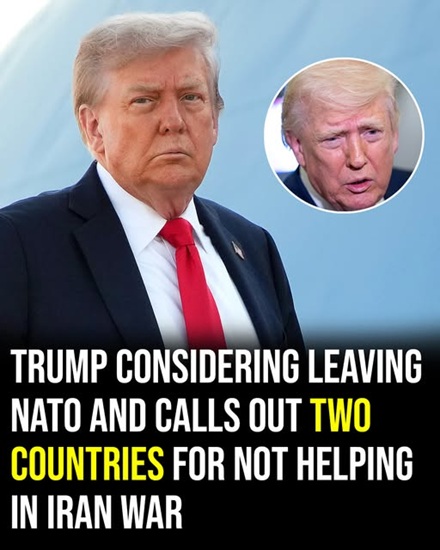
“Trump Says He’s Considering Withdrawing the U.S. From NATO Amid Tensions Over the Iran Conflict”
In recent days, Donald Trump has once again drawn intense global attention with his sharp criticism of North Atlantic Treaty Organization and threats to withdraw the United States from the alliance after the ongoing conflict with Iran.
In an interview with The Telegraph newspaper, Trump said that he is “seriously considering” pulling the United States out of NATO once the war in Iran ends, a remark that has alarmed diplomats and analysts worldwide.
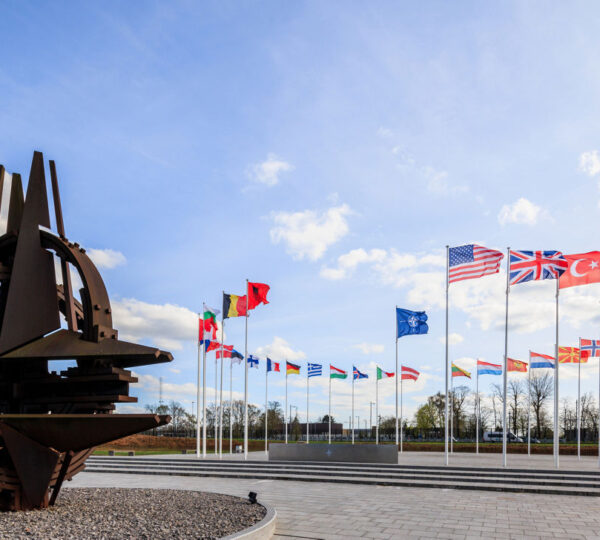
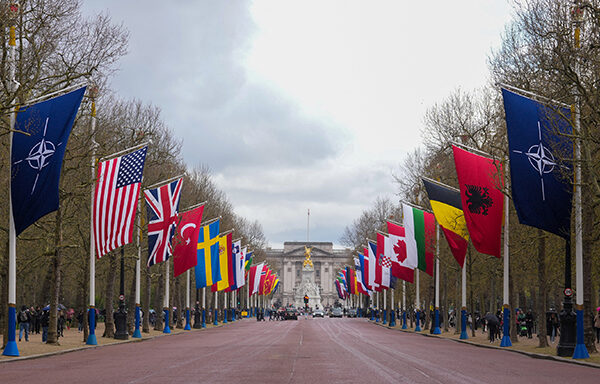
The alliance was created in 1949 with 12 founding members, including the U.S., the United Kingdom, France, Canada, and others, under the principle that an attack on one member is an attack on all. Today, NATO includes 32 countries across North America and Europe.
Trump’s comments echo his long‑standing criticisms that NATO members do not spend enough on defense and are reluctant to share military burdens equally with the United States.
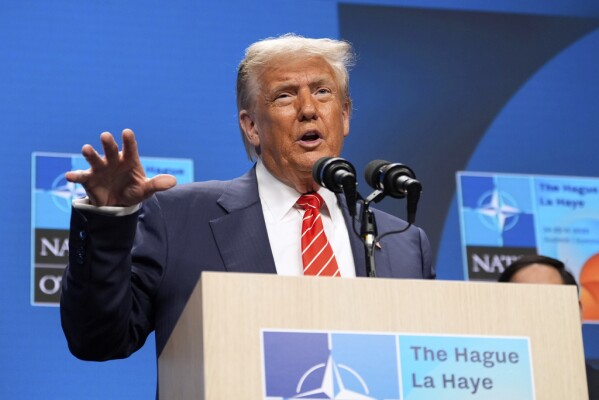
In the interview, he repeated a phrase he has used before, calling the alliance a “paper tiger” and arguing that its military strength and collective resolve are overstated and not respected by foreign leaders.
He asserted that Vladimir Putin of Russia does not fear NATO, suggesting that the alliance’s credibility has been hollowed out by decades of uneven burden‑sharing among members.
Trump linked his threat to U.S. loyalty to NATO allies with the current U.S.-Israel conflict with Iran, pointing to what he views as a lack of cooperation from key European countries during the crisis.
Several NATO members have declined to allow U.S. military aircraft to use their airspace or bases in the campaign against Iran, underscoring disagreements over strategy and the alliance’s role.
One of the core points of contention has been the Strait of Hormuz, a critical maritime passage through which nearly one‑fifth of the world’s oil supplies transit, currently disrupted by the conflict.
Trump has demanded that NATO allies contribute ships and forces to ensure freedom of navigation through the strait, an idea widely opposed by European governments, who view the situation as outside NATO’s traditional mission.
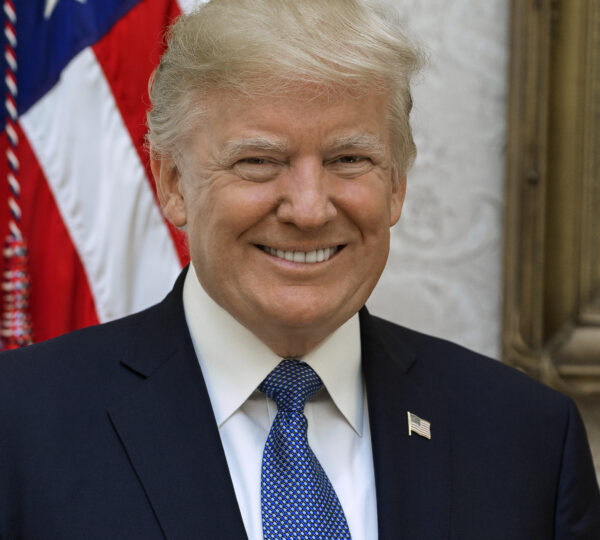
In response to NATO’s reluctance, Trump has publicly criticized key U.S. partners, including the United Kingdom and France, blaming them for failing to support U.S. objectives in the Iran conflict.
On his Truth Social platform, Trump disparaged European allies, asserting that some have refused to assist in the conflict and complaining about rising fuel prices tied to disruption of oil shipments.
He also made pointed remarks about the United Kingdom’s military capabilities, claiming it lacks a functional navy and disparaging its aircraft carriers — comments that have drawn sharp rebukes in London.
French officials have also pushed back after Trump accused France of blocking flights carrying military supplies to Israel and described Paris as “very unhelpful” in the ongoing crisis.
European capitals, however, have stressed that their decisions not to participate militarily are based on legal constraints and concerns about escalation, not a lack of willingness to support U.S. interests.
The broader context of Trump’s rhetoric includes intensified global tensions following Iran’s restriction of oil flow through the Strait of Hormuz after attacks on shipping and strategic pressure from Tehran.
This disruption has contributed to a surge in global energy prices, moving the issue beyond military strategy into economic distress affecting consumers worldwide.
Trump has described the military campaign in the region as nearing completion, even as violence continues and diplomatic efforts remain stalled and contentious.
Legal experts note that under U.S. law, the president cannot unilaterally withdraw the United States from NATO without Congressional approval, adding a constitutional limitation to Trump’s threat.
In 2023, Congress passed a law requiring legislative approval for any withdrawal from the alliance, meaning a formal exit would require cooperation from lawmakers in Washington.
Despite this legal check, Trump’s comments have heightened tensions in the alliance, with European politicians and diplomats warning that even talk of withdrawal could weaken NATO’s deterrence and cohesion.
Supporters of the alliance argue that NATO has adapted over decades to deter threats from Russia and other adversaries, and remains a cornerstone of trans‑Atlantic security cooperation.
Critics of Trump’s stance claim his focus on short‑term military objectives risks eroding long‑standing partnerships that have underpinned Western defense since World War II.
Senior U.S. officials, including Secretary of State Marco Rubio, have indicated that the alliance must be examined in light of changing global threats, even as they reaffirm the value of cooperation.
Some analysts argue Trump’s statements are aimed at pressuring allies to assume a greater share of defense responsibilities rather than signaling an imminent withdrawal.
Others warn that public attacks on allies could have the opposite effect, deepening political divisions and undercutting collective security frameworks that have stood for decades.
In Europe, several capitals are already planning diplomatic talks on the Hormuz crisis without direct U.S. involvement, illustrating the widening gap between Washington and its traditional partners.
The parliament of France and leaders in Germany, Spain, and Italy have all expressed resistance to entanglement in a broader military conflict involving Iran.
Back in Washington, lawmakers from both parties have reiterated the importance of the trans‑Atlantic alliance, pushing back against the suggestion that the U.S. could or should depart NATO.
Legal scholars emphasize that treaty withdrawal is a complex and unprecedented move that could take years, if it were attempted at all, and would reverberate through global geopolitics.
Republican and Democratic senators alike have expressed concerns that undermining NATO could embolden rivals like Russia and China, who monitor Western unity closely.
Despite the heated rhetoric, the immediate impact on NATO operations remains limited, with member countries continuing standard defense planning and cooperative missions unrelated to the Iran crisis.
Some European leaders have reiterated that humanitarian and diplomatic engagement remain priorities as the alliance navigates an increasingly complex global security environment.
Opinion among experts varies widely — from those who believe NATO must reform to address modern threats to others who see any withdrawal as a strategic mistake.
Public opinion in allied countries is also mixed, with some voters questioning the cost and scope of collective defense commitments and others warning against weakening trans‑Atlantic ties.
The question of NATO’s future in its current form has therefore become a topic of intense debate, both within member governments and among international relations scholars.
As Trump’s remarks continue dominating headlines, diplomats are urging sustained dialogue and engagement to prevent mistrust from eroding decades of strategic cooperation.
How NATO adapts to these tensions — and whether it survives any shift in U.S. policy — remains an open question in global security discussions.
Whether one agrees or disagrees with Trump’s statements, they have undeniably sharpened focus on the alliance, prompting reflection on how NATO can remain relevant in a changing world.