A Blood-Stained Backpack in a Drain Just Blew Open the Nancy Guthrie Mystery, And What Was Inside Is Even More Chilling
It didn’t start with a suspect.
It didn’t start with a confession.
It started with something no one expected—a routine cleanup that turned into a discovery no one was prepared for.
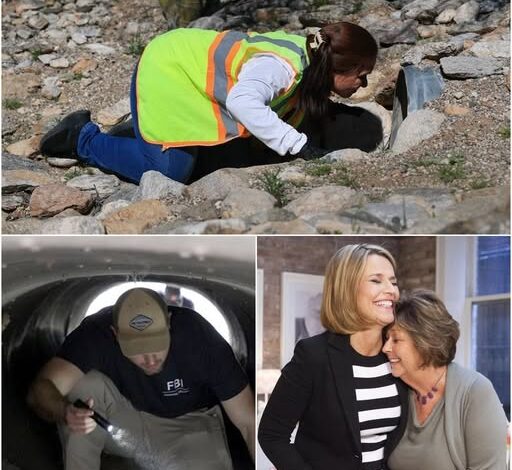
On what should have been an ordinary day, a city maintenance worker was clearing debris from a storm drainage system near the Catalina Foothills. It was the kind of job that rarely leads to anything unusual—leaves, sediment, runoff, the usual buildup that collects over time.
Then something caught his attention.
A dark object wedged beneath a metal grate.
At first, it looked out of place but not alarming. Just another piece of discarded debris, something that didn’t belong but wasn’t worth a second thought.
Until he looked closer.
It was a backpack.
Black. Partially submerged. And marked with what appeared to be dried blood.
In that moment, everything changed.
What had been a routine task instantly became something else—a possible breakthrough in a case that had already unsettled an entire community.
Because just two kilometers away, Nancy Guthrie had vanished weeks earlier under circumstances that never made sense.
Now, for the first time, there was something tangible.
Something real.
And possibly, something dangerous.
Authorities responded immediately. The area was secured, and forensic teams moved in with precision. Every step was documented. Photographs were taken before anything was touched, preserving the exact position of the backpack, the surrounding debris, the way it had settled into the drainage system.
Because details matter.
Especially in cases like this.
The bag was carefully extracted and transported for analysis.
And what investigators found inside only deepened the mystery.
According to sources familiar with the investigation, several items inside the backpack were directly linked to Nancy Guthrie. While officials have not released a full inventory, the connection was strong enough to confirm that this was not a random object.
It belonged to her—or to someone connected to her.
But the most disturbing discovery wasn’t just the contents.
It was a piece of paper.
Folded carefully. Tucked inside an inner compartment.
A handwritten note.
At first glance, it didn’t look like anything extraordinary. But as investigators examined it more closely, its significance became impossible to ignore.
The note was described as a “to-do list.”
Not casual. Not ordinary.
Structured.
Intentional.
Bullet points outlining actions—some of which appeared to reference the handling or disposal of certain items. The language wasn’t fully disclosed, but sources indicate it carried implications that raised serious concerns.
And then there was what it was written on.
Not a random piece of paper.
A business card.
Specifically, a card linked to the Guthrie family—complete with logo, contact details, and identifiable markings.
That detail alone shifted the weight of the discovery.
Because it wasn’t just about what the note said.
It was about where it came from.
Why use something so specific? Something so traceable? Was it intentional? A message? Or something else entirely?
Forensic analysts immediately began examining the document. Ink composition, pressure marks, handwriting characteristics—every element was scrutinized. Specialists compared it against known samples from individuals connected to Nancy’s personal and professional life.
They also considered environmental factors.
The backpack had been sitting in a drainage system—exposed to moisture, sediment, and fluctuating conditions. Could water exposure have altered the ink? Changed its appearance? Affected how it was preserved?
Every variable had to be accounted for.
At the same time, investigators turned their attention to the environment where the backpack was found.
Storm drains are not static spaces. Water flow, debris accumulation, and natural movement can shift objects over time. To understand how long the bag had been there, experts began analyzing sediment layers, moisture patterns, and the way debris had built up around it.
This wasn’t guesswork.
It was reconstruction.
A timeline had to be established.
Was the backpack placed there immediately after Nancy disappeared?
Or did it arrive later?
That distinction could change everything.
Authorities are also exploring whether the placement was deliberate.
Because while it’s possible for objects to move through drainage systems, early assessments suggest that the positioning of the backpack—lodged in a way that caught attention—may not have been accidental.
If that’s true, it raises another question:
Was it hidden?
Or was it meant to be found?
That possibility introduces an entirely different layer to the investigation.
One that involves intent.
Messaging.
And potentially, manipulation.
Meanwhile, detectives are cross-referencing this discovery with everything else they’ve gathered so far.
Digital records.
Financial activity.
Vehicle movements.
Surveillance data.
The location of the drain is now being mapped against known travel routes and timelines from the night Nancy disappeared. If the site aligns with those movements, it could provide critical context—showing not just where the evidence was found, but how it got there.
And who might have put it there.
Despite the significance of this discovery, officials are urging caution.
Nothing has been confirmed.
No suspect has been named.
No definitive conclusion has been reached.
Because in cases like this, one piece of evidence—no matter how striking—is never enough on its own.
It has to connect.
It has to be supported.
It has to fit into a larger narrative that can withstand scrutiny.
That’s why forensic testing is still ongoing.
DNA analysis.
Fingerprint comparisons.
Blood pattern evaluation.
Every detail is being documented, verified, and rechecked.
Because once conclusions are drawn, they need to hold.
For Nancy’s family, the discovery brings a complicated mix of emotions.
Hope—because there’s movement in the case.
Fear—because of what the evidence might reveal.
And uncertainty—because answers still feel just out of reach.
The community, too, has felt the shift.
What was once a quiet concern has become something more urgent. More people are paying attention. More questions are being asked. And more eyes are looking for anything unusual, anything that might have been overlooked before.
Because sometimes, it’s not the obvious details that solve a case.
It’s the ones that almost go unnoticed.
A backpack in a drain.
A piece of paper.
A single decision that leads to a discovery no one expected.
That’s what this moment represents.
Not the end of the investigation.
But a turning point.
Because now, there is something concrete.
Something investigators can hold, analyze, and connect.
And somewhere within that evidence—whether in the handwriting, the placement, or the materials themselves—there is a truth waiting to be uncovered.
The case is still open.
The questions are still unanswered.
But one thing is clear.
What was hidden beneath that storm grate may be the key to everything.