Can You Find the Right Answer?
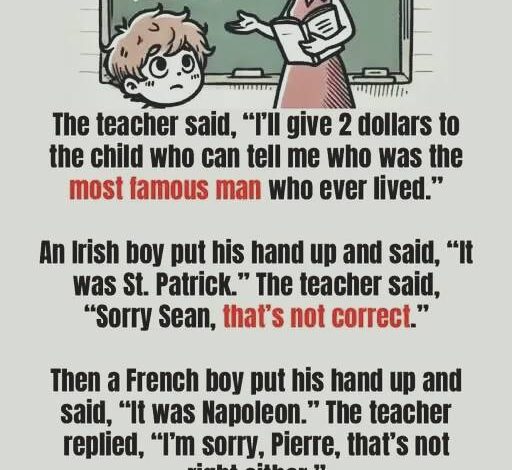
The classroom was filled with the low hum of chatter as students shuffled in their seats. The teacher, Ms. Reynolds, smiled warmly, a glint of mischief in her eyes, ready to engage her students in a unique challenge.
She clapped her hands once and said, “Alright class, today I have a special question. I’ll give two dollars to the child who can tell me who they think is the most famous man who has ever lived.”
Instantly, a young Irish boy, Sean, shot his hand up without hesitation. He was confident, his green sweater slightly askew, and he declared loudly, “It was St. Patrick, the patron saint of Ireland, of course!”
Ms. Reynolds shook her head gently, suppressing a laugh at his earnestness. “Sorry, Sean,” she said, “that’s not correct. But I admire your enthusiasm and your historical knowledge of Ireland’s traditions and saints.”
Next, a French boy named Pierre raised his hand, his beret slightly tilted. With a proud tone and an air of sophistication, he announced, “It was Napoleon Bonaparte, the Emperor who conquered much of Europe.”
The teacher sighed softly, trying not to smile too widely. “I’m sorry, Pierre,” she replied. “That’s not right either, though your answer reflects impressive knowledge of European history and leadership.”
Finally, a Jewish boy, Maurice, who had been quietly observing, raised his hand. He leaned slightly forward and said clearly, “It was Jesus Christ, the central figure in Christianity, known worldwide for his teachings.”
Ms. Reynolds’s face lit up. “Absolutely correct, Maurice!” she exclaimed. “Come on up here and get your two dollars for giving the right answer, even under surprising circumstances.”
As she handed him the money, she added teasingly, “I must admit, Maurice, I’m surprised you said Jesus Christ, given your Jewish heritage.” Maurice nodded and responded thoughtfully.
“Yeah,” he said with a small smile, “in my heart I knew it was Moses, but business is business. Two dollars is two dollars, and I couldn’t pass it up.”
The class erupted in laughter, and even Sean and Pierre couldn’t help but giggle at the clever pragmatism Maurice had shown in turning knowledge into opportunity.
Later, the teacher shared another story to illustrate human nature and perspective. She described a woman of considerable wealth, poised and confident, and a man who was poor but honest, standing before her one evening.
The man, emboldened by the evening and the woman’s kindness, asked carefully, “You are very rich, aren’t you?” She nodded with quiet composure and replied, “Yes. I am worth 1.25 million dollars, to be precise.”
He hesitated for a moment, then said softly, “I’m poor, as you can see. But I have to ask… will you marry me?” His tone was honest, without arrogance, reflecting hope and curiosity.
The woman, calm and unwavering, responded simply, “No.” Her words were gentle but firm, a mix of practicality and amusement at the man’s audacity.
He nodded with a faint smile, as though he had anticipated her answer. “I thought you’d say no,” he said quietly, his eyes reflecting both humor and resignation.
Curious, she asked, “Then why did you ask, if you expected my refusal?” The man’s expression softened, and he replied with a wry smile, “Just to see how a man feels when he loses 1.25 million dollars.”
The subtle humor and clever insight behind his words lingered in her mind, highlighting how human emotions often interact with money, expectations, and curiosity.
Later still, another tale unfolded in a bustling city’s antique district. Stanley, a man in search of a new office desk, wandered into a narrow shop filled with curiosities from decades past.
He immediately noticed a desk that seemed to gleam under the dim lighting. The wood was polished to perfection, and the brass handles gleamed, promising elegance and utility in equal measure.
The shopkeeper, a thin man with spectacles perched on his nose, explained that the desk cost $5,000. Stanley nearly laughed, thinking the price outrageous for a second-hand piece of furniture.
“That’s not just a desk,” the shopkeeper said mysteriously, “it’s a magic desk. It has a unique ability to count the money in your pockets with perfect accuracy.”
Stanley raised an eyebrow, skeptical yet intrigued. He decided to test the claim, placing his wallet on the desk. To his surprise, the numbers appeared on a small brass dial embedded in the surface.
Curiosity transformed into amazement when Stanley asked the desk to calculate his wife’s bank account. The desk went wild, numbers spinning uncontrollably, lights flashing, and the drawers rattling.
“Where did she get all that?” Stanley gasped aloud, astonished and slightly panicked as the desk’s legs slid apart and the drawers dropped open, revealing its secret compartments.
The shopkeeper chuckled softly. “Magic isn’t just about numbers, sir,” he said. “It also reflects life’s surprises, your wife’s cunning, and the unpredictability of household finances.”
Stanley could only laugh nervously, realizing the lesson the desk had unintentionally imparted about trust, curiosity, and the unexpected truths hidden in everyday life.
Returning home, Stanley recounted the story to his wife. Her laughter filled the apartment, equal parts surprise and amusement at the magical exaggeration of her savings, turning an ordinary purchase into an unforgettable memory.
The combination of humor, human observation, and unexpected surprises threaded through each of these stories, revealing the absurdity and charm of life’s ordinary and extraordinary moments.
Whether it was Maurice claiming two dollars, the poor man testing the wealthy woman, or Stanley confronting the magical desk, each tale illustrated clever wit, subtle irony, and lessons in human nature.
The students in Ms. Reynolds’s classroom continued to discuss Maurice’s choice long after the lesson, debating pragmatism, morality, and humor in everyday decision-making.
Similarly, the story of the wealthy woman and the honest man prompted conversations about risk, emotional curiosity, and the economics of personal interactions, blending ethics and humor seamlessly.
Stanley’s magical desk became a metaphor for life’s surprises: no matter how controlled or structured, unforeseen revelations often spark laughter, learning, and humility in the face of unexpected truths.
The humor and lessons from each story were further enriched by the details: the personalities, emotions, and clever timing that allowed each punchline to resonate beyond its immediate moment.
Maurice’s quick thinking, the man’s playful risk, and Stanley’s encounter with the enchanted furniture each demonstrated the complex interplay between intelligence, courage, and the willingness to engage with life’s peculiarities.
Through these anecdotes, the reader is reminded that human behavior, even in humorous contexts, reflects broader truths about ingenuity, perception, and the subtle art of navigating social expectations.
The classroom, the wealthy woman’s home, and the antique shop all served as microcosms of society, where wit, courage, and surprise illuminate everyday interactions and personal choices.
In the end, laughter and reflection coexist: we laugh at Maurice, at the poor man, at Stanley’s magical desk, but we also recognize the deeper truths about curiosity, pragmatism, and the unexpected outcomes of life.