Global Tensions Explode as Ceasefire Emerges and Greta Thunberg Fires Back at Trump in Brutal Clash
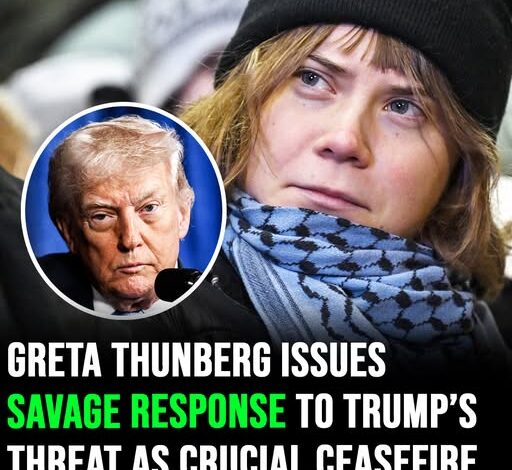
What began as a moment of cautious relief quickly shifted into a wave of outrage, tension, and sharp public reaction. A fragile ceasefire between the United States and Iran created a temporary pause in a conflict that had been escalating for weeks, but the words exchanged leading up to that pause left an impact that reached far beyond the situation itself.
At the center of it all stood a high-stakes diplomatic effort—and a response that cut straight through the noise.
After weeks of rising hostilities, both sides agreed to a two-week ceasefire. The decision followed intense behind-the-scenes discussions involving several international figures, including leaders from Pakistan who reportedly urged restraint at a critical point. One of the key conditions tied to the agreement was the full reopening of the Strait of Hormuz, a crucial route for global oil transport and economic stability.
The importance of that passage cannot be overstated. Any disruption there sends shockwaves through energy markets, trade systems, and the global economy. Reopening it safely signals not just de-escalation, but a step toward restoring balance in a region that had been moving dangerously close to deeper conflict.
According to official statements, the United States received a proposal from Iran outlining multiple conditions for a ceasefire. It was described as a workable starting point, suggesting that despite ongoing tension, there was at least a possible path forward. Some long-standing disagreements, it was claimed, had already been addressed in principle, leaving room for continued negotiations during the two-week pause.
On paper, it looked like progress.
But the atmosphere surrounding the agreement told a different story.
Just before the ceasefire was announced, remarks attributed to Donald Trump triggered widespread backlash. In setting expectations for Iran, he warned of severe consequences if conditions were not met, using language that many perceived as extreme. The intensity of those statements drew strong reactions, not only from political analysts but from the public as well.
For some, it was strategic pressure. For others, it crossed a line.
Criticism came from unexpected directions. Former supporters, commentators, and public figures who had previously aligned with his approach began openly questioning the tone and implications of those remarks. The concern extended beyond strategy—it focused on what such rhetoric represents in an already unstable situation.
Then came one of the most direct and emotionally charged responses.
Greta Thunberg, known globally for her activism and outspoken views, responded with visible frustration. In a video shared online, she reacted strongly to the statements, framing them as part of a larger and more concerning pattern.
She pointed to what she described as the normalization of extreme language surrounding conflict and destruction, questioning how such statements could be made without immediate and widespread pushback. Her response was not diplomatic—it was direct, emotional, and intentionally confrontational.
In her view, the issue extended beyond a single leader or situation. It reflected a broader failure to challenge rhetoric tied to large-scale violence. She connected it to wider concerns about human rights, environmental consequences, and the dangers of unchecked power.
Her message was clear: silence in moments like this is not neutral.
The reaction to her response was immediate. Supporters praised her for speaking out, arguing that challenging powerful voices is necessary during times of crisis. Critics, however, dismissed her comments as excessive or misplaced, questioning whether her involvement in geopolitical issues was appropriate.
Regardless of perspective, the exchange highlighted something undeniable.
The boundaries between political decision-making, public opinion, and global activism are becoming increasingly blurred.
This was not the first time Greta Thunberg and Donald Trump found themselves on opposite sides of a public conversation. Their past interactions have often reflected deeper ideological divides. This moment simply intensified that contrast, placing it within the context of an active and sensitive conflict.
Meanwhile, the ceasefire itself remains fragile.
Two weeks is not a resolution—it is a window. A pause that allows both sides to reassess, negotiate, and potentially move toward something more lasting. Whether that happens depends on factors that go far beyond public statements.
There are still unresolved issues. Deep-rooted tensions. A long history of mistrust that cannot be erased quickly.
For now, though, the immediate threat of escalation has been reduced—at least temporarily.
And that matters.
Still, the controversy surrounding the lead-up to the ceasefire continues to shape how the situation is perceived. Words carry weight, especially when spoken from positions of power. They influence not only diplomatic outcomes, but also public sentiment and international relationships.
In this case, the words spoken before the agreement may linger longer than the agreement itself.
The world is watching closely—not just to see what happens next between the United States and Iran, but to observe how leaders communicate during moments of high tension. The balance between strength and restraint is delicate, and when it shifts too far, the consequences can reach far beyond the immediate situation.
At the same time, voices like Greta Thunberg continue to challenge not only decisions, but the language behind them. Whether people agree with her or not, her response reflects a growing expectation that leaders will be held accountable not just for their actions, but for their words.
As the two-week ceasefire unfolds, attention will turn toward negotiations, conditions, and outcomes. But the echoes of this moment—the tension, the reactions, and the clash of perspectives—are unlikely to disappear anytime soon.
Because in a world already on edge, even a fragile calm can feel uncertain.