Teacher Risks Career to Save Star Student After Cruel Stepmother Sabotages Final Exam but Graduation Reveal Leaves the Whole Town in Shock
Fifteen years in a classroom teaches you to read the silent languages of your students. Maya was a girl of steady habits and quiet brilliance, but after her father passed away, that stability began to fracture. She never complained, yet one afternoon she confessed her greatest fear: “If I don’t pass, I’ll have to stay with my stepmother forever.” I didn’t realize then that Maya wasn’t just talking about grades; she was talking about her freedom.
When the day of the final exam arrived, Maya’s chair remained empty. I watched the clock with a sinking heart as ten, twenty, then sixty minutes ticked by. I knew Maya wouldn’t just miss the most important test of her life. That afternoon, I drove to her house and found her on her knees, scrubbing the kitchen floor under the watchful, cold eye of her stepmother, Jennie. Jennie didn’t hide her malice, claiming Maya had “responsibilities” that outweighed her education. It was a calculated act of sabotage designed to trap a young girl in a cycle of domestic servitude.
That night, I sat before my grading portal. Maya had been a perfect student for two years. To let one missed morning erase her future felt like a secondary crime. For the first time in my career, I broke the rules. I entered a final grade for her based on the consistent, high-quality work she had produced all year. I didn’t invent the grade; I validated the effort she had already proven.
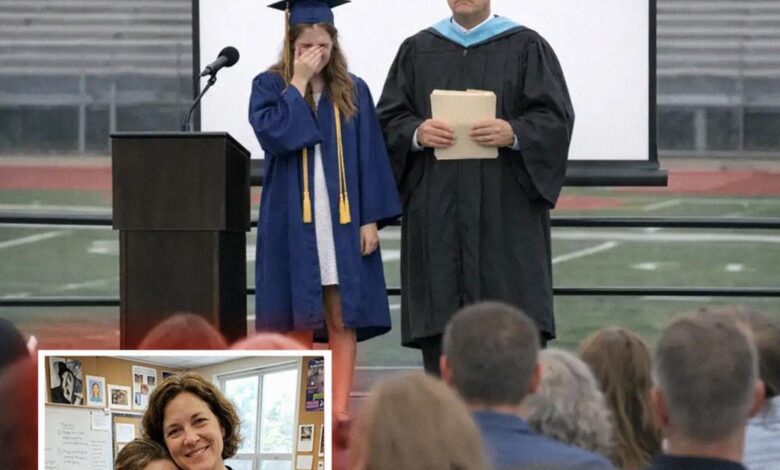
Graduation day was a blur of heat and nervous energy. Maya was there, looking pale but present, while Jennie sat in the front row with a smug, victorious expression. My heart stopped when the principal interrupted the ceremony to call me to the stage. He announced that a grading discrepancy had been discovered—an exam grade entered for a student who never walked into the hall.
The crowd went silent. My colleague, Mrs. Hayes, hissed that it wasn’t fair to the other students. I stood there, ready to lose my license, admitting that I had altered the record. Jennie leaned forward, her eyes gleaming with the anticipation of my ruin.
But the principal wasn’t done. He signaled to the tech booth, and a video began to play on the giant projector screen. It showed Maya being forced to labor at home, documented by a concerned neighbor and a wellness check the principal had performed himself. He revealed that he had visited the house after my report and witnessed the abuse firsthand.
The murmurs of the crowd turned into a roar of indignation. Police officers moved in to escort Jennie away, her grip on Maya’s life finally shattered. The principal then turned to me. He acknowledged that while I had crossed a professional boundary, I had done so to prevent a tragedy. Instead of a termination letter, he handed us a folder.
Inside was a Resilience Scholarship for Maya, a full ride to college that recognized both her academic excellence and the extraordinary circumstances she had overcome. I received a formal warning, a permanent mark on my record that I wear with pride.
A few days later, Maya’s aunt arrived to take her away to a new life. As they pulled out of the driveway, I realized that fairness isn’t always about a rigid adherence to the handbook. Sometimes, being a teacher means standing in the gap when the world tries to swallow a student whole. Maya didn’t just walk across a stage that day; she walked into a life that finally belonged to her, and my fifteen-year record was a small price to pay for her liberty.