My Grandfather Left Me Only An Envelope Until I Landed In London And Everything Changed
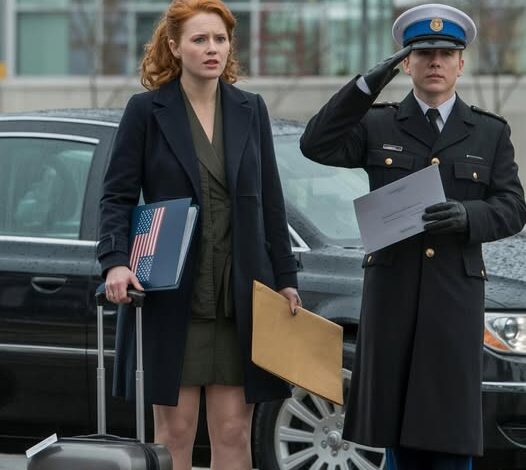
The twenty-one-gun salute had already faded across the Virginia hills when Mr. Halloway cleared his throat and spoke my name.
From the library window of the estate, I had been watching the flag ceremony. Marines moved through their ritual with controlled precision—the kind of practiced grief that serves as honor rather than expression. I remember thinking about my last conversation with my grandfather, six months earlier, in the sunroom of this same house. We had sat with coffee gone cold while he told me something I only later understood was a final lesson: that the people who do quiet work are rarely remembered by history, yet they are the ones history depends on most.
He had looked at me differently than he looked at the rest of the family—like someone who had already seen something in me that I had not yet recognized, and was waiting for me to catch up to it.
My grandfather had been a four-star general. Three decades of service had left behind records, medals, and other achievements that were never publicly displayed—things I came to understand were meant to remain unspoken. In our family, he was the center of gravity, the force everything quietly revolved around without fully understanding why.
In the wood-paneled room where his estate was read aloud, what he left me was an envelope.
My father did not hide his satisfaction. Sitting beside my mother with a calm, assured posture, he watched as Mr. Halloway confirmed that the house and financial assets were going to them. My brother Thomas leaned back, already calculating outcomes. My grandmother held the folded flag without looking at any of us.
My father said, quietly, that the envelope “didn’t mean I was loved.” It was meant as a passing remark, but it landed exactly where it was intended. A lifetime of not quite belonging in that family suddenly sharpened into something undeniable.
I held the envelope steady while everyone watched.
Inside was a single sheet of thick stationery and a plane ticket.
Evelyn, it read. You’ve served quietly, as I once did. It’s time you understand the rest. Report to London. One-way ticket enclosed. Duty does not end when the uniform is gone.
It was signed only with his initials.
The ticket was for Washington Dulles to Heathrow, departing the next morning.
Afterward, my father found me on the porch. He asked if I was really going. He said it while swirling bourbon, performing calm detachment. I told him yes. He remarked that London was expensive and I shouldn’t call when the money ran out. I told him I wouldn’t—not in the way he thought I meant it.
Then I went inside, packed my Navy file, my uniform, and the letter, and left at dawn.
At Heathrow, a driver waited with my name written in precise script. He wore royal livery. When I asked if this was connected to the Crown, he showed his credentials without speaking further.
The car was a black Bentley with a crown on the plate. As we drove through London, the city unfolded with quiet authority—the Thames, the bridges, the guards in red uniforms—everything suggesting a place accustomed to history.
The driver mentioned, carefully, that my grandfather had been known for his discretion in certain circles. He did not elaborate, and I did not press.
Sir Edmund Fairchild met me inside Buckingham Palace. He had the same composed posture as my grandfather—men shaped by long proximity to responsibility. He explained that my grandfather had once led a joint American-British Cold War operation that prevented what he described, with restrained language, as a significant catastrophe. Few knew it existed. Fewer knew its cost.
My grandfather had been offered a formal royal commendation and had declined it.
When I asked why, Sir Edmund said he had asked for it to be deferred.
On a nearby table was a sealed case bearing both flags. Inside: an envelope, a medal, and a letter in my grandfather’s handwriting.
He wrote that he had refused recognition so it might one day mean more. That I had earned what came next not through rank, but through service. He asked me to deliver the medal where it belonged.
The medal read: FOR SERVICE BEYOND BORDERS.
The Queen received me in a smaller room than expected, lit by soft afternoon light. She spoke with calm precision, saying my grandfather had spoken of me more than once. She described his service as something beyond what medals could contain.
Then she added that he had believed honor lived in quiet action rather than ceremony—and that I had continued something he had started.
I told her honestly that I wasn’t sure that was true yet.
She regarded me for a moment and then repeated something my grandfather had once told her: that a legacy is not what is inherited, but what is carried forward.
Later, I was taken to the royal archives beneath St. James’s Palace. The space felt less like a museum and more like a working system—people moving through aisles of records with purpose. Sir Edmund led me to a secured case marked with my grandfather’s name.
Inside were journals. The smell of ink and aged tobacco rose as they were opened. It felt like him in a way I wasn’t prepared for, and whatever distance I had maintained since his funeral collapsed.
The journals described operations never recorded in official histories—evacuations, intelligence work, recovery missions across Europe. In every entry, one phrase appeared again and again:
leave no one behind.
At the back was a photograph: my grandfather beside a young Queen Elizabeth, both in uniform, both smiling like people who had survived something together.
Written on the back: True allies never retire.
I stayed with the journals until the light shifted. Sir Edmund eventually told me there was one final file—OPERATION REMEMBRANCE—a long-standing relief initiative for veterans my grandfather had quietly funded for decades. A joint foundation between American and British partners.
It had been inactive since his death.
The reason for that inactivity lay in a second folder, newer, more recent.
The twenty-one-gun salute had already faded across the Virginia hills when Mr. Halloway stepped forward and called my name.
I stood at the library window of the estate, watching the ceremony below. Marines moved in perfect formation, their discipline almost distant, as if grief itself had been trained into ritual. I wasn’t really focused on them. My mind was somewhere else—six months back, in the sunroom with my grandfather, both of us sitting with untouched coffee while he spoke in that calm, steady voice of his.
He told me then that history never remembers the quiet ones, even though everything depends on them. I didn’t fully understand what he meant at the time. I thought it was just another one of his reflections. It wasn’t.
He had been a four-star general. A man shaped by wars most people only read about. On the walls of his house were medals I recognized, and others that were never explained. Even as a child, I knew he wasn’t like the rest of the family. He wasn’t orbiting anyone—others orbited him.
And when the lawyer finally opened his will, he didn’t leave me wealth or property.
He left me an envelope.
My father looked pleased before it was even opened. My mother sat beside him, composed and expectant. My brother Thomas watched like everything was a calculation. When the main inheritance went to my parents and brother, they accepted it as confirmation of what they believed was already true.
Then Mr. Halloway handed me the envelope.
My father said, almost casually, that it probably didn’t mean anything important—that it certainly didn’t mean I was “special.” He didn’t need to say it loudly. The message landed anyway.
Inside was a single sheet of stationery and a plane ticket to London.
The note was brief. My grandfather wrote that I had served quietly, just as he once had, and that now I needed to see the rest of his world. He told me to go. One way.
No discussion. No explanation beyond that.
My father mocked the idea when I told him. Said London was expensive, and that I shouldn’t expect support if things went wrong. I didn’t argue. I just left.
At Heathrow, a driver was waiting with my name written neatly on a sign. He wore formal household livery, which immediately made it clear this wasn’t ordinary transport.
The car was a black Bentley. Crown emblem on the plate.
As we drove through London, the city unfolded like something carefully preserved. Bridges, river light, uniformed guards—everything felt intentional, structured. The driver spoke only briefly, telling me my grandfather had been known in certain circles for his discretion. The way he said it told me not to ask further questions.
At Buckingham Palace, I was met by Sir Edmund Fairchild.
He explained, carefully and precisely, that my grandfather had once led a classified joint operation during the Cold War—one that had prevented a major international disaster. Almost no official record of it remained. It had never been publicly acknowledged.
He had even been offered royal recognition.
And he refused it.
Instead, he asked that any honor be deferred.
Inside a secured case was a medal, documents, and another letter in his handwriting.
The letter said he had chosen silence so that one day it might mean something greater when revealed. He believed I would understand it when the time came.
The medal read: For Service Beyond Borders.
Later, I was taken to meet the Queen.
She spoke calmly, almost formally, saying she had known of my grandfather’s service and respected his decision to remain out of public view. She told me he believed that honor wasn’t something displayed, but something carried.
I left that meeting without fully understanding what my role was meant to be. Only that I now had one.
Beneath St. James’s Palace, I was taken into the archives.
There, in a secured case bearing my grandfather’s name, were journals—years of handwritten records, missions never publicly recorded, humanitarian operations, evacuations, rebuilding efforts after conflicts that never appeared in textbooks.
He had worked quietly with allies across nations, always guided by the same principle: leave no one behind.
In the back of one journal was a photograph of him standing beside a young Queen Elizabeth. Both were smiling, not as leaders, but as people who had survived something together.
On the back he had written: True allies never retire.
Further documents revealed something even larger—a foundation he had privately funded for decades, supporting veterans and families across both nations. It had been built quietly, sustained without recognition.
And now it had been left unstable.
Because someone close to home had interfered.
The records showed that my father had been given administrative control after my grandfather’s death. Over time, funds had been redirected—through companies, investments, and personal ventures. Nothing immediately criminal in isolation, but together it formed a clear pattern of misuse.
Sir Edmund did not need to explain the moral weight of it. The documents already did.
I signed the restoration papers the next morning.
Each signature felt less like loss and more like alignment, as if something long unbalanced was finally settling into place.
When I returned to Virginia, nothing about the estate had changed—but everything felt different.
My father tried to dismiss what I had done when I told him. He called it unnecessary, dramatic. But as I explained the foundation, the history, and the missing funds, his confidence started to crack.
Not in anger.
In recognition.
That night, I went through every document again. What I saw was not abstract wrongdoing—it was years of resources meant for veterans quietly diverted into a lifestyle my family had come to treat as normal.
For the first time, everything made sense in a way that was impossible to ignore.
The next morning, I called the estate attorney.
When I arrived, I placed the full documentation on his desk. He reviewed everything carefully, then confirmed what it meant: control of the foundation needed to be restored immediately.
I signed without hesitation.
When my father found out, he was furious at first. Then defensive. Then something quieter—something like fear.
He tried to explain himself. Tried to reframe what had happened. But there was no version of events that removed the facts.
I told him plainly that what I had done wasn’t revenge.
It was correction.
Weeks later, the foundation reopened publicly in Washington.
The ceremony was attended by veterans, families, and service members. My grandfather’s portrait stood beside the stage.
When I spoke, I didn’t try to make it dramatic. I spoke about service, responsibility, and the people who do the work no one sees. I spoke about continuity—how one generation passes responsibility to another, not through wealth, but through purpose.
The room stayed silent the entire time.
Not out of formality.
Out of attention.
Afterward, my father sent a message. He said he finally understood.
I read it more than once. Not because it was unclear, but because I didn’t yet know where it belonged in me.
I didn’t reply.
Months later, spring returned to Virginia.
I drove back to the estate in uniform, not for show, but because the day required it.
My father was in the garden.
He was trimming the grass near the grave with careful hands. He looked older. Slower. Less certain in the way he carried himself.
He looked up when I arrived.
He said he wasn’t sure I would come.
I told him I wasn’t sure either.
We stood at the graveside for a long moment without speaking. It was unusual for our family—silence without tension, without performance, without anyone trying to control the meaning of it. Just presence.
My mother placed a bouquet of white roses at the base of the stone. The inscription was simple: Served Both Duty and Humanity. It didn’t try to explain him. It didn’t need to.
My father reached into his coat and pulled out a small wooden box. He said nothing at first, only that my grandfather had given it to him after his first promotion, telling him to open it only when he finally understood leadership better than he did at the time.
He had never opened it.
Now he handed it to me.
Inside was a silver chess piece—a queen.
It rested in my palm with a weight that felt less physical and more intentional, like something meant to be found at a specific point in time. Something placed carefully years in advance.
We stayed there longer than anyone required to. No one rushed it. That was the point.
When we finally turned back toward the house, my father stopped walking. For a moment he just looked at the ground, as if choosing his words carefully mattered more than speaking quickly.
Then he said he and my mother wanted to be involved in the foundation.
Not for credit. Not for appearances. Just… to contribute to something that actually mattered.
I didn’t answer immediately. I let the silence sit between us.
Then I told him there was a veterans’ housing project in Norfolk that needed a dependable construction team.
He looked up. “Do you trust me with it?”
I shook my head slightly. “I’m not trusting you with it. I’m giving you the chance to prove something different.”
He didn’t respond right away. But something in his expression shifted—not dramatic, not sudden. More like alignment. As if he was finally facing a version of himself he could work with instead of argue against.
That evening I drove toward the coast.
It was a place my grandfather used to take me fishing when I was young. Back then, I didn’t understand why he liked it so much. Now I thought I did. The water at dusk didn’t demand anything. It just existed, carrying light without explanation.
I stood at the shoreline with the chess piece still in my hand.
And I thought about how someone’s belief in you can outlive them. How it can arrive years later like a sealed instruction finally being opened at the right time.
I thought about the will reading. About my father’s expression when the envelope was opened. About the distance between who he had been in that moment and who he was now standing at the grave. That distance wasn’t simple punishment or forgiveness. It was something slower than both—reckoning, maybe. Or the beginning of one.
Not everything was repaired. Not everything was settled.
But something had shifted into the possibility of repair.
The foundation’s headquarters in Washington was modest by design. Nothing about it asked for attention. Inside, people worked steadily—calls to families, housing applications, logistics for veterans in transition. It functioned like something that had always needed to exist.
On one wall were two flags. Beneath them, a single engraved line from my grandfather:
Service is not what we do for recognition. It is what we do when no one is watching.
He had lived by that for most of his life. Quietly. Consistently. Without audience.
And now others were continuing it.
Later that night I left my notes for the morning staff and drove back through Virginia.
The road passed fields that disappeared into darkness, familiar landmarks sliding by without needing attention anymore. Even the turnoff to the estate felt less like a pull and more like a memory passing at the edge of vision.
Above me, the stars stayed fixed. Unbothered. Unchanged. The same ones my grandfather had once used to navigate by, because they didn’t adjust themselves for whoever was looking.
That had always been the point.
I rolled the window down and let the cold air fill the car.
And I kept driving—toward the city, toward the work, toward whatever came next.