I Hated My Biker Father… Until I Learned the Truth After He Died
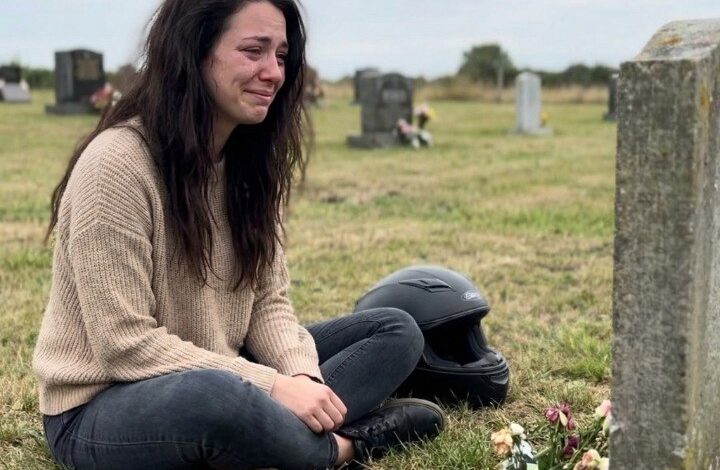
I spent most of my life believing my father chose his motorcycle over me.
That belief didn’t come from nowhere—it was built slowly, year after year.
Missed birthdays. Empty seats at school events. Silence where he should’ve been.
To a child, absence doesn’t need explanation. It becomes the truth.
And for me, that truth was simple: I wasn’t important enough.
My father wasn’t a casual rider.
Riding wasn’t a hobby—it was his entire life.
He had an old 1994 Harley Softail that he treated like it mattered more than anything.
At least, that’s how it looked through the eyes of a kid waiting by the door.
A kid who kept hoping, and kept being disappointed.
One of my earliest memories is standing at the front door in pajamas.
I must have been four years old.
I remember watching his red taillight disappear into the night.
It got smaller and smaller until it vanished completely.
That’s what my childhood felt like—watching him disappear.
My mom always tried to soften things.
“Daddy will be back soon,” she’d say.
But “soon” could mean days… sometimes longer.
And every time I waited, I learned something new about disappointment.
It doesn’t arrive loudly—it settles quietly and stays.
He missed my fifth birthday.
Then my eighth.
Then my tenth.
Eventually, I stopped counting the ones he missed.
Because it was easier than hoping he’d finally show up.
By the time I was thirteen, I stopped expecting anything.
At sixteen, I stopped caring—or at least, I told myself I did.
And at eighteen, I left.
I moved across the state without giving him my new address.
I wanted distance. I wanted freedom from that feeling.
He still called sometimes.
I would watch the phone ring until it stopped.
Then I’d listen to the voicemail.
“I love you.”
“I’m sorry.”
“One day you’ll understand.”
But I didn’t want to understand.
Understanding felt like forgiving.
And forgiving felt like letting him off the hook.
I didn’t want explanations.
I wanted the father I never had.
For eight years, we barely spoke.
Our relationship existed only in missed calls and ignored messages.
I built a life without him in it.
And over time, anger turned into something colder.
Something quieter. Something permanent.
Then one day, my mom called.
Her voice sounded different.
“He’s sick,” she said. “It’s serious.”
I didn’t ask questions at first.
Part of me didn’t want to go.
But I did.
Not for him—if I’m honest.
I went for her.
Because she had always been there, always tried to hold things together.
And she needed me to be there now.
He was in a hospital bed when I saw him.
The man I remembered—strong, confident, untouchable—was gone.
In his place was someone fragile.
Someone smaller than I ever imagined him being.
It didn’t feel real.
He tried to speak to me.
“There are things you don’t know,” he said quietly.
I stood there, arms crossed, protecting myself.
“I know enough,” I replied.
And that was the end of it.
Two days later, he died.
No final conversation.
No closure.
Just silence.
The kind that doesn’t leave room for fixing anything.
After the funeral, my mom asked me to clean out his garage.
She couldn’t bring herself to do it.
I agreed, mostly because I needed something to do.
Grief is strange when it’s mixed with unresolved anger.
It doesn’t come out the way you expect.
The garage smelled like oil and dust.
Tools were scattered everywhere.
Parts of the motorcycle lay on worktables.
It looked exactly like I imagined it would.
Until I found the box.
It was hidden under his workbench.
Old, wooden, covered in dust.
Not something meant to be seen.
Not something meant for anyone but him.
Still, I pulled it out.
Inside were envelopes.
Twenty-six of them.
One for every year of my life.
Each labeled with a date.
My birthday.
My hands hesitated before opening the first one.
Something about it felt heavy.
Like I was about to cross a line I couldn’t come back from.
But curiosity pushed me forward.
And I opened it.
Inside was a receipt.
A pharmacy bill from out of state.
Attached to it was a note in his handwriting.
“Missed her first birthday. Needed medication. She’ll be okay.”
I read it again. Then again.
I opened the next envelope.
Another receipt.
Another note.
This one talked about a specialist appointment.
About traveling overnight just to secure it.
My chest tightened.
This wasn’t what I expected.
This wasn’t neglect.
This was something else entirely.
Something I had never considered.
I kept going.
Envelope after envelope.
Each one told the same story.
Each one explained a birthday he missed.
And why.
Medical bills.
Travel records.
Doctor appointments.
Treatments I didn’t even remember having.
Things he had handled alone.
Every time I thought he chose the road over me…
He was actually on the road because of me.
Because of something I never knew.
Something my parents never told me.
Something he protected me from.
I called my mom that night.
“You knew?” I asked.
She didn’t hesitate.
“Yes,” she said softly.
“He made me promise not to tell you.”
I didn’t speak for a moment.
The silence said everything.
“He wanted you to feel normal,” she continued.
“He didn’t want you growing up thinking you were fragile.”
So he carried it all alone.
“And he let me hate him?” I asked.
“Yes,” she said.
“He said he could live with that… as long as you were okay.”
That answer broke something inside me.
Because it made everything make sense.
At the bottom of the box was one last envelope.
It wasn’t dated.
It just said: “When she’s ready.”
My hands shook as I opened it.
Inside was a letter.
He explained everything.
Every mile he rode.
Every job he took.
Every sacrifice he made.
All for me.
He wrote that the hardest part wasn’t the work.
It wasn’t the exhaustion.
It wasn’t even the money.
The hardest part… was me hating him.
And not being able to explain why.
Some nights, he wrote, he would come home late.
He’d stand outside my door.
Just listening to me breathe.
Too tired to wake me, too broken to explain.
But still there.
At the very end, he told me to check the motorcycle.
I went back into the garage.
His Harley stood there, silent.
Like it was waiting.
Like it had one last secret.
Inside the saddlebag, I found a small box.
Velvet. Worn.
I opened it slowly.
And inside was a bracelet.
Twenty-six charms.
One for every year of my life.
Every birthday he missed…
He never forgot.
Not once.
I sat on the floor and cried.
Not out of anger.
Not out of confusion.
But out of realization.
The kind that comes too late.
My father didn’t choose his motorcycle over me.
He chose it for me.
Every mile he rode was for my future.
Every absence was a sacrifice.
And I never saw it.
Now I understand.
But understanding came at a cost.
A cost I can’t undo.
Because some truths arrive too late to fix anything.
They only change how you remember.