The Ultimate Roommate Reality Check Why One Mother Handed Her Disrespectful Teen An Invoice For Being A Free Person And The Viral Lesson That Every Parent Needs To See
The transition from childhood to adolescence is often marked by a series of boundary-pushing maneuvers, but for one mother, the line was crossed when her thirteen-year-old son decided that a small amount of internet fame made him exempt from the rules of the household. Most adults understand that the “real world” is a place of relentless overhead costs, where electricity, shelter, and sustenance are earned through labor and responsibility. To a child, however, these essentials can appear to be as natural and free as the air they breathe. When Heidi Johnson’s son, Aaron, began to believe his minor success as a YouTuber granted him the status of an independent adult, she decided to grant his wish in the most literal, and viral, way possible.
The conflict began with a common household friction: homework. Aaron, emboldened by the “teeny tiny bit of money” he was earning from his digital content, refused to follow his mother’s directives. In a moment of defiant bravado, he stormed out of the room, declaring that he was a “free person” because he was now a breadwinner. It was a classic teenage play for autonomy, but it was based on a fundamental misunderstanding of what freedom actually costs. Rather than engaging in a shouting match or resorting to traditional grounding, Heidi took a seat and drafted a document that would eventually be shared by millions. She didn’t treat him like a disobedient child; she treated him like a roommate who had failed to pay his share.
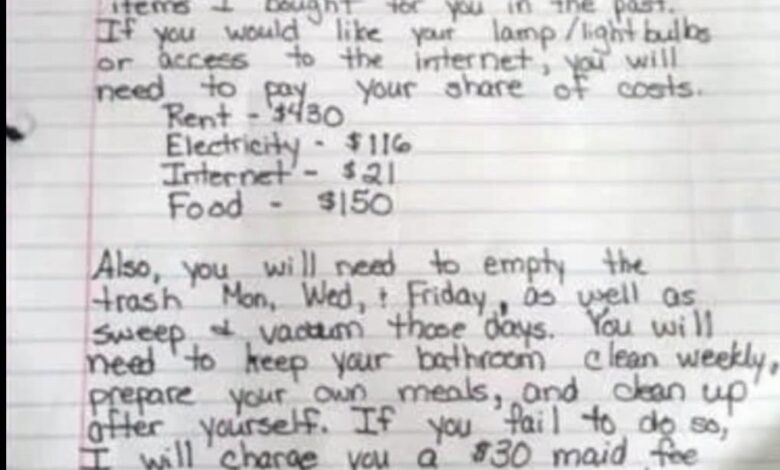
The letter, which she dubbed a “roommate contract,” was a masterpiece of tough-love pragmatism. She began by acknowledging his claim to independence and pointed out that since he was now “making money,” it would be much easier for him to buy back all the items she had provided for him over the years. The terms were stark and undeniable. If Aaron wanted access to the internet—the very tool he used to make his money—he would need to contribute to the service fee. If he wanted the luxury of lightbulbs or a lamp in his room, there was a price tag attached. She even went as far as outlining his share of the rent and utilities, as well as the requirement that he cook his own meals and maintain the cleanliness of the shared living spaces.
The brilliance of the approach lay in its mirror effect. By taking his claim of being a “free person” at face value, she forced him to confront the staggering weight of adult responsibilities that he had previously ignored. When Aaron first saw the note taped to his door, his reaction was one of predictable teenage fury. He crumpled the paper, threw it on the floor, and left the apartment to cool down. However, the silence of the “real world” began to set in quickly. While he was out, Heidi began the process of “repossession,” removing the items from his room that he had not yet “earned” or paid for under the new agreement.
When the anger finally subsided, the realization hit Aaron with the force of a tidal wave. He returned to his mother, not with more defiance, but with a question that signaled the success of her strategy: “What can I do to start re-earning my privileges?” The experiment was never truly about the money; Heidi had no intention of actually charging a thirteen-year-old rent. It was about dismantling the illusion of a cost-free life. Aaron quickly recognized that his YouTube earnings were a drop in the bucket compared to the ocean of expenses required to run a household. He even went as far as collecting the items his mother had missed during her initial repossession and handing them over, acknowledging that he hadn’t yet met the standards to keep them.
The story, which first surfaced years ago, continues to resurface and go viral because it taps into a universal parental anxiety: the fear of raising an entitled adult who lacks an appreciation for sacrifice. Online reaction was overwhelmingly supportive, with parents praising Heidi for acting as a mentor rather than a “maid.” They saw in her letter a vital lesson in character development—the understanding that every comfort enjoyed by one person is often the result of another person’s labor.
Predictably, there were those who accused Heidi of publicly shaming her son by posting the letter on social media. She addressed these critics with the same unwavering logic she used with her son. She argued that a teenager’s developmental stage involves having one foot in adulthood while the other is still firmly planted in childhood. Her goal was to ensure that when he eventually stepped fully into the workforce or college, he wouldn’t carry an attitude of entitlement or a lack of accountability. In the real world, a superior doesn’t care if you’ll “get to it when you get to it”; results and responsibilities are the only currency that matters.
Heidi’s “roommate contract” serves as a powerful reminder that parenting isn’t always about being liked; it’s about being effective. It’s about preparing a child for the day when the safety net of home is gone and they are truly “free people” in a world that doesn’t provide lamps, lightbulbs, or food for free. By forcing Aaron to see the strings attached to his comfortable life, she didn’t just discipline him; she gave him the gift of perspective. It was a lesson in independence that he carried long after his room was returned to normal, and a blueprint for parents everywhere who are looking for a creative way to turn a moment of disrespect into a lifetime of gratitude.