Social Media Reacts as Charlie Puth’s Super Bowl Anthem Draws Criticism and Praise
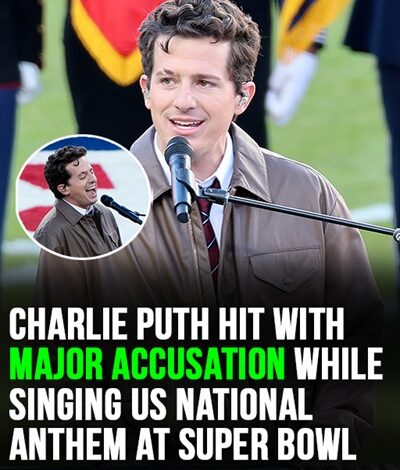
As Super Bowl LX unfolded on the evening of Sunday, February 8, 2026, at Levi’s Stadium in Santa Clara, California, the pregame festivities began with a moment that carries enormous symbolic weight:
the singing of “The Star‑Spangled Banner,” the national anthem of the United States. On one of the largest global television stages of the year, it was Charlie Puth.
The Grammy‑nominated pop star and songwriter — who was given the honor of performing it live before millions of viewers around the world.
Puth’s rendition of the anthem set the tone for a packed evening of football, music, and cultural spectacle, with the New England Patriots facing off against the Seattle Seahawks in the NFL’s championship game.
But while many praised his performance, not everyone agreed on how it should have sounded — and a lively debate quickly sprang up online about whether he truly sang live, or whether his performance was pre‑recorded or “lip‑synced” in some part.
Below is an expanded, factual, and detailed look at what happened — including the performance itself, reactions from fans and critics, the origins of the controversy, and the broader context for how national anthems are handled at major televised sporting events like the Super Bowl.
A Storied Tradition: National Anthem at the Super Bowl
The performance of “The Star‑Spangled Banner” before major sporting events has long been a tradition in the United States — and none is bigger than the Super Bowl.
Over decades, artists ranging from Whitney Houston to Billy Joel, Celine Dion, and Chris Stapleton have taken the microphone, turning the opening song into a moment that is itself almost as anticipated as the game.
For Charlie Puth — a native of Rumson, New Jersey, and a graduate of Berklee College of Music — this was a milestone opportunity.
He has built a career on pop hits like “See You Again”, “Attention”, and numerous collaborations, and performing the anthem at the Super Bowl offered a chance to bridge his mainstream pop success with a moment of patriotic pageantry few artists ever experience.
In the days leading up to the game, Puth himself spoke openly about the pressure and significance of the assignment.
On social media, he acknowledged the long history of iconic anthem performances — most famously Whitney Houston’s 1991 rendition — and said that he was both honored and humbled by the moment.
The Performance: Simplicity, Emotion, and Precision
Just before kickoff, Charlie Puth took the stage at Levi’s Stadium. Instead of arriving with a full orchestra or elaborate staging, he chose a more stripped‑down presentation:
Puth stood alone at a white minimalist platform with his electric piano, backed by a gospel choir and band, and delivered a piano‑accompanied rendition of “The Star‑Spangled Banner.”
His arrangement leaned into emotional impact. Rather than opting for dramatic flourishes or big vocal theatrics, Puth focused on clarity, control, and musicality — allowing the melody to be at the forefront as he navigated the anthem’s famously wide vocal range, from low verses to high, sustained climaxes.
The NFL itself praised the moment, highlighting both Puth’s performance and the dramatic eight‑ship military flyover that followed, which brought the crowd to its feet and added a visually stirring close to the pregame ceremony.
Within Levi’s Stadium, players, coaches, and fans reacted emotionally to the rendition. Cameras captured Seahawks and Patriots personnel placing hands over their hearts, some closing their eyes in reflection as Puth reached the high note toward the end, and others applauding immediately as the anthem concluded.
For some viewers, the performance even brought them to tears — a reaction that underscores how emotionally resonant the anthem can be, especially in the charged atmosphere of the Super Bowl.
Widespread Praise: “Flawless,” “Powerful,” and “Emotionally Moving”
Many commentators and fans reacted positively to Puth’s performance. Social media users shared praise for his ability to navigate the anthem’s challenging vocal line and for delivering a rendition that felt earnest and respectful.
One viewer on X described the song as “beautiful” and “perfectly executed,” while others complimented the musical choice to emphasize piano and vocal clarity.
Some highlighted how his approach — avoiding exaggerated vocal runs or unnecessary embellishment — gave the traditional song a fresh but reverent feel.
Comments across platforms noted that the simplicity of the arrangement allowed the melody and lyrics to shine through without distraction.
Even viewers who aren’t typically fans of Puth’s music wrote that they enjoyed his version of the anthem. For many, it was a performance that did what the anthem is supposed to do at a national event like the Super Bowl: unite listeners and set an emotional tone for the moment ahead.
The Lip‑Sync Controversy: Why Some Fans Doubted It Was Live
Despite broad praise, a notable portion of the online reaction quickly shifted toward skepticism. Soon after the broadcast, social media posts began claiming that Puth might not have sung the anthem completely live.
Some viewers wrote that his voice sounded “too perfect,” or that his mouth movements didn’t align precisely with the audio they heard — fueling speculation that his vocals may have been prerecorded.
Typical comments seen across platforms included claims like:
“Seemed like Charlie Puth was lip‑syncing the national anthem.”
“It was too perfect — not one little note was off.”
“Clearly pre‑recorded.”
On Reddit, some users echoed this sentiment, saying parts of the performance felt “too studio‑perfect” or that backing tracks might have been used to support live vocals.
Others responded that virtually all anthem performances at big events use some form of prerecorded elements to ensure broadcast quality.
Understanding Live Performance vs. Broadcast Reality
It’s important to note that national anthem performances at major sporting events — especially ones broadcast to hundreds of millions of viewers — often involve a hybrid approach to sound.
Because stadium acoustics and broadcast feeds present technical challenges, artists frequently sing alongside a prerecorded track, or their live vocals are blended with pre‑recorded elements to ensure consistent audio quality for both the in‑venue audience and the television broadcast.
This practice does not necessarily mean the artist “didn’t sing,” but rather that multiple audio layers are used to guard against sound inconsistencies.
Even some legendary past performances — including Whitney Houston’s unforgettable Super Bowl anthem in 1991 — were later confirmed to involve prerecorded backing audio as part of the production.
Because of this, it is often impossible for viewers watching at home to know definitively whether every note was live, subtitled, or enhanced — and that ambiguity feeds online debate, as seen with Puth’s performance.
Broader Online Reactions: Divided But Passionate
Reactions online spanned a broad spectrum:
Supportive Fans
Many defended Puth against the lip‑sync claims, saying:
His vocal control and phrasing matched what fans know from his live shows.
Perfection on a one‑take national anthem performance is rare, but not impossible.
Stadium audio and broadcast delay can make live singing seem mismatched with lip movement.
Some fans pointed out that criticisms of technical quality often overlook the emotional energy and difficulty of performing the anthem — one of the most technically challenging songs in the American musical canon.
Skeptical Observers
Others maintained that the performance sounded too polished — especially compared to earlier pregame acts like Brandi Carlile’s “America the Beautiful” and Coco Jones’ “Lift Every Voice and Sing,” which seemed more visibly live.
A few commenters said the lack of visible microphones for backing choir or instruments in camera shots raised questions, though this is often part of camera framing decisions in large broadcasts.
Neutral and Mixed Views
Some observers struck a middle ground — praising Puth’s technical ability while noting the performance didn’t wow them emotionally in the same way as some past Super Bowl anthems.
Commentary from media outlets described his rendition as “technically strong” but quieter or more understated than memorable historical performances.
How This Fits Into Anthem History
National anthem performances at major sporting events have a long history of stirring conversation:
Whitney Houston’s 1991 rendition at Super Bowl XXV is widely regarded as iconic.
Recent performers like Chris Stapleton, Reba McEntire, and Jon Batiste brought their own styles in previous years.
In that context, Charlie Puth’s interpretation — piano‑led, televised before millions, and followed by a dramatic military flyover — was among the most discussed performances in years.
That reaction is as much a sign of how central the anthem is to American spectacle as it is commentary on performance style and audience expectation.