Check Your Jar Now The Secret Wartime Error That Could Turn Your Penny Into A 336000 Dollar Fortune
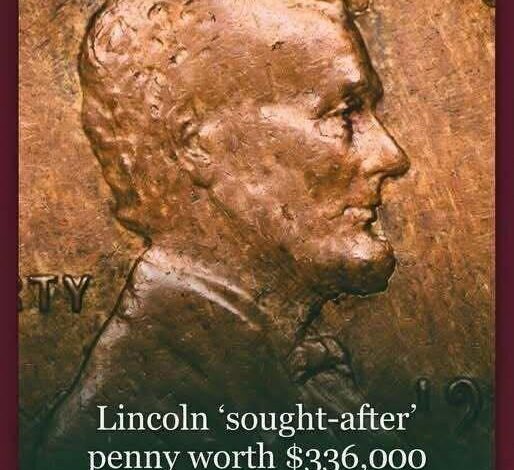
In the quiet corners of American households, tucked away in dusty glass jars, forgotten ceramic piggy banks, and the deep crevices of sofa cushions, lies a potential fortune that most people would never suspect. We handle coins every day, passing them from palm to palm in exchange for coffee or groceries, rarely giving a second glance to the copper-colored discs that weigh down our pockets. However, within the vast sea of billions of Lincoln cents, there exists a tiny group of metallic anomalies that carry a value so staggering it could pay off a mortgage or fund a child’s entire education. The 1943 Bronze Lincoln Cent is not merely a piece of currency; it is a legendary ghost of the United States Mint, a mechanical accident born from the desperate pressures of World War II that has become the ultimate “holy grail” for treasure hunters and collectors alike.
The story of this extraordinary coin begins in the early 1940s, a time when the world was engulfed in a conflict that demanded every available resource. As the United States ramped up its military production, copper became a critical strategic material, essential for the manufacturing of shell casings, communications wiring, and various equipment for the front lines. In a patriotic move to conserve this vital metal, the U.S. Mint made a historic decision to change the composition of the penny for the year 1943. Instead of the traditional 95% copper alloy, the Mint switched to zinc-coated steel planchets. These “steelies,” as they were colloquially known, were bright and silvery, often mistaken for dimes, and they remain a common curiosity in many coin collections today. But it was in the transition between the 1942 bronze production and the 1943 steel production that a monumental mistake occurred—one that would eventually create a legend.
In the feverish rush of wartime manufacturing, a few leftover bronze planchets from the previous year’s stock remained lodged in the heavy machinery of the Mint. As the massive presses began striking the new 1943 dies, these stray copper-alloy blanks were fed into the machines alongside the new steel ones. The result was a handful of coins that looked exactly like a traditional penny but bore the date 1943. At the time, no one at the Philadelphia, Denver, or San Francisco mints noticed the error. These “wrong-metal” coins were swept into canvas bags with millions of their steel brothers and shipped out into the American economy, beginning a silent journey through the hands of unsuspecting citizens.
For several years, these bronze rarities circulated unnoticed, hidden in plain sight. It wasn’t until 1947, two years after the war had ended, that reports began to surface of a “copper 1943 penny.” The news sent shockwaves through the numismatic community. Initially, the U.S. Mint was dismissive, even going so far as to deny that such coins could exist. They suggested that any 1943 copper penny was likely a fake—a steel coin that had been copper-plated by a clever trickster or a souvenir seeker. However, as the reports persisted and more sophisticated testing was applied, the truth became undeniable. Through metallurgical analysis and weight testing, experts confirmed that these were genuine mint errors. The “impossible” coin was real.
The rarity of the 1943 Bronze Lincoln Cent is difficult to overstate. Experts estimate that fewer than twenty of these coins were ever produced across all three mint branches. Because of this extreme scarcity, the coin’s value skyrocketed, transforming it from a simple penny into a high-stakes investment. While a standard steel penny from 1943 might be worth only a few cents or dollars depending on its condition, an authentic bronze version is worth a king’s ransom. In recent years, authenticated specimens have crossed the auction block for hundreds of thousands of dollars. One particularly pristine example, struck at the Denver Mint, famously sold for over $1.7 million, making it one of the most valuable coins in existence. Even those in circulated, “worn” condition routinely fetch prices in excess of $200,000 to $300,000.
This astronomical value has sparked a nationwide treasure hunt that has lasted for over eighty years. The legend of the 1943 copper penny has become a staple of American folklore, fueling the dreams of everyday people who hope to find a fortune in their pocket change. One of the most famous stories involves a teenager from Massachusetts named Don Lutes Jr., who discovered one of these bronze cents in his school lunch change in 1947. Despite the Mint’s initial denials, Lutes held onto the coin for decades. It wasn’t until after his passing that the coin was sold at auction for over $200,000, a life-changing sum for his estate and a testament to the fact that these treasures really were out there, waiting to be found by anyone lucky enough to look closely.
How does one know if they have stumbled upon this hidden fortune? The first and most important test is surprisingly simple: a magnet. Because the standard 1943 pennies are made of steel, they are strongly attracted to magnets. If you find a 1943 penny that sticks to a magnet, it is a common steel coin. However, if you have a 1943 penny that looks like copper and does not stick to a magnet, you may be holding a legendary treasure. The second test is weight. A genuine bronze cent weighs approximately 3.11 grams, while the steel versions weigh about 2.7 grams. Of course, due to the high value, many fakes exist—mostly steel coins that have been plated or 1948 cents where the “8” has been shaved down to look like a “3.” Professional authentication is always required to confirm a find of this magnitude.
The 1943 Bronze Lincoln Cent represents more than just a financial windfall; it is a physical artifact of a pivotal moment in global history. It serves as a reminder of a time when every scrap of metal was diverted to the war effort and even the humble penny had to be reinvented to serve the nation. The accidental creation of these coins captures the human element of industrial production—the small, overlooked mistakes that can happen in the midst of grand historical events. To hold one of these coins is to hold a mistake that turned into a masterpiece.
As we move further into a digital age where physical currency is used less frequently, the opportunity to find such a rarity in circulation is slowly dwindling. Yet, many of these coins may still be sitting in the back of a drawer or at the bottom of a container of loose change, waiting for someone with a keen eye and a simple magnet to discover them. The story of the 1943 bronze cent continues to captivate because it suggests that extraordinary wealth is not always reserved for the elite or the lucky few who win the lottery. Sometimes, it is right there in your pocket, disguised as a common cent, a quiet reminder that history and fortune are often hidden in the most ordinary of places. So, before you spend your next handful of change or dump your coin jar into an automated sorting machine, take a moment to look at the dates. You might just find that a simple mistake from eighty years ago is your ticket to a small fortune.