I ORDERED PIZZA FOR DINNER BUT WHEN I OPENED THE BOX I NEARLY CALLED THE POLICE
The sun had dipped below the horizon, leaving the kitchen bathed in the cool, artificial glow of the overhead fluorescent light. It was one of those long, draining Tuesdays where the idea of standing over a stove felt like a Herculean task. My hunger wasn’t just a physical sensation; it was an irritable presence, a hollow ache that demanded immediate satisfaction. Like millions of others across the country, I sought refuge in the digital glow of a delivery app. I scrolled through the local options until I landed on a parlor I hadn’t tried before. The photos looked artisanal, the reviews were glowing, and the promise of a thirty-minute arrival time felt like a lifeline. I clicked “Order,” tracked the little car icon on my screen with the intensity of a hawk, and waited.
When the doorbell finally rang, the smell hit me through the wood of the door—yeasty, salty, and warm. I tipped the driver, retreated to my kitchen island, and prepared for that sacred moment of the first slice. But the moment I flipped the cardboard lid open, the steam didn’t just carry the scent of oregano; it carried a sudden, jarring wave of confusion.
I didn’t reach for a slice. I didn’t even breathe. I just stared.
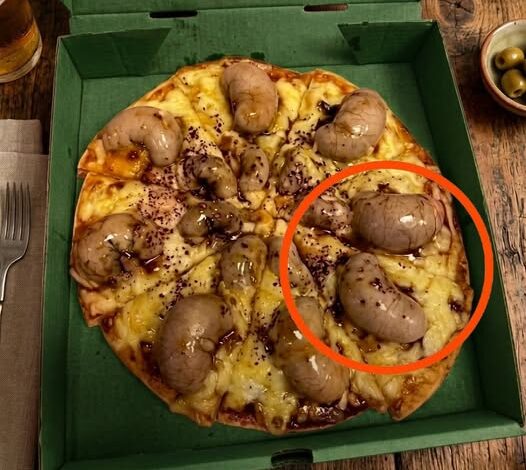
My appetite, which had been screaming for attention only moments ago, suddenly engaged in a violent wrestling match with pure, unadulterated suspicion. Sitting in the center of the pie were several large, glistening “blisters.” They weren’t the charred, brown bubbles of dough you usually find on a well-fired crust. No, these looked like something else entirely. They looked like strange, translucent organs trapped beneath a layer of molten mozzarella. They were smooth, inflated, and caught the kitchen light in a way that made them seem biological, almost pulsing.
I leaned in closer, my face inches from the heat. In my mind, the list of possibilities grew darker by the second. Had some mystery ingredient fallen into the vat? Was this a botched recipe involving some chemical leavening agent that had gone rogue? My mind even drifted toward the unthinkable—contamination. We live in an era of hyper-awareness regarding food safety, and in that moment, the artisanal pizza looked less like a meal and more like a laboratory experiment gone wrong. The more I examined the glossy domes, the more I felt that specific, prickling mix of fascination and dread you get when something looks almost familiar, but not quite safe. It was the uncanny valley of fast food.
I stood there for a long time, the silence of the kitchen magnifying the absurdity of the situation. Part of me wanted to toss the entire box into the trash and settle for a bowl of cereal. Another part of me wanted to call the restaurant and demand an explanation for the biological anomalies sitting on my dinner. But there was a third part—the curious part—that refused to let it go. I needed to know what I was looking at.
I grabbed my phone, my fingers still trembling slightly, and began a deep dive into the digital abyss of the internet. I started searching for “pizza bubbles,” “cheese blisters,” and “inflated pizza toppings.” I navigated through dozens of forums, comparing high-resolution photos of other people’s dinner disasters. I read through heated debates on Reddit where amateur chefs argued over the moisture content of low-moisture versus fresh mozzarella. I looked at macro shots of industrial ovens and read about the science of thermal expansion.
Slowly, the frantic beating of my heart began to steady. I found a thread from a professional pizzaiolo who explained the phenomenon in exhaustive detail. That’s when the truth finally dawned on me.
Those weird, intimidating domes were nothing more than a perfect storm of physics and fats. It turned out that when a pizza is cooked at an extremely high temperature, pockets of moisture or air can become trapped between the dough and the cheese, or even within the layers of the cheese itself. As the heat intensifies, the water turns to steam, inflating the cheese like a balloon. Because of the specific fat content and the way the proteins in the mozzarella align, these bubbles can sometimes remain smooth and translucent rather than browning and popping.
They weren’t “organs.” They weren’t “contamination.” They were simply pockets of hot air and butterfat, a harmless quirk of a high-heat stone oven.
I looked back down at the pizza. The “blisters” didn’t look like medical anomalies anymore. They looked like what they were: evidence of a very hot, very efficient oven. The suspicion that had been curdling in my stomach evaporated, replaced by a sudden, sharp return of my original hunger. I realized how easy it is for the human brain to transform the unknown into something sinister. We are hardwired to spot patterns and anomalies, a survival instinct left over from a time when a strange-looking berry could be the end of you. But in the modern world, that instinct often just ruins a perfectly good meal.
I let out a short, sharp laugh that echoed in the quiet kitchen. I felt ridiculous. I had spent fifteen minutes researching the molecular biology of cheese when I could have been eating. I reached out, grabbed a slice that was still remarkably warm, and didn’t hesitate. I took a huge, defiant bite.
The crust was crisp, the sauce was tangy with a hint of garlic, and the “blister” popped with a satisfying burst of salty, melted cheese. It was, without a doubt, one of the best pizzas I had ever tasted. As I sat there in the glow of my kitchen light, finishing the first slice and reaching for a second, I realized there was a lesson in the cardboard box. Sometimes, the scariest-looking things in our lives—the things that make us pause and retreat in fear—turn out to be perfectly, beautifully normal once we bother to understand them. Suspicion is a heavy weight to carry, but the truth is usually much lighter, and occasionally, it’s even delicious. I finished the pie, closed the lid, and went to bed, no longer afraid of the anomalies in the dark.