The Miracle Backpack Why This Fourteen Year Olds Secret Savings Triggered An Urgent Police Summons
I used to believe the most terrifying phone call a person could receive was the one that told me my husband wouldn’t be coming home. Eight years ago, that call shattered my world and left me to raise our son, Grayson, in the quiet shadows of grief. I thought I had already faced the worst life could throw at me. I was wrong. The second call came at exactly 7:43 a.m. on a Tuesday morning. It was from the local police station. In that breathless moment, as I stared at the caller ID, I was certain my life was about to collapse for the second time.
To understand that morning, you have to understand the life we’ve built in the wake of tragedy. For nearly a decade, it has been just me, my son, and my father, living in a small, weathered rental on the edge of town. I spend my days—and many of my nights—at a local diner. I am a woman defined by the weight of a coffee pot and the math of crumpled tips. My father, a man of few words and immense dignity, keeps our home running, often pretending not to notice when I fall asleep at the kitchen table still wearing my apron. We didn’t have much, but we had a rhythm. And as anyone who has struggled knows, rhythm is the only thing that keeps a family standing when the floor feels like it’s made of glass.
Grayson, now fourteen, grew up in that silence. He is a boy who observes rather than participates. He notices the slight limp in my step after a double shift and moves the laundry basket so I don’t have to. He notices when his grandfather’s breath hitches during yard work and quietly takes the mower from his hands. He has a tender heart, the kind that makes a mother swell with pride even as she worries that the world will eventually find a way to bruise it.
A few months ago, I noticed Grayson was acting differently. He started refusing the $2 I gave him for an after-school snack. “I’m not hungry, Mom,” he would say, his eyes averted. A mother knows the difference between a child who is full and a child who is making a sacrifice. He became obsessed with change—pennies, nickels, and wrinkled singles began disappearing into a rusted cookie tin hidden beneath his bed. When I asked him what he was saving for, his answer was cryptic: “Something I need to do.”
My father eventually filled in the blanks. Grayson hadn’t just been saving his snack money; he’d been taking on every odd job in the neighborhood. He mowed lawns before school and walked the neighbor’s restless terrier after his homework was done. He was a boy on a mission, fueled by a purpose he wasn’t yet ready to share.
Finally, one evening after dinner, I sat him down. “Grayson, talk to me. What is all of this for?”
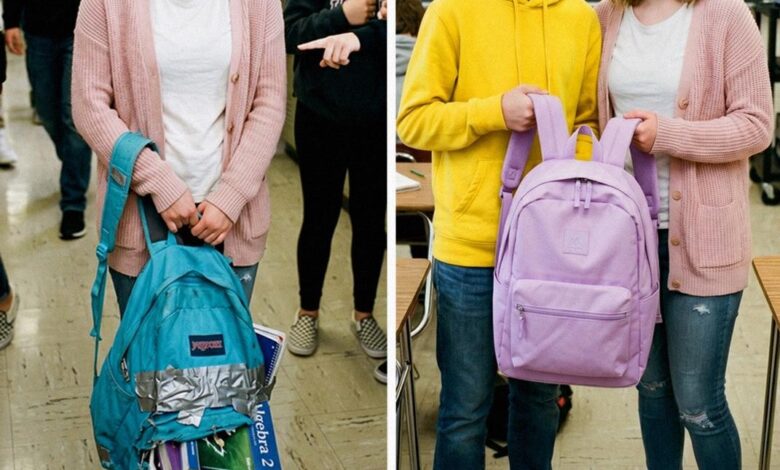
He hesitated, his hands folded tightly on the table. Then, he told me about Tessa. She was a girl in his class whose life had been incinerated in a house fire months earlier. She had lost everything—her clothes, her books, her sense of safety. She and her mother were living in a crowded room at an aunt’s house. Tessa still showed up to school every day, maintaining her grades and her dignity, but she carried the scars of the fire in the form of a melted, half-burned backpack held together by layers of duct tape.
“The tape gave out in the hall yesterday,” Grayson whispered, his voice thick with a fourteen-year-old’s specific brand of empathy. “Her books went everywhere. Some kids laughed. She just knelt down and picked them up like it was nothing, but I saw her face, Mom.”
I offered to buy the backpack myself, but Grayson was adamant. “No. I want to do it. I have to do it.”
I realized then that my son wasn’t just buying a bag; he was reclaiming a piece of someone else’s humanity. He had watched me survive for eight years, and in that time, he had learned that the only antidote to a hard life is a soft heart. We went to the department store together, where he meticulously checked every zipper and seam of a sturdy, deep-blue backpack. At the register, he counted out his hard-earned bills with a solemnity that made the cashier’s eyes mist over.
The next day, he left the backpack on Tessa’s desk before anyone arrived. He didn’t sign a card. He didn’t want the credit. “Kindness is what matters, Mom,” he told me that evening. “Not who did it.”
I went to sleep that night feeling a profound sense of peace. I felt I had successfully navigated the treacherous waters of single motherhood. But that peace was shattered the next morning by the ringing of the phone.
“Ma’am, this is Officer Hale. We need you to bring your son down to the station immediately.”
The drive to the station was a blur of panic and silent prayers. I looked at Grayson, whose face was pale and hair still damp from his morning shower. “Did something happen at school?” I asked, my voice trembling. “Did you get into a fight? Did you take something?”
“No, Mom. I swear,” he replied, his voice small and terrified.
When we walked into the station, my heart was hammering against my ribs. A tall officer approached us, but before I could beg for an explanation, he held up a hand. “Ma’am, take a breath. Your son isn’t here because of a crime. He’s here because of what he started.”
The door to a side room opened, and out stepped Tessa and her mother. Tessa was clutching the new blue backpack as if it were a life raft. Behind them was Mrs. Hale, one of the middle school teachers and the officer’s wife. She had been the one who saw Grayson leave the gift. She had told her husband, and the husband had told the station, and the story had rippled through our small, interconnected community like a tidal wave.
What happened next was a blur of tears and cardboard boxes. The local police, the school principal, and several local business owners had spent the last twenty-four hours organizing a response to Grayson’s “anonymous” act. They hadn’t just brought us there to say thank you; they had brought us there to show us that kindness is a mirror.
Because of Grayson’s sacrifice, a local fund had been established. Tessa’s family was being moved into a furnished apartment, and their utility bills were covered for a year. But the community hadn’t stopped there. Recognizing the struggle of a single mother working double shifts at a diner, they had organized a grocery gift card program and a scholarship fund for Grayson’s future. There were bins of school supplies, new clothes, and even art materials for Tessa.
“I didn’t mean for all this,” Grayson stammered as the room erupted into soft, genuine applause.
I held my son’s hand, feeling the calluses from the lawnmower and the strength of his character. I realized then that the “scary” phone call wasn’t a harbinger of doom, but a summons to witness a miracle. My son had spent his pocket money to buy a classmate a backpack, and in doing so, he had accidentally reminded an entire town how to take care of its own.
That evening, as we sat around our own dinner table, the air felt different. The house didn’t feel like a place where we were merely surviving; it felt like a home. Grayson received a text from Tessa that simply said, “Thank you for making me feel normal again.” My father finally stopped pretending the pepper was making his eyes water and let the tears fall. We had been through the fire, and we had come out the other side—not just standing, but whole.