The Mystery in the Master Bedroom Sheets!
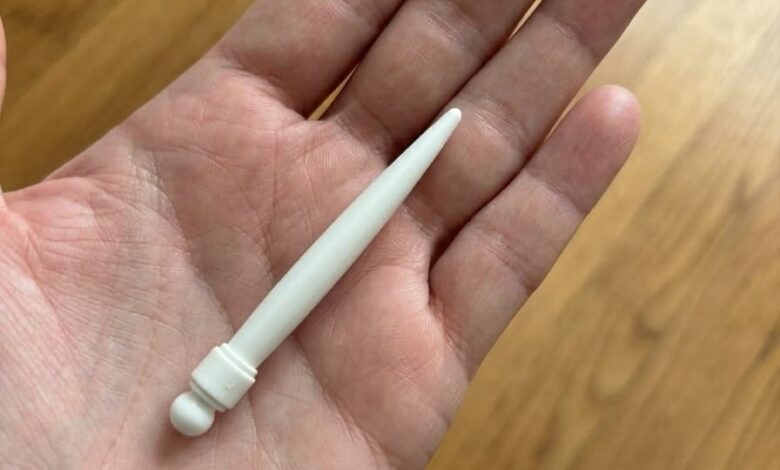
My wife stood by the edge of the mattress, her hand hovering over the rumpled linens with a hesitation that bordered on genuine fear. Between the cotton folds lay an object so utterly alien to our domestic environment that it felt like a breach of reality itself. It was small, plastic, and curiously shaped, possessing a clinical, utilitarian aesthetic that didn’t belong in a room dedicated to rest and intimacy. We stared at it for a long time, the silence of the house magnifying the rustle of the fabric as she finally reached down to retrieve it. It felt heavier than it looked, a dense piece of translucent gray polymer that defied immediate categorization. In that moment, our bedroom—a sanctuary of known quantities—felt compromised by a riddle we couldn’t solve.
We began the process of elimination, a frantic mental inventory of everything we owned. We turned the object over in our hands, passing it back and forth like a piece of evidence at a crime scene. I checked the back of our television, thinking perhaps a component had shaken loose from the mounting bracket, but the plastics didn’t match. My wife held it up against her jewelry boxes and the hardware on our dresser, but the industrial texture of the item clashed with the polished wood and brass of our furniture. It didn’t belong to the kitchen gadgets, it wasn’t a piece of a child’s toy, and it certainly wasn’t a part of any medical device we recognized. The more we looked at it, the more the object seemed to grow in significance. It was an intrusive thought made manifest, a physical glitch in the matrix of our daily lives.
As the minutes ticked by, the atmosphere in the room shifted. What started as a curious observation began to ferment into a mild, irrational panic. Our brains, wired by millennia of evolutionary survival instincts, began to skip over the mundane and sprint toward the theatrical. Was it a piece of surveillance equipment? A specialized tool used by someone who shouldn’t have been in our house? We found ourselves looking at the windows, checking the locks, and wondering if the privacy of our home had been violated in some dark, cinematic fashion. We had effectively built a high-stakes thriller in our heads, casting ourselves as the unwitting protagonists in a story of intrigue and danger, all because of a three-inch piece of molded plastic.
Then, the fog of imagination began to lift as a specific timeline finally clicked into place. We stopped looking at the object as an omen and started looking at it as a physical remnant of the recent past. Just three days earlier, our home had been a construction zone. We had hired a team of painters to refresh the master suite, a job that required them to move the heavy oak bed frame away from the wall, pry off the aged baseboards, and meticulously seal the cracks that had formed in the settling plaster. The room had been filled with ladders, drop cloths, and the sharp, chemical scent of fresh pigment and industrial adhesives.
Suddenly, the “alien” artifact felt a little less threatening. The industrial gray color, the tapered end, and the threaded interior base all began to speak a different language—the language of the hardware store. I opened a browser and began a reverse image search, my fingers flying across the keys as I sought to reconcile my fear with the truth. Within seconds, the screen populated with dozens of identical images. It wasn’t a bugging device, a fragment of a weapon, or a piece of a secret machine. It was a simple, disposable cartridge nozzle.
These nozzles are the unsung heroes of home renovation, designed to be screwed onto the end of a pressurized tube of silicone or acrylic sealant. The painters had likely been using one to create a seamless bead along the top of the new baseboards. In the chaos of the job, as they shifted the heavy furniture and navigated the tight corners of the room, one of these nozzles must have detached and fallen onto the mattress, perhaps hidden under a tossed duvet or trapped within the folds of the fitted sheet. When they pushed the bed back into place and cleared their gear, the little plastic tip remained behind, a stowaway in our sanctuary, waiting to be discovered days later during a routine linen change.
The realization hit us like a physical wave, and the tension that had tightened our chests for the last twenty minutes dissolved into a fit of embarrassed, cathartic laughter. We were two grown adults standing in our pajamas, terrified of a piece of plastic that cost less than a nickel. We had managed to project a narrative of invasion and mystery onto a piece of garbage left behind by a hardworking contractor. It was a humbling moment, a reminder of how quickly the human mind can abandon logic when faced with a gap in information. We prefer a scary story to a boring one because a story implies meaning, whereas a forgotten tool is just a mistake.
As I tossed the nozzle into the wastebasket, I felt a strange sense of relief that went beyond the absence of danger. There was a profound comfort in the ordinariness of the truth. We live in a world that often feels chaotic and unpredictable, where we are bombarded with news of data breaches, surveillance, and complex threats. In that environment, it is easy to become hyper-vigilant, to see a shadow and assume it’s a ghost. But that afternoon, the ghost was just a caulk tip.
This experience left us with a quiet, lingering lesson about the way we perceive the world. Our brains are designed to fill in the blanks, to connect dots that aren’t necessarily related, and to prioritize drama over the mundane. We are the architects of our own anxieties, building elaborate structures of “what if” on foundations of nothing. Yet, reality is often far more pedestrian—and oddly beautiful in its simplicity. The world isn’t always out to get us; sometimes, it just leaves its tools behind. We climbed back into bed that night, the sheets fresh and the room quiet, finally able to sleep soundly knowing that the only thing haunting our home was the remnants of a job well done.