HIS HEAD SUDDENLY DROPPED AND HE COULD NOT LIFT IT BACK UP THE TERRIFYING TRUTH ABOUT THE SMARTPHONE SYNDROME RUINING YOUNG LIVES
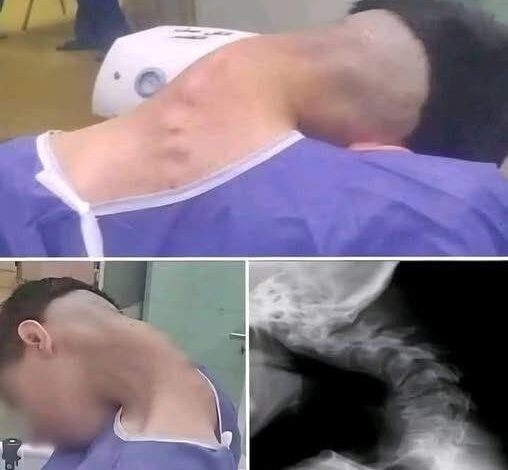
The frenzied energy that had brought the family to the hospital room in Isfahan only hours earlier contrasted sharply with the peaceful hum of the ward. A twenty-three-year-old guy sat in a condition of bodily suspension that defied gravity and reason in a room filled with the low drone of medical monitors and the sterile smell of antiseptic. He was young, robust, and in the prime of his life, but his physical form was eerie, resembling an old statue that was crumbling under its own weight. His eyes were fixed on the ground, his chin pressed hard against his chest. He was unable to raise his head to meet his doctors’ eyes, no matter how hard he tried or how tightly his jaw tightened.
This young guy had come to represent Dropped Head Syndrome, or DHS, a frightening and uncommon neuromuscular condition. He had been experiencing a persistent weariness at the back of his neck for weeks, which he had written off as a normal side effect of living in the contemporary world. He spent hours crouched over textbooks and glowing displays, just like millions of people his age, believing that the stiffness was merely a temporary penalty paid for his digital habits. However, the body has a breaking point, and for him, it came with an abruptness that altered everything. The muscles that had supported his world for more than twenty years gave out one morning. The pressure that had been building for years caused the unseen wires that regulated his position to shatter, and the massive globe of his skull fell forward.
The symptoms of Dropped Head Syndrome include severe weakening in the neck’s extensor muscles. These deep tissues are the unsung heroes of our anatomy, working nonstop against gravity to maintain our alignment with the horizon. Ptosis of the head is the medical term for the condition when the head droops forward into a fixed position due to the failure of these muscles. It is a condition that is both physically and psychologically crippling. Imagine living in a world where you are unable to see your loved ones’ faces, where breathing becomes a difficult task due to your body’s weight compressing your airway, and where walking becomes a dangerous risk due to your inability to see the path ahead.
DHS has long been seen to be a sign of a serious neurological breakdown. It is most frequently linked to serious systemic illnesses like Myasthenia Gravis and Amyotrophic Lateral Sclerosis. The lowered head in these situations is a sign of a far more extensive battle going on inside the neurological system. However, because it raises the possibility of a more subtle genesis, this latest occurrence in Isfahan has shocked the medical community. A diagnosis of a progressing fatal illness was anticipated by the young man’s team of specialists upon his admission. They conducted a series of tests, including electromyography sessions that tracked his muscles’ electrical impulses and high-resolution MRIs.
The outcomes were puzzling. There were no symptoms of the usual neurological culprits that typically induce such a collapse, no damage from an accident, and no spinal cord injuries. Rather, the doctors discovered a fixed curvature of the spine that had cemented without any obvious external source. The hypothesis that surfaced should serve as a cautionary tale for a whole generation: chronic bad posture and protracted, severe physical strain were probably the causes of the condition. The muscles had been forced into a degenerative state beyond the point of exhaustion. The physical exhaustion was so severe that the tissue was starting to deteriorate.
Subtle, whispered messages from a body under siege had been the early warning signs for this young guy. He began with a slow tilt, a small forward lean that he made up for by shifting his shoulders. The neck tiredness followed, a dull aching that seemed to go away after a little sleep. Like a lot of today’s young adults, he wrote off these warning signs as the inevitable “text neck” or “tech neck” that has gained popularity in contemporary culture. Our society has evolved into one that views musculoskeletal health as an afterthought, believing that our bodies are eternally flexible and able to withstand prolonged periods of motionless, hunched posture. Unaware that we are gradually changing our basic foundations, we ignore the burning sensation between our shoulder blades and the pressure in our upper spines.
The diagnosis was only the start of an arduous journey for the young guy in Iran. After the testing verified that there was no underlying neurological condition, attention turned to the enormous undertaking of rehabilitation. DHS treatment is a complex battle. It entails rigorous physical therapy intended to strengthen the neck’s core and awaken dormant muscle fibers. It has postural exercises that are similar to relearning how to walk. As the body fights against the altered, warped geometry of the spine, pain management frequently becomes a daily requirement. Complex surgery to join the vertebrae in an upright position—a permanent and invasive solution to a problem that starts with simple habits—is the only chance for a restoration to a normal life in the most severe cases.
It is impossible to exaggerate the significance of this case. It is a sobering reminder that our physical well-being is not a fixed bank account that we can use without making any deposits. Our ability to move and engage with the outside world depends on our spinal health. When held upright, the human head weighs about ten to twelve pounds; nevertheless, the weight on the cervical spine increases exponentially when the neck bends forward and downward. The tension on the neck increases to sixty pounds at a sixty-degree angle, which is the usual angle of someone staring at a smartphone. This is more than just “bad posture” after years of daily repetition; it’s a mechanical attack on the body.
Although preventive measures appear straightforward, we are finding it more and more challenging to stick to them. The importance of ergonomic awareness is emphasized by the medical team working on the Isfahan case. This entails keeping electronics at eye level, purchasing chairs that accommodate the spine’s natural bend, and—perhaps most importantly—taking regular pauses. The modern computer environment demands frozen, slumped positions, whereas the body was designed for movement. Seeking prompt medical attention for chronic neck discomfort is not only about comfort but also about averting a catastrophic breakdown of the muscles that allow us to interact with our environment.
The young man’s story continues to be a potent illustration of the frailty of our physical forms as he continues to heal. It draws attention to an uncommon ailment that is frequently misdiagnosed or confused with minor orthopedic problems until it is too late for easy solutions. A striking metaphor for a civilization that is growing more and more cut off from its own physical reality is the picture of a twenty-three-year-old who is unable to raise his head. We may prevent the cries of a failing system tomorrow by listening to the murmurs of our bodies today. The simple, deliberate act of looking up and regaining the posture we were meant to maintain is the first step on the route to wellness.