Blood Stained Tuxedos and the Fall of the Elite The Unthinkable Truth Behind the Correspondent Dinner Massacre
The chandeliers of the Washington Hilton ballroom usually reflect the glimmer of champagne flutes and the polished grins of the nation’s most powerful figures. But on the evening of April 26, 2026, those same crystals acted as silent witnesses to a shattering of the American psyche. It began not with a toast, but with a rhythmic, mechanical thud that sliced through the laughter of three thousand guests. The White House Correspondents’ Dinner, an event long criticized as a self-congratulatory “nerd prom” for the political and media elite, transformed in a heartbeat from a gala into a slaughterhouse.
The atmosphere prior to the first shot had been unusually tense. Outside, protesters had lined the streets, their voices muffled by the thick walls of the hotel. Inside, the President sat flanked by Hollywood royalty and the titans of cable news, unaware that the security perimeter had already been breached. When the first volley of gunfire erupted, the ballroom didn’t immediately react with terror; it reacted with confusion. Many guests later reported thinking it was a pyrotechnic stunt or a botched sound effect for a comedian’s opening monologue. That illusion evaporated when a prominent news anchor’s wine glass exploded, showering a nearby Senator in crimson liquid that wasn’t Merlot.
The chaos that followed was a visceral descent into primal survival. Cameras that had been livestreaming the event to millions of homes worldwide froze on frames of pure hysteria. The President was not merely escorted but physically tackled by a swarm of Secret Service agents, dragged from the dais with such force that his podium was upended, spilling notes and water pitchers across the stage. A low, haunting chant of “God Bless America” began to rise from a corner of the room, an eerie counterpoint to the high-pitched screams of socialites and staffers diving beneath tables draped in white linen.
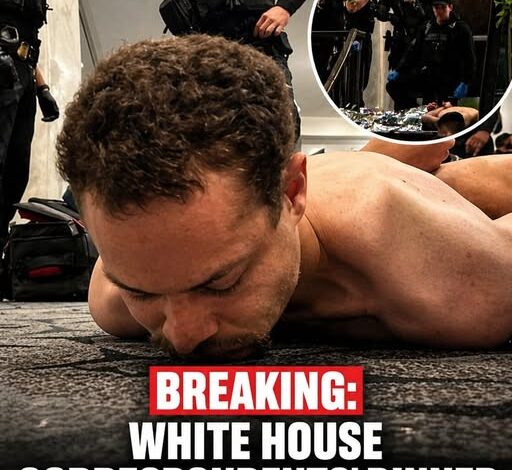
Security forces converged on a single point near the rear of the ballroom. The air was thick with the acrid scent of gunpowder and the metallic tang of blood. Within minutes, the threat was neutralized. The alleged shooter was tackled and pinned to the plush, patterned carpet. In a surreal tableau that would soon dominate every screen on the planet, the assailant was found to be shirtless, his torso covered in a chaotic map of symbols and scars. Surrounding him was an arsenal that seemed better suited for a battlefield than a banquet hall: multiple semi-automatic handguns, tactical knives with serrated edges, and several high-capacity magazines.
As the smoke cleared, the identity of the shooter began to ripple through the frantic crowd. John Revokee, a name that had previously existed only in the dark, dusty corners of radicalized internet forums, was now the most infamous man in the world. He lay face down, silent and defiant, as federal agents stripped him of his remaining gear. The investigation into Revokee’s background revealed a disturbing trajectory of a man who felt the modern world had left him behind. His digital footprint was a breadcrumb trail of grievances against the very people who were in that room—the gatekeepers of information, the architects of policy, and the celebrities who fueled the cultural machine.
The aftermath in the Hilton was a scene of shattered prestige. Broken glass crunched under the boots of tactical teams. Half-eaten plates of expensive sea bass sat abandoned next to dropped cell phones that buzzed incessantly with “Are you okay?” texts from the outside world. The event, meant to celebrate the First Amendment and the peaceful transition of ideas, had become a grim testament to the volatility of the current era. It wasn’t just a physical attack; it was a symbolic assassination of the American social contract.
Journalists who spent their lives reporting on tragedies suddenly found themselves the primary subjects of one. Pulitzer Prize winners were seen weeping in the hallways, their designer gowns stained with the dust of the ballroom floor. The irony was lost on no one: the people who spent their careers analyzing the “pulse of the nation” had been blindsided by the very rage they often claimed to understand. The shooter hadn’t just brought weapons; he had brought a mirror, forcing the elite to look at the violent fringe that their rhetoric had, perhaps inadvertently, helped to cultivate.
In the hours following the arrest, the city of Washington D.C. went into total lockdown. The Capitol was dark, and the streets were patrolled by armored vehicles. The narrative of the “lone wolf” began to circulate, but the sheer complexity of how Revokee bypassed multiple layers of Secret Service and private security suggested something far more organized. Rumors of an internal breach or a failure in the hotel’s security protocols began to surface. How could a shirtless man, armed to the teeth, find his way into a room containing the President and the entire executive branch of the American media?
The medical reports from the scene were harrowing. While the Secret Service successfully extracted the President without injury, several high-profile guests were not as fortunate. The ballroom, once a symbol of the “inner circle,” was now a crime scene cordoned off by yellow tape. Evidence technicians moved slowly between the tables, bagging shell casings and photographing the carnage. The contrast between the tuxedoed bodies and the tactical gear of the FBI agents created a visual dissonance that many struggled to process.
Public reaction was instantaneous and polarized. While the majority of the nation watched in horror, dark corners of the internet began to lionize Revokee. They viewed his shirtless, defiant stance as a symbol of the “forgotten man” striking back at a distant and uncaring aristocracy. This radicalization served as a chilling reminder that the ballroom floor was just one front in a much larger, ideological war. The shooting wasn’t just an act of violence; it was a communication—a brutal, bloody message sent from the fringes to the center of power.
As the sun began to rise over the Potomac, the world was left to grapple with the implications of the White House Correspondents’ Dinner massacre. The “nerd prom” was over, and in its place was a vacuum of security and a mountain of questions. The shooter had been identified, but the underlying rot that produced him remained unaddressed. John Revokee became a household name overnight, a bogeyman for some and a martyr for others. But for those who were in that room, the sound of the gunfire would never truly stop. It would echo in the silent pauses of every future broadcast and linger in the shadows of every gala, a permanent reminder that the walls of the elite are far thinner than they seem. The cameras may have frozen that night, but the story was only just beginning, written in the ink of trauma and the blood of a nation’s crumbling composure.