Biker Discovers Secret Bundle in Gas Station Bathroom and Makes Life Changing Decision at 3 AM
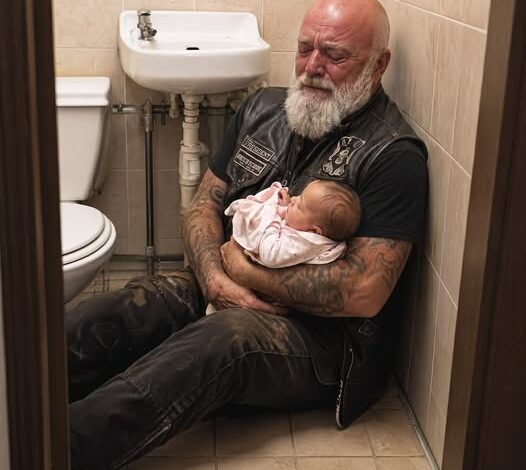
The neon sign of the convenience store hummed a lonely tune, flickering against the heavy darkness of 3 AM on a Sunday. At that hour, the world belongs to the drifters, the weary, and the broken. I was stocking shelves, lost in the rhythmic clicking of cans against metal, when the low, guttural throb of a heavy engine vibrated through the glass. A motorcycle pulled up to pump seven. Through the window, I watched a man who looked like he’d been carved out of granite. He was huge, well into his sixties, with a silver beard that reached his chest and a leather vest thick with patches that told stories of a thousand long highways.
But it wasn’t his size that stopped me. It was what he was doing. With hands as thick as mallets, he was gingerly unstrapping an infant carrier from the back of his bike. It wasn’t in a sidecar; it was bungeed directly to the frame like a piece of luggage. My heart climbed into my throat. The baby inside was screaming—a raw, jagged sound that pierced through the glass and the hum of the refrigerators. It was the sound of a child who had reached the end of her tether.
The biker looked just as frayed. His eyes were bloodshot and swollen, his face a roadmap of exhaustion and grief. He pumped his gas with one hand, his other arm rhythmically rocking the carrier in a desperate, failed attempt to soothe the child. When he finished, he scooped up the carrier and stumbled into the store. His voice was a hoarse rasp when he asked for the bathroom. I pointed toward the back, watched him disappear, and tried to return to my work.
Five minutes later, I heard it. Over the sound of the infant’s shrieks, a new sound emerged from behind the bathroom door: the heavy, shuddering sobs of a man who had finally shattered. It was a visceral, gut-wrenching noise. I dropped my price gun and walked to the back, knocking softly on the wood. When I asked if he was okay, the silence that followed was heavier than the crying. Then, a broken whisper drifted through the door. He didn’t know how to do it. He didn’t know how to do any of it.
I am fifty-two years old. I’ve survived the trenches of motherhood, changed a sea of diapers, and raised three children into adulthood. I knew that tone. It wasn’t just frustration; it was the sound of a soul drowning. I told him I was coming in. He didn’t protest.
The scene inside was heartbreaking. This massive man was slumped against the tiled wall, his head in his hands. The baby lay on a changing pad on the floor, her diaper on backward, unfastened, and useless. I knelt beside him, my knees hitting the cold floor, and told him to let me help. Within ninety seconds, the baby was clean and dry. She was a beautiful little girl, no more than three months old, with a shock of dark hair. As soon as the discomfort of the soiled diaper was gone, her screams faded into soft, rhythmic whimpers. She began to root against my hand, her tiny mouth searching for milk.
When I asked when she had last eaten, the man—David—looked at me with a hollow expression. He thought it had been five or six hours. He had formula in his saddlebags, but he had been too afraid to stop. He confessed that if he stopped moving, he’d have to think about the reality he was running from. Then, the dam broke. He told me his daughter, Jessica, was dead. This baby, Emma, was all he had left of her, and he was terrified that he was failing them both.
I led him to the store’s small break room, away from the fluorescent glare of the aisles. While I prepared a bottle, David’s story poured out of him like an open wound. He had been a long-haul trucker, a man used to being alone on the road. He had raised Jessica solo after his wife passed away years ago, but he admitted he hadn’t been there enough. Jessica had struggled with the shadow of addiction for years, a cycle of recovery and relapse that had defined her adult life. But six weeks ago, she had come to him clean, holding Emma, promising to be the mother the baby deserved. Two nights ago, David had found her unconscious in the bathroom. She had overdosed. The paramedics couldn’t bring her back.
In the wake of the tragedy, Child Protective Services had arrived. They saw a sixty-one-year-old single man with no experience and a daughter who had died with drugs in her system. They talked about foster care and “the system.” Terrified that Emma would be lost forever in a maze of paperwork and strangers, David did the only thing he knew how to do: he packed his bike and started riding. He was a fugitive of love, trying to outrun a grief that was already sitting in his sidecar.
I looked at him holding that bottle, his tattooed fingers trembling as Emma gripped his pinky, and I knew I couldn’t let him keep riding. He was going to crash, literally or figuratively. I told him that running would only guarantee he lost her. But I also told him he wasn’t alone. I called my daughter, a family law attorney, right then at 3:15 AM. She didn’t mind the wake-up call; she heard the urgency in my voice.
For the next half hour, my daughter spoke to David, stripping away his fear with the cold, hard facts of the law. She promised to represent him pro bono, to file emergency motions, and to prove that a grandfather’s love was the best place for that baby. She told him he had to go back and fight the right way. David was terrified, but for the first time since he found his daughter on that bathroom floor, he had a map.
He stayed in our break room until my shift ended at 7 AM. I taught him the basics—how to burp a baby without hurting her, how to test the temperature of the formula, the “football hold” that keeps a fussy infant secure. When he left that morning, he wasn’t a man fleeing into the night. He was a man heading toward a battlefield, armed with a lawyer and a feeding schedule.
Three months later, my phone rang with a call from an area code I didn’t recognize. It was David. His voice was thick, but this time with joy. He had won. The judge had seen the effort, seen the support system my daughter had helped him build, and granted him full custody. He had sold the bike and bought a safe sedan with a top-rated car seat. He was taking parenting classes and attending support groups for “grand-families.”
A few weeks later, he drove out to see me. When he walked into my house, he looked ten years younger. Emma was thriving, a chubby, smiling six-month-old who reached for me the moment she saw me. David sat on my sofa and told me that he was going to make sure Emma knew everything about her mother—the struggles, yes, but also the love and the fact that she had tried.
I often think about that night at the gas station. It’s easy to judge a man with a baby on a motorcycle at 3 AM. It’s easy to call the police and let the “proper” channels handle it. But sometimes, the proper channel is just a stranger with a little bit of empathy and a daughter who knows the law. David told me I was Emma’s grandmother now, whether I liked it or not. I wouldn’t have it any other way. We still talk every week, and every time I hear a motorcycle in the distance, I don’t see a stranger. I see a father, a grandfather, and a hero who just needed someone to show him how to fasten a diaper.