White House Responds to Online Claims About Alleged Trump Assassination Attempt

In the modern digital landscape, political news involving high-profile figures such as Donald Trump often spreads rapidly across social media platforms. In many cases, verified information and unverified claims circulate side by side, making it difficult for audiences to immediately distinguish between fact and speculation. This environment has contributed to the rise of misinformation surrounding major political events, especially those involving security concerns or alleged threats.
Recently, social media platforms were flooded with posts claiming that a serious security incident occurred at a high-profile political gathering in Washington, D.C., allegedly involving a violent attempt targeting public officials. These posts described dramatic scenarios, including armed individuals, emergency evacuations, and law enforcement intervention. However, no official reports from credible law enforcement agencies or established news organizations have confirmed such an incident as described in these viral narratives.
The White House Correspondents’ Dinner, an annual event attended by journalists, politicians, and public officials, is often the subject of online discussion due to its political significance and media visibility. In these discussions, even unrelated comments or jokes can be taken out of context and reinterpreted as evidence of hidden events or coordinated actions. This pattern is common in digital misinformation cycles, where fragmented content is reshaped into misleading narratives.
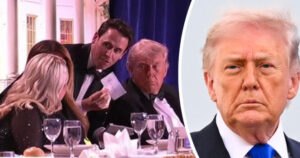
In some versions of the circulating claims, social media users attempted to connect unrelated public statements made by political figures to the alleged incident. For example, remarks from White House Press Secretary Karoline Leavitt were interpreted by some users as having hidden meaning related to the supposed event. These interpretations, however, were not supported by any verified evidence and were largely based on selective quoting and speculation.
Experts in digital communication and misinformation studies explain that such situations often occur when emotionally charged political environments intersect with viral social media content. Users may share incomplete clips, screenshots, or partial quotes without context, which can quickly evolve into misleading narratives. Once a theory gains traction online, it often spreads faster than corrections or fact-checks.
At the same time, official communication channels emphasize the importance of relying on verified information. Government agencies, including law enforcement bodies, typically release statements or press briefings when serious security incidents occur. In this case, no confirmed reports from such authorities have validated the claims circulating online about a coordinated attack or major security breach at the event.
The rapid spread of these claims highlights a broader issue in the digital age: the challenge of distinguishing between verified journalism and viral misinformation. Platforms such as X (formerly Twitter), Facebook, and TikTok allow information to circulate instantly, but they do not always ensure accuracy before content reaches large audiences. As a result, misleading narratives can gain significant visibility in a short period of time.
In many cases, conspiracy theories emerge when users attempt to connect unrelated events or interpret coincidence as evidence of planning or intent. These theories often rely on speculation rather than documented facts. Once established online, they can be difficult to correct, even after official clarifications are issued.
Media literacy experts recommend that audiences verify breaking news through multiple reputable sources before accepting or sharing it. Established news organizations, official government statements, and verified investigative reporting remain the most reliable sources of information in situations involving public safety or national security.
It is also important to understand how context can be distorted online. A single phrase, joke, or offhand comment can be removed from its original setting and reframed in a way that changes its meaning entirely. This process often contributes to misunderstandings and fuels unnecessary public concern.
In the case of the claims surrounding the alleged incident, no verified evidence supports the existence of the dramatic events described in viral posts. There are no confirmed reports of arrests, coordinated attacks, or official investigations matching the narrative being shared on social media. As such, the responsible interpretation is that these claims remain unverified and unsupported by credible sources.
This situation serves as a reminder of the importance of careful information consumption in the digital era. Political topics, in particular, are highly susceptible to misinformation due to strong public interest and emotional engagement. Without proper verification, false narratives can quickly become widely believed.
Ultimately, responsible reporting and careful fact-checking are essential to maintaining public trust. Readers are encouraged to approach viral claims with caution, seek confirmation from established news outlets, and avoid sharing unverified information that could contribute to confusion or misinformation.