The Secret Hidden Behind the Ornament Box That Saved Eight Orphans From Being Torn Apart
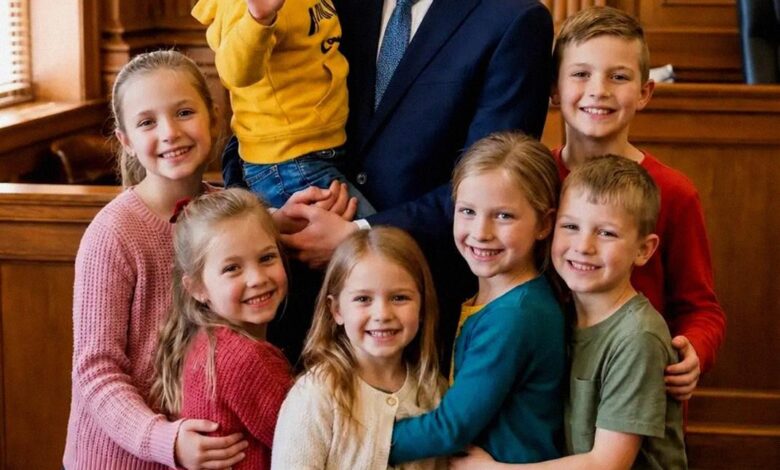
The silence that followed the slamming of the car doors was the loudest thing Rowan had ever heard. At eighteen, his life was defined by the chaotic, rhythmic noise of a household of eight: the clatter of cereal bowls, the screech of siblings arguing over hoodies, and the constant thud of Benji’s dragged blanket. But when those two police officers stood on his porch with grim, rehearsed faces, the noise died. In ten seconds, Rowan transitioned from a teenager worried about community college finals to a man holding the shattered remains of a family in his calloused hands.
His parents were gone, lost to a sudden accident that left no room for goodbyes. The tragedy was compounded almost immediately by the arrival of the state. Ms. Hart from child services sat at their kitchen table, her eyes darting between Rowan’s youthful face and the thick folder that dictated their doom. Her verdict was clinical and cold: the siblings would be separated. The house was behind on its mortgage, Rowan had no income, and the sheer logistics of keeping seven children together under the care of a teenager was, in her words, impossible.
Rowan looked at Tommy, who was six and still clutching their mother’s old keychain, and felt a surge of protective fury. He refused to let them become mismatched socks in the foster system. He promised to work, to learn, and to fight. But the legal system requires more than just heart; it requires stability.
The threat didn’t just come from the state; it came from within the family tree. Aunt Denise arrived at the first court hearing draped in pearls and smelling of expensive perfume, presenting herself as the savior the children needed. She didn’t want all eight of them, of course. She wanted the youngest two, treating them like accessories she could curate for her lifestyle while leaving the older siblings to fend for themselves. She whispered to Rowan that he was being selfish, that love wasn’t enough to pay the bills.
Against all odds, the judge granted Rowan temporary guardianship, moved by the boy’s intimate knowledge of his siblings’ lives—knowing who needed an inhaler, who hid food when scared, and who needed the hallway light on to sleep. For three years, Rowan lived a life of brutal sacrifice. He dropped out of school and worked triple shifts at warehouses and grocery stores. He learned to sleep standing up and how to navigate the complex bureaucracy of insurance and school districts. His only ally was Mrs. Dalrymple, the elderly neighbor who provided casseroles and free childcare, refusing every cent Rowan tried to offer.
Despite his efforts, the walls were closing in. Three years after the accident, the house was fraying at the edges, and the bank was looming. Aunt Denise returned, sensing blood in the water. She didn’t bring groceries; she brought criticism, mocking the bedsheet they used as a movie screen and the “instability” of their lives. She was waiting for the estate to settle, eyes fixed on the insurance payout and the equity in the family home. She filed for a legal review, intending to prove Rowan was an unfit guardian so she could seize control of the children and the assets.
The breaking point came at midnight in April. Benji, now nine, appeared in Rowan’s doorway, his face streaked with dust. He had been rooting through the attic looking for Christmas lights, a desperate attempt to feel close to the mother he missed so dearly. Instead of lights, he found a dusty ornament box, and tucked behind it was a single, faded photograph.
The image showed their parents standing outside a courthouse years prior. They looked strained, their father’s arm wrapped tightly around their mother. In the background, Aunt Denise and Uncle Warren stood with predatory smiles. When Rowan flipped the photo over, the handwriting hit him like a physical blow. It was his mother’s script, hurried but firm. It was a warning from the grave: “If anything happens to us, don’t let Denise take the kids. Our eldest, Rowan, will know what to do.”
The revelation was a catalyst. Rowan took the photo to Mrs. Dalrymple, whose reaction confirmed his darkest suspicions. She revealed that the day the photo was taken, his parents had been fighting off a legal attempt by Denise to gain power of attorney. His mother had been so terrified of Denise’s greed that she had secretly left a “break glass in case of emergency” folder with Mrs. Dalrymple.
Inside that folder was a treasure trove of evidence: emails documenting Denise’s attempts to manipulate the parents, and copies of a revoked guardianship agreement that Denise was now trying to pretend was still valid. It turned out that Rowan’s parents hadn’t been careless or unprepared; they had been fighting a silent war to protect their children’s future from the woman now claiming to be their benefactor.
The final court hearing was a transformation. Aunt Denise sat in her navy suit, speaking softly about “the best interests of the children” and Rowan’s “incapacity” to maintain the roof over their heads. She painted a picture of a failing household that only her money could fix.
Rowan didn’t shout. He didn’t cry. He simply walked to the judge’s bench and placed the photograph and the folder down. He explained that his mother’s greatest fear wasn’t poverty—it was her sister. He presented the emails where Denise had outlined her plan to sell the family home and put the older children in group homes while keeping the insurance money for “the care of the young ones.”
The air in the courtroom turned frigid. Mrs. Dalrymple stood as a witness, testifying to the decades of manipulation she had seen. Uncle Warren, who had been a silent partner in Denise’s schemes, finally broke, admitting he had been lied to about the parents’ wishes.
The judge’s gavel fell with a finality that echoed through the halls. Denise’s petition was not just denied; it was scorched. The court recognized the folder as an extension of the parents’ will. More importantly, Mrs. Dalrymple was officially listed as the emergency caregiver, providing the legal “adult” safety net the state required, which finally allowed Rowan to breathe.
That evening, the eight siblings gathered in the kitchen. They weren’t just a group of orphans struggling to survive anymore; they were a legacy. Rowan taped the new emergency contact list to the refrigerator. Under the section for “Relationship,” he didn’t write “Neighbor.” He wrote “Family.” He realized then that for three years, he had been trying to prove he was enough, but his mother had already known he was. She had trusted him before he ever trusted himself. The photo wasn’t just a warning; it was a commission. They were still standing, the roof was still theirs, and for the first time since the accident, the house was filled with the beautiful, chaotic noise of a family that refused to be broken.