Melania Trump Shocks Royal Protocol With A Pink Dior Gown That Left King Charles Stunned
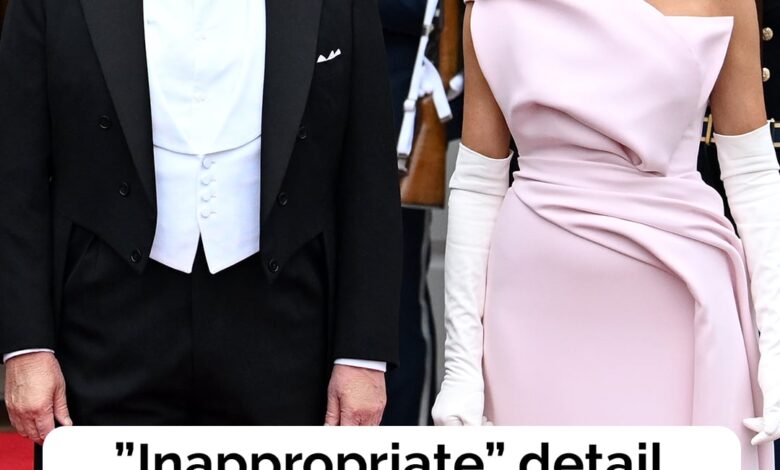
The intersection of high fashion and global diplomacy has always been a minefield of unspoken rules, rigid traditions, and the occasional calculated risk. However, few moments in recent memory have ignited the digital zeitgeist quite like Melania Trump’s appearance at a high-profile royal state banquet. While the world expected a display of sartorial submission to centuries-old etiquette, the former First Lady chose a path of aesthetic defiance. Draped in a sculpted, floor-length Dior gown in a shade of pink that bordered on the defiant, she didn’t just attend the dinner; she commanded the visual narrative of the evening, leaving critics and royal watchers in a state of absolute frenzy.
To understand the magnitude of this fashion choice, one must first understand the environment of a royal state dinner. These events are the gold standard of formality, usually hosted under the heavy, gold-leafed ceilings of Buckingham Palace or similar historic venues. The dress code is typically white-tie, a standard that suggests modesty, tradition, and a certain degree of blending into the historical tapestry. Queen Camilla and other female royals almost exclusively opt for modest necklines, long sleeves, and often white or cream palettes that signify a respect for the institution over the individual. Melania Trump, however, has never been one to disappear into a tapestry.
The gown in question was a marvel of Parisian engineering. A strapless, structural masterpiece by the house of Dior, it featured a neckline that exposed the shoulders—a move that many traditionalists labeled a “radical departure” from the expected decorum of a guest in the presence of King Charles III. The silhouette was tight, precise, and unapologetically modern. While the color was described as a soft pink, in the context of the sea of black and white surrounding her, it glowed like a neon sign. It was a choice that screamed individual identity in a room designed to celebrate institutional continuity.
The reaction was instantaneous and polarized. On one side of the digital aisle, critics descended with surgical precision. They pointed to the bare shoulders as a breach of “diplomatic modesty,” arguing that when one visits a monarch, the goal is to honor their house, not outshine their crown. For these observers, the gown was a symbol of American exceptionalism at its most tone-deaf—an expensive, flashy distraction from the gravity of international relations. The eye-watering price tag of the Dior couture piece became a focal point for those who viewed the display as an exercise in vanity rather than statesmanship.
Yet, for every critic who saw a snub, there was an admirer who saw a masterclass in soft power. Melania Trump has long been regarded as one of the most controlled dressers in the political sphere. Every stitch, every hemline, and every color choice is vetted with the knowledge that it will be dissected by millions. To her supporters, this pink Dior gown was an assertion of strength. It suggested that a woman can be an ally without being a shadow. By choosing a color and cut that deviated so sharply from the royal norm, she wasn’t necessarily disrespecting the King; she was honoring her own role as a representative of a different, more modern, and more individualistic culture.
As the evening progressed, the contrast became the story. Photos of Melania standing beside Queen Camilla offered a striking visual dichotomy: the Queen, an embodiment of British history and understated duty, and the First Lady, an embodiment of American glamour and cinematic polish. It was a clash of two different types of power. One power is rooted in the “way things have always been done,” and the other is rooted in the “way things look on camera.” In the 21st century, the latter often carries just as much weight as the former.
The social media firestorm that followed the event revealed a deeper truth about modern celebrity and politics. We no longer look at clothes as just fabric; we look at them as manifestos. The “disrespect” camp viewed the gown as a metaphorical middle finger to the aging structures of the monarchy. The “confidence” camp viewed it as an act of bravery, a refusal to be intimidated by the weight of the crown. Meanwhile, a third group—perhaps the largest—was simply captivated by the sheer spectacle of it all. In an era of beige trends and safe choices, a sculpted pink gown at a royal dinner is a rare moment of genuine high-drama fashion that demands attention.
Beneath the surface of the debate lies the question of the “cost” of such a moment. Beyond the literal thousands of dollars spent on the silk and labor required for a Dior original, there is a diplomatic cost. Does a dress actually matter in the grand scheme of trade deals and military alliances? Probably not. But in the theater of public perception, image is everything. For Melania Trump, the image has always been her primary tool of communication. She is a woman of few public words, making her wardrobe her primary dialect. This pink dress spoke volumes, even if people couldn’t agree on what exactly it was saying.
As the toasts were finished and the last of the champagne was poured, the ceremony itself was deemed a logistical success. The protocol of the table was followed, the speeches were delivered with the necessary gravitas, and the alliance between nations remained intact. However, the lasting memory of the night wasn’t a quote from a speech or a handshake between leaders. It was the image of that pink dress under the chandeliers. It served as a reminder that even in the most rigid environments, the human desire to stand out is an irrepressible force.
The legacy of the pink Dior gown will likely be studied by fashion historians for years to come. It sits at the peculiar crossroads of tradition and rebellion. It forces us to ask: what do we actually want from our public figures? Do we want them to be perfect mirrors of our expectations, following every rule to the letter? Or do we want them to be icons who challenge the status quo and provide a flash of color in a world that often feels dangerously grey?
Melania Trump’s choice was a calculated gamble. She knew the risks of showing skin at a royal event; she knew the price tag would be scrutinized; and she knew the color would be a lightning rod for commentary. By moving forward with the look anyway, she signaled that she is not a woman who is easily intimidated by the weight of tradition. Whether you see it as a fashion faux pas or a stroke of genius, one thing is undeniable: she didn’t disappear. In a world obsessed with the quiet safety of protocol, Melania Trump chose to be seen, and in doing so, she ensured that the conversation about that night would continue long after the palace lights were dimmed. The pink dress wasn’t just a garment; it was a declaration of independence in the heart of the monarchy.