The Shocking Secret Word Melania Trump Said To King Charles That Stunned Everyone
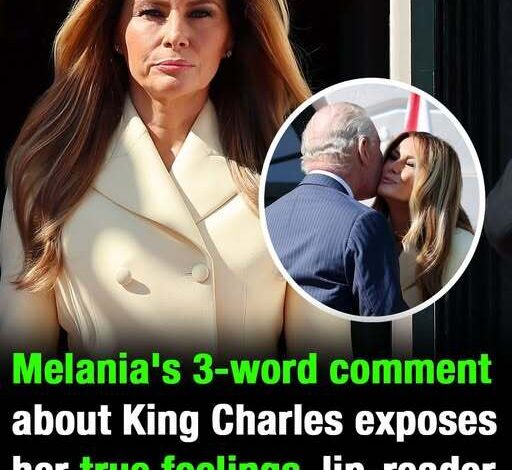
A masterclass in the nuanced art of contemporary diplomacy, the historic four-day state visit of King Charles III and Queen Camilla to the United States combined magnificent ceremonial splendor with nuanced human moments. The visit, which was hosted by Donald and Melania Trump, attracted international media attention for both its high-level policy talks about international relations and the personal, unplanned encounters that always happen when public figures of this caliber get together. While political pundits and analysts devoted hours to analyzing the visit’s wider geopolitical ramifications, the most heated conjecture and discussion among royal observers and body language specialists alike came from Melania Trump and King Charles III’s unexpectedly brief and quiet conversation.
When the royal couple arrived at the White House, they were received with an extremely formal and well-planned welcome. This was a customary presentation that included a dazzling array of official photos, cordial greets, and a measured stroll around the immaculately maintained grounds. Strict attention to procedure and a sincere effort to promote worldwide goodwill coexisted in the atmosphere. Melania Trump used the occasion to present a beekeeping project she had recently started on the White House grounds during the formal tour of the house. In an otherwise highly ceremonial and traditional setting, this seemingly insignificant detail quietly emphasized sustainability and environmental awareness, reminding onlookers that personal passions can be woven into the diplomatic tapestry even in the most formal settings.
As is frequently the case during high-profile state visits, the brief, intimate exchanges that unveil the characters behind the titles sometimes garner greater attention than the formal treaties or the huge speeches. Melania Trump and King Charles had a brief conversation at the first welcome. Despite being brief, the exchange attracted a disproportionate amount of attention from onlookers and commentators who wanted to understand its deeper significance. Jeremy Freeman, a lip-reading specialist, came forward to explain the brief exchange, speculating that it revealed a feeling of mutual respect and courteous familiarity. According to Freeman’s interpretation, she established a tone of warmth that went beyond the customary strict protocols of state visits by responding to the King’s greeting with a calm, sincere statement of delight at seeing him again.
It was a very straightforward moment, but the response to it was anything but. Even ordinary civility is sometimes seen as a significant indication of political or personal alignment in a time of unrelenting media scrutiny, where every gesture, look, and inflection is scrutinized under a potent magnifying glass. Occasionally, an exchange might be profoundly symbolic, acting as a diplomatic ploy or an olive gesture. At other instances, though, it is just what it seems to be: a polite, respectful conversation between two public individuals who have been used to the press’s constant presence and the demands of decorum.
This most recent encounter did not happen in a vacuum; rather, it was based on a foundation of familiarity that had been developed over time through prior exchanges. Melania Trump and the British royal family had already met for a number of occasions, including this one. Notably, Melania Trump made an appearance with Catherine, Princess of Wales, on a previous trip to the UK. This event was extensively reported by the international media. When King Charles made a charming comment about her hat during that earlier event, the tension of the formal gathering was instantly reduced, and witnesses saw a particularly amusing and friendly moment. These minor, seemingly unimportant incidents usually mean more for what they reveal about the people involved than for the exact words that are said. They exhibit an underlying ease, or at the absolute least, the capacity to do so professionally in the harsh public eye.
State visits have always been heavily influenced by public opinion and protocol, and this visit was no exception. The purposeful omission of customary gestures, like bowing or curtsying, which were formerly thought to be required when in the presence of British royalty, received a lot of attention. Such inflexible bodily gestures are no longer strictly necessary or anticipated in contemporary diplomatic settings. Rather than being a conscious or intentional departure from long-standing custom, what the public perceives as strange or even disrespectful is frequently only a reflection of changing international conventions and the modernization of protocol. However, perception has a great deal of weight of its own. Even when the shape itself has already altered to meet the current era, people have a natural tendency to read intention into form, giving gestures significance.
Every public persona is the result of incredible preparation and effort. Even though state visits are well planned events with last-minute scheduling, planners and assistants can never fully control them. There are always moments that transcend rehearsed statements and staged movements—the fleeting conversations, the nuanced responses, the minute details that show something much more human behind the polished, formal exterior. Although these impromptu moments do not define international relations or diplomacy, they unavoidably influence how the public and media interpret the events. It’s quite difficult to strike a balance between being completely present without unintentionally taking over the narrative and staying approachable and open without speaking too much.
In the last reflection, it is evident that people tend to focus on things that are instantaneous and transient, such as a quick glance, a murmured statement, or a delicate gesture. However, the real content of diplomacy is found in quiet rooms and discussions that are not intended for public scrutiny, far from the cameras. The tone, however, is still apparent to the outer world. Additionally, tone can do extremely quiet, significant tasks when maintained steadily and consistently. It provides room for continued collaboration and understanding, acting as a stabilizing influence even in the face of uncertainty and unpredictability in the larger, more complicated world.