The Viral Dress From The 2026 Correspondents Dinner That Sparked A Massive National Debate
The 2026 White House Correspondents Dinner was anticipated to follow a very predictable and familiar script. Held at the prestigious Washington Hilton, the grand event was designed to be formal, highly controlled, and meticulously managed, bringing together the absolute highest echelons of political and media power. High profile figures such as Donald Trump and JD Vance were in attendance, surrounded by a glittering crowd of journalists, celebrities, and political insiders. The evening began exactly as expected, with polished appearances, radiant red-carpet moments, and the usual banter expected at such an elite gathering. But within a matter of hours, the expected narrative was shattered not once, but twice, taking the entire event in completely unprecedented directions.
The first major disruption of the night came in the form of a terrifying security scare. Reports of a potentially armed suspect circulating near the venue triggered a swift and aggressive response from the Secret Service and local law enforcement. For a brief but harrowing period, the dazzling lights and cheerful conversations were replaced by an atmosphere of panic and uncertainty. Attendees were moved to secure locations, and the media focus pivoted entirely to the safety and disruption of the evening. It was a stark reminder of the volatile world in which these public figures operate, and for a moment, it seemed that the night would be remembered for all the wrong reasons rather than the scheduled entertainment.
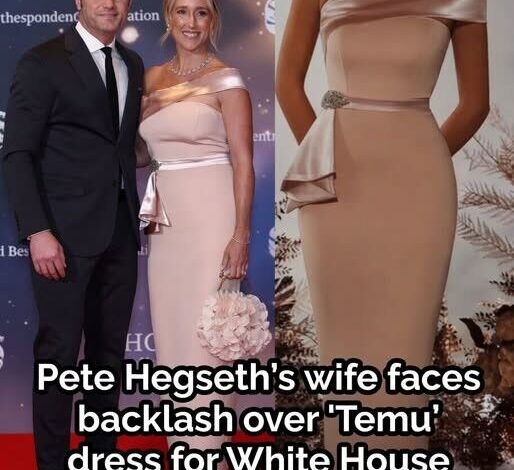
However, as the situation stabilized and the threat was neutralized, the atmosphere returned to a tense normalcy, allowing the crowd to resume their evening. It was then that an entirely different kind of story took over the digital world, one far more ordinary but far more polarizing than a security threat. Photos of Jennifer Rauchet began circulating on various social media platforms, and users quickly took notice of her elegant but seemingly unassuming gown. The gown, a piece that caught the eyes of many, featured flowing details that many would associate with high fashion, yet the price point and the retailer’s catalog told a completely different story. What started as casual admiration quickly exploded when a sharp eyed user claimed that her dress closely resembled a low-cost, budget friendly item sold on the international retail platform Temu.
Almost instantly, a side-by-side comparison of the dress went viral, turning the simple outfit choice into a massive cultural flashpoint. The internet, true to its unpredictable nature, seized upon this discovery and created a chaotic debate that completely overshadowed the serious events of the earlier evening. Critics of the outfit argued that wearing such an affordable or low-cost dress at an event of this magnitude clashed sharply with the traditional expectations of status, wealth, and presentation associated with the Washington elite. Some commentators even attempted to link the fashion choice to broader political messaging, questioning whether a budget-friendly outfit aligned properly with the traditional American First ideals championed by many in the room.
On the other hand, supporters of Jennifer Rauchet pushed back just as strongly against the criticism. They pointed out that affordable fashion is incredibly common in the modern era and argued that making a judgment based on the price tag of a garment is completely out of touch with the reality of everyday Americans. They celebrated her choice to wear what she liked, regardless of its designer label or cost, arguing that a person’s worth and elegance should not be tied to an exorbitant price tag. This perspective highlighted a growing resentment toward the extreme wealth and excess often displayed at elite Washington dinners, positioning her outfit as a stroke of practical genius rather than a fashion faux pas.
The ensuing debate quickly expanded far beyond Rauchet herself and the specific dress she wore. It reignited intense discussions surrounding the ethics of fast fashion, the accessibility of stylish clothing for the general public, and the immense pressure placed on public figures to project an image of extreme wealth. What began as a trivial question about an evening gown transformed into a much broader conversation regarding class dynamics, social symbolism, and the way the public perceives their leaders and representatives. Analysts and fashion historians weighed in, noting that clothing has always been a primary vehicle for political and social communication throughout history.
The timing of the event amplified the intensity of the debate tenfold. The stark contrast between a serious, potentially dangerous security incident and a trivial fashion debate highlighted exactly how quickly public attention can shift in the modern media landscape. In today’s digital age, a single image or a single tweet can redirect the national focus within a matter of minutes, turning a serious political event into a viral internet spectacle that captivates millions of users across the globe.
In the end, the viral moment was never truly about the dress itself. It was about what different people saw when they looked at the outfit. For some, it represented a contradiction in status, while for others, it was a breath of fresh air and a symbol of relatability. Ultimately, the intense reaction says far more about the audience and the fractured nature of our cultural conversation than it does about the outfit. It stands as a powerful reminder of how the modern public interacts with the lives of those in the public eye, constantly searching for meaning and controversy in the most ordinary of places.