Key detail in the eyes of Nancy Guthrie kidnapping suspect spotted as haunting images emerges!
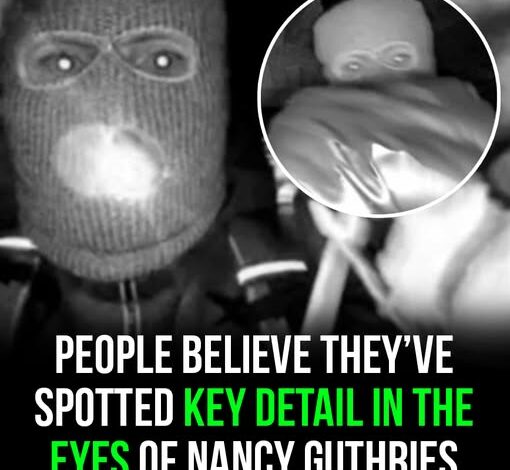
Online attention has intensified after federal authorities released new surveillance images connected to the kidnapping of Nancy Guthrie, with much of the public fixation centering on one narrow but highly visible feature: the suspect’s eyes.
The case, which has gripped Arizona and drawn national focus, took a significant turn when investigators published previously unrecovered footage from outside the 84-year-old’s Tucson home. Nancy Guthrie, the mother of Today show co-anchor Savannah Guthrie, vanished in the early morning hours more than a week ago. Since then, limited official information has fueled both concern and speculation.
The newly released images show a masked, armed individual near the front entrance of Guthrie’s residence around the time she disappeared. The suspect appears to be tampering with a video doorbell camera while dressed in a balaclava, gloves, a zippered jacket, and a backpack. Only a small portion of the person’s face is visible — primarily the eyes and eyebrows framed between the mask and hood.
According to statements made by federal officials, the footage was recovered through backend data after physical recording devices had either been removed or damaged. Investigators worked alongside the Pima County Sheriff’s Department and private-sector technology partners to retrieve what they described as residual digital material that had not been accessible during the initial evidence sweep.
In a public update, officials confirmed that the images represent the first substantial visual evidence in the case. They emphasized that the release was intended to generate credible leads rather than invite speculation. Within hours, however, social media users began dissecting the images in detail, zooming in on the suspect’s eyes and drawing conclusions about identity and gender.
Some online commenters pointed to the apparent arch of the eyebrows and the contour of the eyelids, suggesting the suspect might be female. Others disagreed, arguing that facial features alone are unreliable indicators, especially when partially obscured by clothing and distorted by camera angles. The debate quickly expanded beyond the still images to include analysis of the suspect’s posture and movement in the accompanying video.
Observers have examined the individual’s gait, body language, and build, attempting to interpret subtle cues. Some claim the stride appears more typically masculine, while others insist that such assumptions are rooted in stereotypes. A handful of viewers even speculated about what they believed to be the faint outline of facial hair beneath the mask. None of these interpretations have been confirmed by authorities.
Law enforcement officials have not publicly identified the suspect’s gender and have cautioned against drawing conclusions from limited visual evidence. Investigators stressed that appearance is only one component of a much broader forensic and analytical process. Digital footprints, communication records, vehicle data, and physical evidence are all under review as the inquiry continues.
Former FBI agent Mark Harrigan offered insight into another element captured in the footage: the way the suspect carried a firearm. Harrigan described the positioning of the weapon — visibly exposed at the front of the waist — as unusual. In his view, experienced individuals typically conceal firearms during criminal activity to minimize attention and avoid accidental detection.
He suggested that the exposed carry method might indicate inexperience or haste. Harrigan also speculated that the firearm could have initially been concealed in the suspect’s backpack and later repositioned near the front door. While his analysis provides perspective, it remains independent commentary rather than an official investigative conclusion.
The public release of the footage has reportedly led to a surge of tips. Authorities confirmed that they are actively reviewing incoming information but urged citizens to provide factual observations rather than theories shaped by online discussions. Investigators reiterated that speculation, particularly when amplified across social platforms, can complicate active cases and divert resources from productive leads.
Meanwhile, Nancy Guthrie has now been missing for more than ten days. Reports indicate that two ransom deadlines demanding $6 million in bitcoin have passed. Officials have not disclosed whether communication with the alleged kidnappers is ongoing. It has also been reported that the ransom note did not specify consequences if payment was not made, further complicating interpretations of the suspect’s intentions.
Earlier in the investigation, law enforcement briefly detained a man identified as Carlos for questioning. He later stated that he had been driving with his wife when officers began following their vehicle. According to his account, he was held for several hours before being released without charges. Carlos said he works in Tucson for a delivery service and may have previously delivered a package to the Guthrie residence, but he denied any involvement in the kidnapping.
Authorities have not announced formal charges against any individual. Officials maintain that the investigation remains active and evolving. They have not confirmed whether the suspect acted alone or whether others may be involved.
Behind the forensic analysis and public debate lies a family enduring profound uncertainty. Savannah Guthrie has not provided detailed public comment beyond expressing gratitude for support and urging anyone with information to contact law enforcement. The emotional toll of the case is evident, though officials have emphasized the importance of preserving investigative integrity over immediate public disclosure.
Experts in criminal investigations note that visual clues from surveillance footage can be both valuable and misleading. Camera distortions, lighting conditions, lens curvature, and compression artifacts can alter perception. What appears definitive in a still frame may be ambiguous when examined alongside metadata, timestamps, and contextual evidence.
Investigators are likely analyzing the footage frame by frame, measuring height against fixed objects, studying hand dominance, and assessing environmental cues such as shadows and timing. These methods go far beyond the surface-level observations circulating online.
As the search continues, authorities are balancing transparency with caution. They have pledged to release additional information when it can be confirmed without jeopardizing operational strategy. For now, the images serve as both a critical evidentiary step and a reminder of how little is publicly known.
Nancy Guthrie’s disappearance remains unresolved. Each development introduces new questions alongside incremental progress. While public attention has focused on the suspect’s eyes, investigators are concentrating on the broader picture — assembling data points, verifying timelines, and following leads with measured precision.
In cases like this, small details can matter. But so can discipline and restraint. The investigation moves forward, shaped by evidence rather than assumption, as authorities continue working to determine exactly what happened in the early hours outside a Tucson home — and where Nancy Guthrie is now.