Test Your Observation Skills by Finding the Hidden Pen, Egg, Apple, and Flower
Hospitals often look cold from the outside.
Fluorescent lights. Endless hallways. Monitors beeping through sleepless nights. To many patients and families, hospitals become places associated with fear, uncertainty, and exhaustion. People remember waiting rooms filled with anxiety, whispered updates from doctors, and the heavy silence that settles when loved ones are hurting.
But behind those clinical walls, another reality exists quietly every single day.
A reality built not only on medicine and procedures, but on human connection.
Because hospitals survive emotionally through small acts most people never see.
A nurse leaving crackers beside a patient who finally managed to eat after surgery. A doctor staying an extra five minutes after a shift ends because someone looked too frightened to be left alone yet. Two exhausted coworkers sharing a joke at three in the morning simply to survive another impossible night together.
Tiny moments.
Yet often powerful enough to change the entire emotional atmosphere of a room.
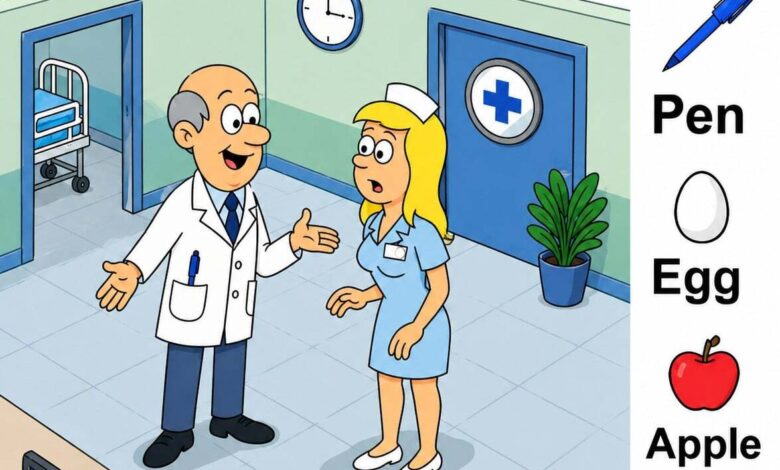
That is what makes scenes like this illustrated hospital setting feel surprisingly moving despite their simplicity. At first glance, it appears cheerful and ordinary — a smiling doctor, an attentive nurse, a neatly prepared room. But beneath the bright colors and clean lines sits something deeper about the emotional architecture of healthcare itself.
The doctor’s expression carries warmth that feels intentional rather than performative. His crisp white coat and neatly adjusted tie signal professionalism, competence, authority. Yet the slight lean forward in his posture suggests something equally important:
Attention.
Real listening.
Because the best healthcare workers rarely treat patients like charts or diagnoses alone. They understand that fear itself becomes part of treatment. Sometimes reassurance matters almost as much as medication. Patients remember tone of voice, eye contact, kindness, and honesty long after they forget medical terminology.
Nearby, the nurse’s calm posture reflects another truth hospitals quietly rely on every day:
Nurses are often the emotional anchors of healthcare.
Patients may see doctors during critical conversations, but nurses remain present through the long in-between hours — checking pain levels, adjusting blankets, answering frightened questions, noticing subtle emotional shifts before anyone else does. Their steadiness becomes part of the environment itself, so constant that people sometimes forget how emotionally demanding that role truly is.
The illustration captures that beautifully through simple details.
Nothing dramatic is happening.
No emergency.
No rushing chaos.
No cinematic crisis.
Just professionals existing together inside routine care with humanity still intact.
Even the smaller touches inside the room soften the clinical setting intentionally. The neatly made bed. The medical symbols. The playful apple decoration on the wall. These details remind viewers that hospitals constantly balance two realities at once:
Precision and compassion.
Sterile procedure and emotional comfort.
Because healthcare workers are not only treating bodies. They are navigating fear, grief, uncertainty, hope, exhaustion, and human vulnerability every single day.
And perhaps what outsiders misunderstand most is how much hospital staff depend on each other emotionally too.
A shared laugh at a nurses’ station can carry someone through the next twelve-hour shift. A quick encouraging glance between coworkers after delivering devastating news can prevent emotional collapse for another hour. Quiet support becomes survival inside environments where burnout constantly threatens compassion itself.
That hidden network of kindness often remains invisible to patients.
Yet it holds entire hospital systems together.
Especially after difficult nights.
Especially after losses.
Especially when professionals must somehow walk from one heartbreaking room directly into another carrying calmness they no longer fully feel themselves.
That is why scenes like this resonate emotionally despite their simplicity. They remind us healthcare is not only machinery, paperwork, diagnoses, or technical skill.
It is also endurance.
Connection.
Shared responsibility.
And ordinary people repeatedly choosing to show warmth inside places where suffering appears every single day.
In the end, perhaps the most comforting truth about hospitals is not that they are free from fear or pain.
It is that even there — in some of humanity’s hardest moments — kindness still quietly survives in the people who keep showing up for strangers, and for each other.