At Prom, Only One Boy Asked Me to Dance Because I Used a Wheelchair — 30 Years Later, Our Paths Crossed Again When He Needed Support
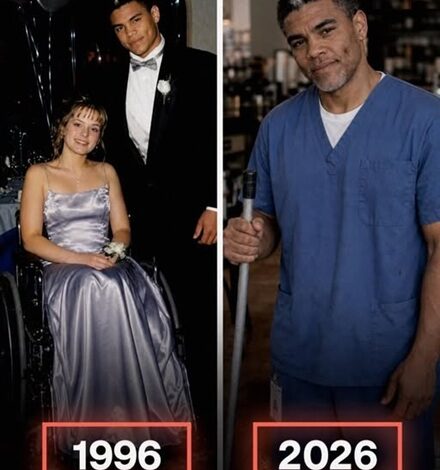
Six months after a devastating car crash left me in a wheelchair, I went to prom expecting to be invisible. I wasn’t just afraid of being stared at—I was afraid of being erased while still physically present. Before the accident, my life had been ordinary in the most comforting way. I argued with my parents about curfews, worried about exams, and obsessed over prom dresses like it was the most important decision in the world. After the crash, everything changed overnight.
Suddenly, my world shrank to hospital rooms, rehabilitation schedules, and the slow, painful process of learning how to exist in a body that no longer responded the way it used to. My injuries were severe, and recovery was uncertain for a long time. Doctors spoke carefully, using words like “possible,” “uncertain,” and “long-term rehabilitation.” I was too young to fully understand how permanent change can feel when it first arrives. What I did understand was that people looked at me differently now.
Not everyone, but enough to notice. Enough to make me want to disappear into the background whenever I entered a room. By the time prom season arrived, I had already decided I wasn’t going. My mother disagreed. She stood in my doorway holding my dress like it still represented the person I used to be. She didn’t try to force me. Instead, she simply said I deserved one night that wasn’t defined by what had happened to me. I told her I didn’t want pity or attention.
She replied that I could choose to sit in a corner, or I could choose to exist in the room on my own terms. That conversation stayed with me longer than I expected. Eventually, I went. The gym was decorated with lights and music that felt distant from my experience of life at that time. I remember sitting near the edge of the room, watching people move freely across the floor. Friends came by, told me I looked beautiful, took pictures, and then drifted back into the flow of the night. I was included, but still separate, like someone watching life through glass.
Then Marcus walked over. I didn’t expect him to stop. We weren’t close before the accident. He wasn’t part of my inner circle of friends or school routines. But he stood in front of me like it was the most natural thing in the world and said hello. I remember thinking he had mistaken me for someone else. When he confirmed he hadn’t, I felt something shift in the air between us.
He asked if I was hiding.
I told him I wasn’t hiding if everyone could see me.
He didn’t argue. He just looked at me differently after that—less like someone trying to make conversation, and more like someone trying to understand.
Then he asked me to dance.
At first, I thought he was joking. So I told him I couldn’t. Not just because I was in a wheelchair, but because I genuinely didn’t understand what he was asking. He didn’t step back or laugh it off. Instead, he simply accepted the reality of the situation and said we would figure it out. That sentence changed the tone of the entire moment.
He wheeled me onto the dance floor without hesitation. I remember freezing, overwhelmed by the idea of being seen so openly. I told him people were staring. He told me they were already staring. There was no judgment in his voice—just honesty. Then he placed his hands gently on mine and began moving with me instead of around me.
It wasn’t a traditional dance. It couldn’t be. But it was still movement. Still connection. Still shared rhythm in a space where I had expected none. For the first time since the accident, I wasn’t being positioned as an exception or a limitation. I was simply part of the moment.
When the song ended, he returned me to my table as casually as he had taken me onto the floor. Before walking away, he said something simple: nobody else had asked.
After that night, life moved forward the way life does—without waiting for emotional meaning to catch up. My family relocated for ongoing medical care and rehabilitation, and Marcus and I lost contact. Not because of conflict, but because life divided us into separate paths that neither of us had the tools to reconnect.
My recovery took years. I learned how to adapt, how to move forward physically, and how to rebuild independence in a world not designed for people like me. Over time, I became an architect. Not because it was easy, but because I became obsessed with spaces—who they include, and who they quietly exclude without ever saying so directly. I built a career focused on accessibility and design that considered human experience beyond aesthetics.
Decades passed.
Then one ordinary afternoon, everything shifted again.
I was in a café near one of my project sites when I spilled coffee across the counter. A man working there came over immediately to help. He moved carefully, with a slight limp, and handled the situation without hesitation or judgment. Something about him felt familiar in a way I couldn’t immediately explain. When I looked at his face properly, I felt time collapse for a second.
He looked at me and said I seemed familiar.
I didn’t respond at first.
The next day, I returned.
When I mentioned prom, I watched recognition slowly build in his expression until it finally settled into certainty. He sat down without needing an invitation. The moment became heavier, not because it was dramatic, but because it was real. Thirty years had passed between that dance and this conversation.
We talked.
He told me about life after high school—how quickly responsibility replaced youth, how family illness reshaped everything, how survival became the only consistent priority. He spoke about injuries, long working hours, and years of postponing anything that felt like personal healing. I told him about my own path—about recovery, education, architecture, and building spaces designed to include people rather than quietly exclude them.
Neither of us had imagined this reunion.
What followed was not instant transformation, but gradual reconnection. He resisted help at first. So did I. We had both learned to equate independence with isolation. But over time, collaboration replaced hesitation. He began working with me on accessibility projects, bringing lived experience that no design textbook could provide. His perspective challenged assumptions in ways that made our work better, more honest, and more human.
There were setbacks too. Physical pain, financial stress, emotional resistance. Healing was never linear for either of us. But slowly, the distance between who we were and who we had become started to narrow.
One night, I showed him an old prom photo. He stared at it for a long time before admitting he had tried to find me after graduation. I had assumed he forgot. He had assumed I moved beyond reach. Both assumptions were wrong.
That realization changed something between us.
Eventually, what had begun as a chance encounter became something steady. Not rushed, not idealized—just two people who had lived full, complicated lives finally learning how to exist in each other’s present.
At the opening of a community center we designed together, music filled the main hall. He walked over, held out his hand, and asked if I wanted to dance.
This time, there was no hesitation.
Because we already knew how.