King Charles’ unexpected response after Rod Stewart praised him for putting ‘ratbag’ Trump ‘in his place’
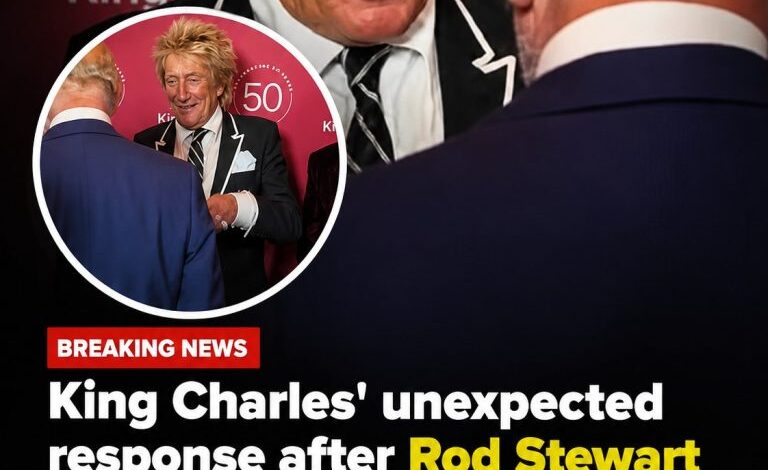
During a crowded London reception filled with cameras, diplomats, and carefully managed royal small talk, Rod Stewart reportedly did something very few people do comfortably around monarchs:
He spoke exactly the way he normally speaks.
No softened language.
No diplomatic filtering.
No nervous attempt to sound politically neutral for the sake of royal company.
Instead, while speaking with King Charles III, Stewart casually referred to Donald Trump as “that little ratbag” — and because cameras happened to capture the interaction, the moment immediately exploded online.
What transformed the exchange from ordinary celebrity gossip into international fascination was not only Stewart’s comment itself.
It was the King’s reaction.
Or rather, the ambiguity of it.
Viewers instantly began replaying the clip frame by frame searching for meaning in Charles’ facial expression. Some insisted he laughed subtly. Others argued he deliberately avoided reacting at all. A few claimed the comment appeared to pass straight over him as he smoothly continued the conversation without acknowledgment.
That uncertainty became the story almost as much as the insult.
Because moments involving royalty operate differently from ordinary public interactions. Every gesture gets interpreted symbolically. Every smile becomes potential endorsement. Every silence invites projection.
And in this case, the conversation collided with one of the most politically charged figures on earth.
For Stewart, criticism of Trump is not new.
Over the years, he has spoken publicly about politics, veterans, and leadership in ways that suggest his feelings toward Trump go beyond casual celebrity commentary. Much of that frustration appears connected to Stewart’s strong admiration for military service and his anger over remarks or controversies he believes disrespected veterans and fallen soldiers.
So when he made the “ratbag” comment, it did not sound like spontaneous outrage.
It sounded familiar.
Comfortable.
Like an opinion long settled privately now slipping casually into public conversation.
The exchange also gained attention because Stewart reportedly praised King Charles for his “wonderful performance in the Americas,” a phrase many interpreted as a sly acknowledgment of the King’s careful diplomacy during Trump-related political events and state interactions.
Royal diplomacy often communicates through symbolism rather than direct confrontation. Small gestures, gift choices, seating arrangements, wording in speeches — all become vehicles for subtle messaging without open political declaration.
That is partly why people became so fascinated by Charles’ reaction in the clip.
The modern British monarchy survives partly through restraint. Public neutrality is not simply etiquette for the King; it is institutional survival strategy. Openly reacting to political insults — especially involving a former and current American president — risks pulling the monarchy directly into partisan conflict.
So Charles did what experienced royals often do best:
He remained difficult to read.
And that unreadability allowed the internet to project whatever version of the moment people preferred seeing.
Some viewers interpreted the King’s composure as quiet agreement hidden beneath royal discipline. Others saw professional detachment from a celebrity making an awkward joke in a formal setting. Critics argued the entire moment revealed how celebrity culture increasingly blurs boundaries between politics, entertainment, and diplomacy.
But underneath the headlines sits something simpler and strangely human:
Even in rooms filled with monarchs, rock legends, diplomats, and cameras, people still gossip.
They still test reactions.
Still make offhand comments to see whether someone else smiles back.
And when the subject is Donald Trump — a figure who provokes unusually intense admiration and hostility simultaneously across the globe — even a whispered aside becomes instantly combustible.
That is why this brief exchange spread so quickly.
Not because a musician insulted a politician.
But because the moment exposed how impossible it has become for Trump’s presence to remain absent from elite public spaces, even years into overlapping political eras. Whether through criticism, admiration, satire, or careful diplomatic silence, he remains a gravitational force shaping conversations inside rooms most people never see.
And somewhere in the middle of all that analysis sits King Charles, maintaining the oldest royal skill of all:
Letting everyone wonder what he really thinks.