A Mother’s Worst Nightmare: She Recognized Her Deceased Son’s Skinned Body on Display as “The Thinker” in a Las Vegas Museum
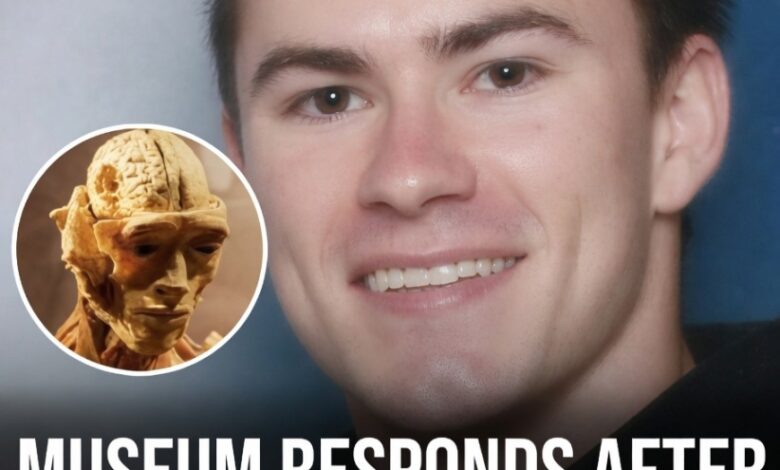
No parent should ever have to bury their child. But for Linda Hargrove, the pain went far beyond the grave. What began as a mother’s quiet grief turned into a horrifying discovery that would haunt her for the rest of her life — and raise disturbing questions about consent, ethics, and the billion-dollar world of human body exhibitions.
It was supposed to be a simple girls’ trip to Las Vegas to celebrate her best friend’s birthday. Linda, still raw from losing her only son Tyler two years earlier in a tragic motorcycle accident, almost canceled. But her friends convinced her that a change of scenery might help. On their second day, they wandered into one of the city’s popular tourist attractions — a traveling exhibition of plastinated human bodies, marketed as educational art.
The displays were striking: real human bodies preserved through a process that replaces fat and fluids with polymers, posed in dramatic, artistic positions. Linda moved through the exhibit with a mix of fascination and unease. Then she stopped in front of one particular figure — a male body posed in deep thought, one hand resting on his chin. The plaque called it “The Thinker.”
Something about the specimen felt eerily familiar. The height. The build. The small scar on the left knee from a childhood bike accident. Linda felt the room spin as she leaned closer. There, on the inner wrist, was the tiny birthmark Tyler had always called his “lucky star.”
Her son’s body — skinned, posed, and put on public display for strangers to gawk at.
The scream that tore from Linda’s throat echoed through the museum. Security rushed in as she collapsed, sobbing uncontrollably. She had donated Tyler’s body to science after his death, believing it would help medical students and researchers. She had no idea it would end up in a commercial exhibition, stripped of skin and turned into macabre art.
The truth that emerged in the following days was even more devastating. Tyler’s body had been sold multiple times through a chain of body donation brokers. What Linda believed was a donation to a respected university program had been funneled into the lucrative world of plastination shows. Companies pay top dollar for healthy, young bodies — and Tyler, an athletic 24-year-old, was exactly what they wanted. His remains had crossed state lines, been processed overseas, and eventually placed in the exhibit without any further consent from his family.
Linda’s fight for justice became national news. She sued the exhibition company, the brokers, and anyone involved in the chain that led to her son’s body being displayed. The legal battle was long and emotionally exhausting, but it brought attention to a largely unregulated industry. Investigations revealed that many families had no idea where their loved ones’ bodies ultimately ended up. Some were used in crash tests. Others in surgical training. And some, like Tyler, became macabre attractions for paying customers.
The exhibition eventually removed “The Thinker” after mounting public pressure. But for Linda, the damage was done. She no longer sees her son’s face in her dreams as the smiling young man who loved motorcycles and wanted to be a firefighter. Instead, she sees the posed, skinless figure that strangers once paid to photograph.
This tragedy highlights the dark underbelly of the body donation industry. While many donations do incredible good — advancing medical science and saving lives — the lack of strict oversight allows bodies to be commodified in ways donors and families never intended. Linda has since become an advocate for stronger regulations, pushing for transparency and requiring explicit consent for any commercial or public display of donated remains.
Today, Linda keeps a small memorial garden for Tyler in her backyard. She talks to him there, telling him about the changes she’s helping to create so no other mother has to experience what she did. The pain hasn’t gone away, but it has purpose now.
If you’re considering body donation for yourself or a loved one, please do thorough research. Ask the tough questions. Demand written guarantees about how the body will be used. And make sure your family fully understands what they’re agreeing to. A simple signature on a form can lead to consequences no one anticipates.
Linda’s story is a heartbreaking reminder that even in death, dignity matters. Tyler deserved better than to become a tourist attraction. Every person does. The wooden box or the donation form might seem small in the moment, but the impact can echo for generations.
Some secrets destroy families when they’re revealed. Others, like the truth behind “The Thinker,” force us to confront uncomfortable realities about how we treat the bodies of those we’ve lost. Linda’s fight continues — not just for her son, but for every family who deserves to know exactly where their loved one’s final journey will lead.