For 10 Years I Brought White Roses to My Wife’s Grave — Until One Rainy Morning Changed Everything
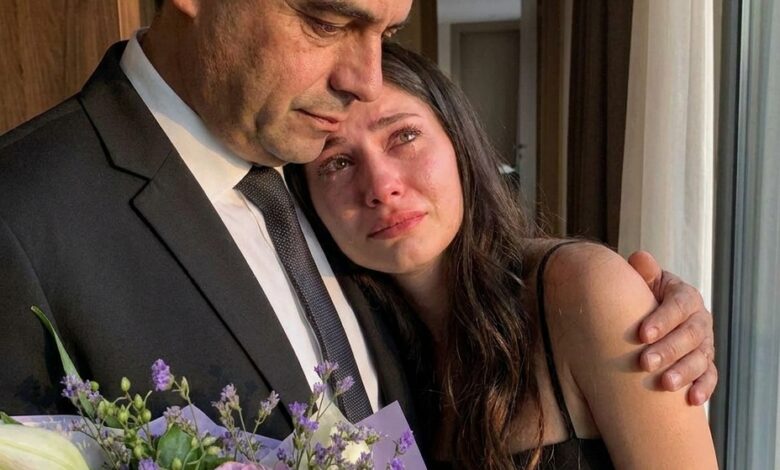
For ten years, my Sundays belonged to my wife. Rain or sunshine, I followed the same ritual without fail — keys in one hand, white roses in the other, speaking to Evelyn as though she still waited somewhere beyond the silence. I would joke with her in the hallway before leaving, asking if I still looked handsome and imagining the gentle laugh she used to hide behind her smile. That morning felt no different, except for one thing. My daughter Anna stood at the top of the stairs with fear written across her face. Paint stained her fingers, and her voice trembled when she quietly asked me not to go to the cemetery. I brushed away her concern with the confidence of routine, kissed her forehead, and left anyway. I had no way of knowing that before sunset, the love story I had carried for a decade would no longer look the same.
The drive followed familiar roads and familiar comforts. I stopped at Mrs. Bell’s flower shop, where she already knew my order by heart — white roses, lilies, and lavender tied with cream ribbon, the same bouquet I had once held while asking Evelyn to marry me. At the cemetery, I stood beside her grave as I always did, speaking softly about ordinary things: gutters that needed cleaning, Anna’s strange mood, and how coffee never tasted right in Evelyn’s favorite blue mug. Rain gathered on the stone while I promised to return the following Sunday. On the way home, I picked up donuts for Anna and thought little of the storm gathering overhead. But when I stepped into our kitchen, every ordinary thought vanished. Sitting on the table was the exact bouquet I had just left at the cemetery — still damp with rain, still tied with the same ribbon — and beside it stood Anna, pale and shaking.
My daughter broke down before I could ask a question. Through tears, she confessed that she had followed me to the cemetery, removed the flowers after I left, and brought them home because she could no longer carry what she had hidden for years. Then she handed me a yellowed envelope with handwriting that instantly stole the breath from my lungs. It was Evelyn’s. According to Anna, my wife had entrusted her with the letter shortly before cancer took her, asking that I read it after her passing. But fear and grief had turned days into months and months into years, until the secret became too large to face. My hands trembled as I unfolded the paper. The first line shattered me: “Thomas, I never truly left you… but you have been mourning the wrong story.” The letter revealed a truth buried beneath decades of silence — the woman I buried had not been Evelyn at all, but her identical twin sister, Marie. After a tragic accident and a desperate family decision made in fear and shame, Marie stepped into Evelyn’s life, carrying a child and a secret nobody believed could survive daylight.
The revelation forced Anna and me onto a long drive to confront the last person who still held the rest of the truth — my mother-in-law. There, piece by painful piece, the story emerged. Evelyn had died years earlier in the accident I thought claimed Marie. Facing scandal and terrified for Marie’s unborn child, the family had hidden the truth and allowed her to take her sister’s place. Marie’s letter confessed everything she could never say aloud — how she learned Evelyn’s habits, copied her routines, and lived inside a borrowed life that grew heavier with each passing year. Yet among the lies was one confession that cut deepest: “Loving you was the only part of this deception that was real.” I sat stunned while decades rearranged themselves inside my mind. The grave I had visited for ten years belonged to a woman who had deceived me — but also loved me. And the daughter beside me, frightened that blood might rewrite our bond, suddenly looked smaller than her twenty-three years.
That night, after we returned home, I watched Anna sleeping on the couch and understood something grief had hidden from me for too long. Love does not disappear simply because truth arrives late. Fatherhood does not belong to biology or paperwork or family secrets. It belongs to the person who stays. I had taught Anna to ride a bicycle, held her through fevers, comforted her after heartbreak, and watched her become the woman she was. Nothing inside a letter could erase that. The following Sunday was the first in ten years that I did not drive to the cemetery. Instead, I stood in the kitchen beside the fading white roses while morning light filled the room. Anna joined me quietly and slipped her hand into mine like she used to as a child. I still do not know how to mourn the woman I thought I lost or how to forgive the years built on silence. But I know this much: the promise I kept for ten years was never really about a grave. It was about love. And love, even when wounded by truth, sometimes survives in forms we never expected.