The Groom Stopped the Wedding With Six Words — And Suddenly My Family Couldn’t Hide Who I Was Anymore
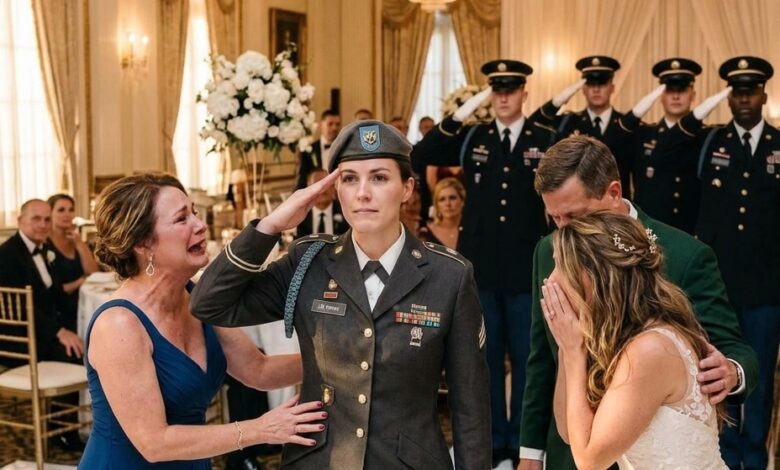
The ballroom was built for perfection — imported roses, candlelight, polished marble, and the soft music of a string quartet drifting beneath crystal chandeliers. My sister Chloe stood at the altar in white satin, surrounded by the kind of guests my mother spent years collecting like trophies. I had almost left before the ceremony began, already exhausted by the polished insults and carefully disguised remarks about my “military phase.” Then the groom looked directly at me and said six words that changed everything: “Captain Sarah Bennett. You were there.” The room froze. Conversations died. Even the musicians hesitated. And for the first time in years, my family looked at me not with dismissal or irritation — but with uncertainty.
Liam did not say my name like someone recognizing an old acquaintance. He said it with the weight of memory. The moment his voice reached me, the ballroom disappeared and I was back in Helmand — dust, rotor wash, twisted metal, and radio static filling the air after a convoy attack that had gone wrong in seconds. Four years earlier, Liam had been caught in that chaos. While guests shifted awkwardly around champagne towers and wedding flowers, he told the room exactly what happened. How an explosion flipped vehicles. How gunfire followed. How a military medic ran toward danger instead of away from it. And how that medic dragged him to safety, treated his wounds, and came back for him when he lost consciousness. Then he looked at me and said the sentence that reordered the room: “I’m alive because Captain Sarah Bennett refused to leave me there.”
The silence afterward felt crowded with realization. My mother, Eleanor, recovered first — not with pride, but with irritation. That had always been her instinct when life disrupted appearances. She tried to dismiss the moment with a brittle smile, describing my service as a dramatic phase and implying the military had simply been a convenient outlet for me. But this time the room did not follow her lead. The donors, business friends, and carefully curated guests could hear what she could not: gratitude, sacrifice, and dignity standing where she had expected decoration. Liam, visibly shaken, looked at my mother with disbelief and asked if she understood who her own daughter was. The answer became painfully clear when he revealed a letter my mother had written months earlier after learning he was engaged to Chloe. In it, she dismissed me as someone who exaggerated her significance and asked that my military history not be discussed at family events because it was “grim” and “not who we are.”
That letter cracked something wider than embarrassment. It exposed years of careful family editing. Liam turned toward Chloe and asked whether she had known. At first she denied it, but silence betrayed her. She admitted she did not think it mattered. Those words hit harder than anything else spoken that evening. Because the real wound was not ignorance — it was indifference. My sister had never cared enough to know who I became after leaving home. The daughter who received the BMW while my tuition went unpaid. The daughter who stood silently while our parents reduced me to “average.” Liam understood the meaning immediately. His expression changed from confusion to recognition — the cold, permanent kind. He removed his boutonnière, set it on the table, and told Chloe there would be no wedding. Gasps rippled through the ballroom. My mother’s voice rose in horror. Chloe cried. My father stood motionless, trapped between shame and optics. But Liam remained calm as he said the thing nobody else had been willing to say aloud: he could not marry into people who mistook cruelty for class.
I left before the cake was cut and before the arguments fully erupted behind me. Outside, the evening air felt cleaner than the ballroom ever had. A few moments later, Liam joined me beneath the hotel lights, no bride beside him and no ceremony left to save. He apologized for being late, meaning late in gratitude and late in understanding. I told him he owed me nothing. Weeks later, after my mother’s furious voicemails turned into tearful requests to “talk like family,” I still did not go back. Not out of revenge — out of clarity. The wedding had not created the injury. It had only exposed it. Months later, Liam and I met again in Washington, not for romance or dramatic reconciliation, but to build something useful through his veterans’ foundation. Over coffee he asked whether I ever wished my family had simply been decent. I thought about the years, the comparisons, the silences, and the wedding that collapsed under its own dishonesty. Then I gave him the only truthful answer: “No. I wish they had been honest sooner.” Because decency might have changed my childhood. But honesty would have saved me years.