Can you tell someone will die months before it happens? End-of-life nurse explains the subtle clues
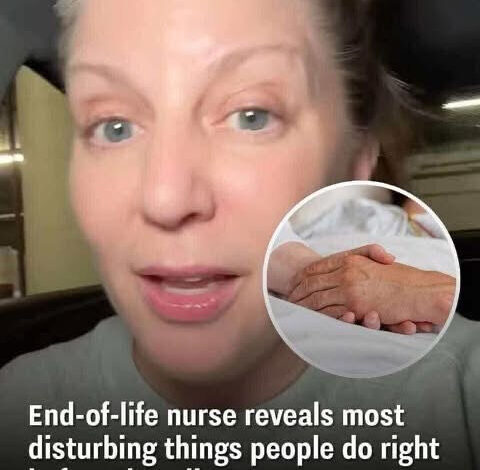
Julie McFadden has spent years beside people during the final moments of their lives. As a hospice nurse, she has witnessed death more times than most people could emotionally imagine, and instead of avoiding the subject, she speaks openly about it. Through her work, books, and social media videos, Julie tries to remove some of the fear surrounding dying by explaining the physical and emotional changes that often happen near the end of life. Her goal, as she often says, is to “alleviate the fear and stigma around death.”
For many families, death feels terrifying partly because the process itself is unfamiliar. Small physical changes can appear shocking if nobody has explained them beforehand. Julie’s videos have resonated with millions because she calmly describes these experiences in ways that help loved ones understand what they are witnessing instead of immediately assuming suffering or panic.
One of the most emotionally disturbing experiences for families is often the change in breathing patterns that can happen as death approaches. Julie explains that many dying patients experience something called Cheyne–Stokes breathing, a pattern caused by metabolic changes happening naturally inside the body. The person may breathe rapidly for a short period, pause for several seconds, and then begin breathing quickly again. To loved ones standing nearby, it can look frightening and painful.
“You can see that chest rapidly breathing, and then a long pause […] and then rapid breathing again,” Julie explained while describing the process.
But according to her, these changes do not necessarily mean the person is suffering. Families often panic because they interpret the unusual breathing as distress, when in reality the body is simply moving through its natural shutting-down process. Many relatives later tell hospice workers they wish someone had explained these changes before witnessing them.
Another phenomenon Julie frequently discusses is something known as the “death rattle.”
This sound happens when saliva gathers in the mouth and throat because the brain no longer signals the body to swallow normally. The result is a wet, gurgling sound that many families mistakenly believe comes from fluid filling the lungs. Julie emphasizes that although the noise can sound upsetting, it is usually not causing the patient discomfort or suffocation.
“People hear it, they don’t understand it, they automatically assume it’s coming from their lungs. That is not happening. It’s truly just a little bit of saliva,” she explained.
She further reassures families by noting that the body often appears physically relaxed during this stage, suggesting the person is not experiencing panic or air hunger despite how alarming the sound may seem.
One of the most fascinating aspects of Julie’s work is her belief that the human body often begins preparing for death months before it happens. Over years in hospice care, she says she has learned to recognize patterns that frequently appear during the final stages of life.
According to Julie, around six months before a natural death, many people begin showing broad but noticeable changes. They often become less social and more withdrawn emotionally. They sleep significantly more than before and gradually lose interest in eating and drinking. These symptoms appear so consistently in hospice care that nurses use them as important indicators when evaluating a patient’s decline.
At approximately the three-month stage, physical weakness tends to increase further. Patients may spend most of their time at home because even simple activities — such as walking to the bathroom or moving around independently — become exhausting. Sleeping increases even more, while appetite and hydration continue declining steadily.
Then comes one of the most mysterious experiences families often report.
Julie explains that during the final month of life, many patients begin describing encounters with deceased loved ones, pets, or old friends who have already passed away. These experiences are commonly referred to as “visioning” in hospice care.
“Usually around the one month mark is when people will start seeing ‘the unseen,’” Julie explained. “They’ll be seeing dead relatives, dead loved ones, dead pets, old friends who have died.”
Not every patient experiences this, but hospice workers report it often enough that many consider it a normal part of the dying process. Importantly, these visions are frequently comforting rather than frightening. Patients may appear calmer afterward, as though the encounters help them emotionally prepare for death.
Other hospice professionals share similar observations.
Angela Morrow, a nurse associated with Verywell Health, also notes that people nearing death often report sensing or hearing from deceased loved ones. She encourages families not to argue with dying patients about these experiences or dismiss them harshly as hallucinations. Instead, caregivers are advised to respond gently, listen calmly, and focus on making the person feel emotionally safe rather than confused or invalidated.
“You might feel frustrated because you can’t know for sure whether they’re hallucinating, having a spiritual experience, or simply confused,” Morrow explains. “The uncertainty can be unsettling, but it’s part of the process.”
Julie also explains that in the final weeks before death, sleep begins overtaking wakefulness almost entirely. Many patients spend more time asleep than awake, while eating and drinking become minimal. Hospice nurses closely monitor these changes, not to aggressively interfere, but to guide patients and families compassionately through the process.
According to Julie, hospice care is not about “giving up.”
Instead, it focuses on allowing the body to guide the process naturally while healthcare workers provide comfort, pain management, emotional support, and dignity during the final stage of life.
Her work has deeply affected people online, especially those caring for dying relatives. Many viewers say her videos helped reduce fear during some of the most painful moments of their lives. One woman wrote that her mother was in hospice and likely only hours from death, adding that Julie’s explanations had helped her emotionally prepare. Another viewer described finding peace after realizing her grandmother’s final behaviors were normal parts of the dying process rather than signs of terror or suffering.
Healthcare workers themselves have also praised her educational approach because it helps families understand experiences that otherwise feel traumatic and incomprehensible.
Ultimately, death remains one of the most emotionally difficult subjects humans face because it carries uncertainty, fear, and grief all at once. Through her openness and honesty, Julie McFadden tries to replace at least some of that fear with understanding.
Her message is simple but powerful:
Dying is often not a sudden, chaotic event.
In many cases, it is a natural process the body slowly prepares itself for — and hospice care exists not to fight that process endlessly, but to guide people through it with compassion, dignity, and as much peace as possible.