The Strange Little Spoon
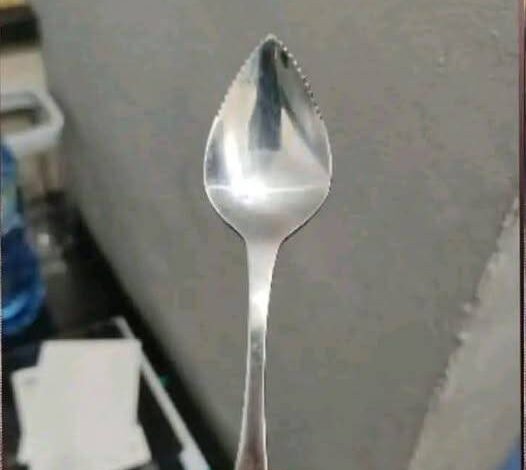
Have you ever found one of those odd little spoons buried in a kitchen drawer and wondered why it even exists? The shape looks slightly wrong, the edges seem unnecessarily sharp, and the tiny teeth along the sides make it appear more like a miniature gardening tool than something meant for breakfast. Most people glance at it once, shrug in confusion, and toss it aside beside forgotten utensils nobody understands. Some even assume it’s decorative or outdated — a relic from another generation’s strange kitchen habits.
But throwing it away would be a mistake.
That strange-looking utensil is actually one of the smartest small tools ever designed for fruit, quietly solving a problem most people accept as unavoidable: the messy struggle of eating soft, segmented foods cleanly. The grapefruit spoon may look old-fashioned, but its design is surprisingly precise. Every tiny serrated edge serves a purpose. Unlike an ordinary spoon that slips uselessly against membranes and peel, this one cuts gently as it moves, sliding between fruit sections with almost surgical ease.
What makes the tool so satisfying is how effortless it feels once you understand it. Grapefruit, for example, can be frustrating to eat neatly. A regular spoon crushes the segments. Knives require awkward slicing and leave juice everywhere. Fingers turn sticky almost immediately. But the grapefruit spoon turns the entire process into one smooth motion. Its serrated edges separate the fruit from the membrane while the bowl of the spoon lifts out perfect, juicy bites ready to eat. Suddenly a fruit that felt inconvenient becomes simple and strangely elegant.
That’s the hidden brilliance of good kitchen design: solving irritation so smoothly you barely notice the problem existed.
And despite the name, the spoon’s usefulness extends far beyond grapefruit.
The same delicate cutting edges that glide through citrus membranes work beautifully on kiwi, passion fruit, peaches, mangos, and even avocados. It can scoop soft fruit cleanly without crushing it, trace around pits with precision, and carve through slippery textures that normal utensils struggle to handle. People often discover its versatility by accident. One day they use it for grapefruit, then suddenly find themselves reaching for it whenever any delicate fruit appears on the counter.
It quietly transforms messy tasks into controlled, satisfying movements.
There’s also something oddly comforting about tools like this surviving through generations. In a world full of oversized kitchen gadgets promising revolutionary convenience, the grapefruit spoon remains simple, inexpensive, and almost unchanged for decades because the design already works perfectly. No batteries. No complicated instructions. Just a tiny adjustment to an ordinary spoon that makes a frustrating task dramatically easier.
That’s why people who actually use one tend to become unexpectedly loyal to it. Before trying it, the spoon seems unnecessary — almost ridiculous. Afterward, it becomes one of those oddly specific kitchen tools you can’t imagine living without. The moment you effortlessly lift out a perfect citrus segment without juice running down your wrist or pieces tearing apart, something clicks. You suddenly understand why somebody invented it in the first place.
And maybe that’s part of its charm.
The grapefruit spoon is a reminder that some of the best inventions aren’t flashy or revolutionary. Sometimes they’re small, quiet improvements that remove tiny frustrations from everyday life. They don’t demand attention. They simply work so well that eventually you stop noticing the tool entirely and only notice how much easier things have become.
So the next time you spot that weird little spoon with tiny teeth hidden in the back of a drawer, don’t throw it away. Keep it. Because once you use it properly even once, it will stop looking strange forever — and start looking indispensable.