Black couple gives birth to blonde, blue-eyed child who they call “a miracle baby”
Every expectant parent engages in the same quiet ritual of anticipation. We spend nine months constructing a mental gallery of our unborn child, wondering which ancestor will claim stake to their features. We debate whether they will inherit a father’s distinct ears or the depth of a mother’s gaze. Regardless of whether a child is born with golden curls or dark coils, or whether their skin reflects the deep mahogany of West Africa or the porcelain tones of the North, the sentiment remains universal: every child is a blessing, and every child deserves an equal measure of love.
However, while we understand that genetics is a game of probability, we generally expect the results to stay within certain biological boundaries. For Ben and Angela Ihegboro, a Nigerian couple living in London, those boundaries weren’t just pushed—they were completely redrawn.
An Unexpected Arrival
In 2010, the Ihegboros prepared to welcome their third child into the world. Having already parented two black children who mirrored their own Nigerian heritage, they had no reason to expect anything out of the ordinary.
But when their daughter, Nmachi, finally made her debut, the atmosphere in the delivery room shifted from routine joy to profound, absolute shock.
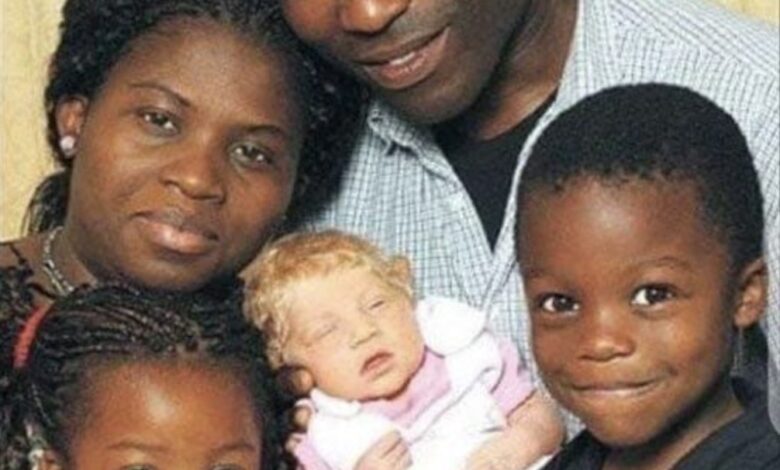
Despite her parents’ heritage, little Nmachi entered the world with pale skin, striking blue eyes, and a shock of blonde hair. The sight was so unexpected that it left the couple—and the medical staff—in a state of total disbelief.
“A Miracle Baby”
In the wake of the birth, the immediate question was “how?” In a world where we rely on the consistency of ancestral genes to predict our children’s appearance, Nmachi represented a biological anomaly that defied the naked eye.
“She is beautiful, a miracle baby,” Angela told reporters at the time, her pride in her daughter’s health and beauty undiminished by the confusion surrounding her appearance.
Yet, the “how” remained a persistent shadow. While the couple embraced their daughter with open arms, they were left scratching their heads, grappling with the scientific mystery of how two Nigerian parents could produce a child who looked, by all traditional accounts, white.
In the wake of Nmachi’s birth, the atmospheric shift in the delivery room was followed by an inevitable, if uncomfortable, societal “elephant in the room.” In cases where a child’s appearance deviates so sharply from their parents, whispers of infidelity often follow. However, Ben Ihegboro, a customer advisor by trade, was swift and steadfast in shutting down any such speculation.
“Of course she is mine,” Ben told The Sun with unwavering conviction. “My wife is true to me. Even if she hadn’t been, the baby still wouldn’t look like that.”
The shock, it seems, was purely a matter of biological bewilderment. Recalling the initial moments of fatherhood to the New York Post, Ben admitted his first reaction was a blunt, “What the flip?” The couple reportedly sat in stunned silence for a long duration, simply staring at the newborn who had defied every expectation of their family tree.
Three Theories: Cracking the Genetic Code
While the Ihegboros leaned into the “miracle” of the moment, the scientific community began looking for a more grounded explanation. Though doctors confirmed early on that Nmachi did not appear to have standard albinism, they proposed three primary genetic theories to explain her pale skin, blue eyes, and blonde hair—though none were deemed entirely conclusive at the time.
1. The Unique Mutation
The first hypothesis suggests that Nmachi is the result of a de novo mutation—a genetic change completely unique to her that occurred at the point of conception. If this is the case, Nmachi would be the first in a new genetic line, potentially passing these “white” traits down to her own future children.
2. Dormant Ancestry
A second possibility posits that both Ben and Angela carry recessive Caucasian genes from an interracial coupling deep within their family histories. In this scenario, these genes remained dormant for generations, “skipping” dozens of ancestors before finally meeting and manifesting in their third child.
3. A Mutated Variant of Albinism
The final theory suggests a mutated form of albinism. Unlike the traditional presentation of the condition, this variant might allow the skin to darken slightly over time. Ben, however, remains skeptical of this diagnosis. “She doesn’t look like an albino child anyway,” he noted, comparing her to cases he had seen in Nigeria or in medical texts. “She just looks like a healthy white baby.”
A Universal Truth
Ultimately, the genetic “how” serves as a secondary plot point to a much more vital story. Whether Nmachi’s appearance is the result of a rare mutation or a hidden branch of a family tree, she was born into a home defined by devotion.
As the dust settles on the medical mysteries and the tabloid headlines, one fact remains unchanged: Nmachi is a daughter of the Ihegboro family, destined to be loved and treasured with the same intensity as any other child. Nature may be a mystery, but the bond of a family is remarkably clear.