I was walking on the beach when I suddenly came across this.
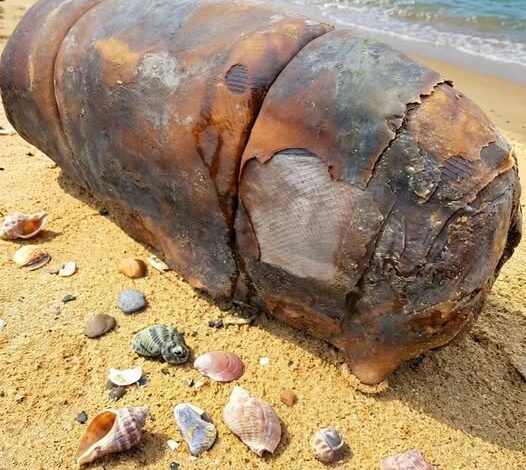
At first glance, it looked like a corpse.
Not something unusual.
Not a piece of debris.
Not an object washed ashore after a storm.
A corpse.
The shape alone was enough to stop me in my tracks.
Half-buried in the wet sand, it stretched awkwardly along the shoreline, its surface darkened by seawater and sun. The exposed sections appeared disturbingly organic. From a distance, it resembled something that had once been alive and had somehow ended up abandoned between the ocean and the land.
For several seconds, I couldn’t move.
My heart immediately began pounding.
The rational part of my mind searched for explanations, but fear moved faster.
Every detail seemed to reinforce the worst possibilities.
The color looked wrong.
The texture looked wrong.
The shape looked wrong.
Everything about it triggered the same instinctive reaction:
Don’t get closer.
Around me, the beach remained quiet.
Waves rolled toward shore in their endless rhythm. Seagulls drifted overhead. The breeze carried the familiar scent of saltwater.
Yet suddenly the entire scene felt different.
What had moments earlier seemed peaceful now felt unsettling.
I found myself staring at the object, unable to look away.
Part of me wanted to leave immediately.
Another part needed to know.
So I moved closer.
Slowly.
Carefully.
Each step seemed to reveal new details.
The object appeared even stranger up close.
The outer surface looked torn and weathered. Sections of it seemed peeled back, exposing an inner structure that looked eerily similar to flesh, muscle, or connective tissue.
The resemblance was so convincing that my stomach tightened.
For a moment, I genuinely wondered if I was looking at something far more serious than beach debris.
My imagination began filling in gaps before evidence could.
Maybe it was an animal.
Maybe it was something washed in from deeper water.
Maybe it was something much worse.
Fear has a remarkable ability to create stories before facts arrive.
And in that moment, my mind was writing several at once.
Then I noticed something unexpected.
A pattern.
Beneath the damaged outer layer was a woven structure.
Not biological.
Manufactured.
Symmetrical.
Artificial.
The closer I looked, the clearer it became.
This wasn’t a living thing.
It had never been alive at all.
What lay before me was an old cable.
A massive industrial cable, likely part of a long-forgotten marine installation, utility system, or underwater infrastructure project.
Years of exposure had transformed it beyond recognition.
The sun had baked its outer covering.
Saltwater had slowly eroded its surface.
Waves had battered it repeatedly against rocks and sand.
Time had stripped away layer after layer until the interior fibers became exposed.
Those fibers, twisted and woven together, created an illusion so convincing that from a distance they appeared almost human.
What looked like muscle was insulation.
What looked like skin was weathered protective casing.
What appeared to be something organic was actually the remains of a machine-made object slowly being reclaimed by nature.
The realization brought immediate relief.
But it also left me thinking.
Because what frightened me most wasn’t the cable itself.
It was how quickly my mind had leapt to the most dramatic conclusion possible.
Within seconds, I had transformed an abandoned piece of industrial waste into something terrifying.
I wasn’t alone in that tendency.
Human beings are wired to detect threats.
Throughout history, assuming danger often carried fewer consequences than ignoring it.
As a result, our brains frequently prioritize alarming explanations over ordinary ones.
A shadow becomes a figure.
A noise becomes an intruder.
An old cable becomes a corpse.
Fear often arrives before logic has a chance to speak.
Standing there on the beach, I began looking at the object differently.
What initially appeared horrifying now felt strangely symbolic.
Because the cable itself told a story.
Long ago, it served a purpose.
Perhaps it carried electricity beneath the sea.
Perhaps it transmitted data between distant locations.
Perhaps it connected communities, industries, or infrastructure systems that people depended upon every day.
At some point, however, it became obsolete.
Abandoned.
Forgotten.
Left to the ocean.
Years passed.
The sea did what the sea always does.
It weathered.
Eroded.
Transformed.
Until the object no longer resembled what it once had been.
And eventually it washed ashore, carrying with it a silent reminder of humanity’s relationship with the natural world.
We often imagine that things disappear once they leave our sight.
Trash thrown away.
Equipment abandoned.
Materials discarded after serving their purpose.
But oceans remember.
They collect what we leave behind.
Sometimes those remnants remain hidden beneath waves for decades.
Sometimes they return unexpectedly.
A plastic bottle on a remote beach.
A fishing net tangled around rocks.
A rusted piece of machinery exposed by shifting tides.
Or a cable so altered by time that it resembles something entirely different.
What I discovered that day wasn’t a body.
But it was evidence.
Evidence of how much human activity reaches places we rarely think about.
Evidence of how easily waste becomes part of the landscape.
Evidence that the ocean is not simply a destination for things we wish to forget.
It is a living system that eventually returns many of those things to us.
As I continued walking along the shoreline, the encounter stayed with me.
The fear faded.
The curiosity remained.
So did the lesson.
Not every frightening sight hides a horror story.
Sometimes the truth is more ordinary.
Sometimes it is stranger.
And occasionally, the ordinary truth reveals something deeper than the frightening illusion ever could.
The next time I walk along a beach, I’ll still search for shells, driftwood, and treasures carried in by the tide.
But I’ll also look more carefully at the things that seem out of place.
Because somewhere beneath the waves, countless forgotten objects continue their slow journey toward shore.
And who knows what stories they might tell when they finally arrive.
What looked like a body on that quiet beach turned out to be nothing more than an old cable.
Yet in its own way, it revealed something important.
Not about death.
But about perception.
About waste.
About the stories our minds create when fear outruns reason.
And about the countless traces of human activity the ocean continues to carry long after we’ve stopped paying attention.