The Deadly Fever: Why You Must Check Your Child for This One Subtle Mark Immediately
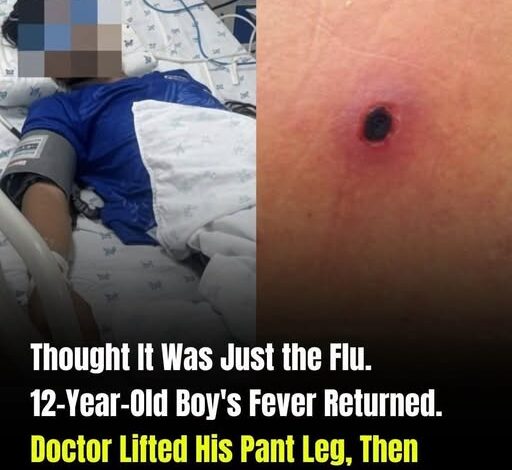
It began as a routine fever, a common annoyance that every parent knows all too well. We brushed it off as the flu, trusting the familiar rhythm of rest, fluids, and patience. But when the fever returned with a vengeance, accompanied by an eerie, bone-deep exhaustion, our world shattered. We rushed to the hospital, terrified, only to discover that the true enemy wasn’t the flu at all. It was hiding in plain sight, disguised as a harmless, tiny blemish on his skin. A single, dark lesion was the only clue to a life-threatening infection that had been silently ravaging my son’s body from the inside out.
The ordeal began with a healthy 12-year-old boy whose vibrant energy suddenly evaporated into a haze of lethargy and body aches. We went through the standard motions: a trip to the pediatrician, a confirmed diagnosis of a viral bug, and the long, tedious days of waiting for his immune system to win the battle. When he finally showed signs of improvement, we exhaled, believing the worst was behind us. He even returned to his normal routine, his appetite tentatively returning, and his smile brightening. We felt the relief that only a parent whose child is recovering can truly understand. It was the calm before the most terrifying storm of our lives.
The relapse was violent and swift. Without warning, the fever spiked to a level that made the thermometer seem like it was broken. My son, usually restless and talkative, became unnervingly quiet, drifting into a state of deep, unresponsive sleepiness that was impossible to break. His weakness was profound; he could barely lift his head, and his body was clearly buckling under an invisible, crushing weight. The panic that set in was cold and paralyzing, a far cry from the manageable stress of his first illness. We didn’t wait for morning. We scooped him up, his skin burning against our arms, and raced to the emergency room, knowing in our gut that something was fundamentally wrong.
The examining physician, a calm and methodical woman, began the intake with professional precision. She moved through the assessment, asking the same questions we had answered a dozen times before, until she reached the physical examination. She carefully checked his throat, listened to his lungs, and scrutinized his limbs. Then, she paused. On the lower part of his leg, hidden by the hem of his jeans, she pointed to a small, dark lesion. At first glance, it appeared to be nothing more than a minor skin injury or perhaps an aggressive insect bite—the kind of thing a child picks up while playing outside in the summer. But the physician didn’t see a minor scratch; she saw localized redness, subtle swelling, and a danger that made her demeanor change instantly.
Her urgency was the most frightening thing I had ever witnessed. She ordered immediate blood tests and specialized imaging, her voice clipped and professional. The medical team suspected that the innocent-looking lesion was the gateway for a virulent bacterial infection that had breached the barrier of the skin and invaded the bloodstream. This was no longer just a fever; it was the onset of a systemic infection that could rapidly trigger sepsis. In the world of pediatrics, this is the nightmare scenario—where the body’s own frantic defense against a pathogen begins to consume its own tissues and organs.
The transition to the intensive care unit happened in a blur of sterile lights and hushed, rapid conversations. I remember the feeling of helplessness as they wheeled him away, his small frame dwarfed by the complexity of the medical equipment surrounding him. For the next several days, our life consisted of the rhythmic beeping of monitors and the sight of IV fluids drip-feeding hope into his veins. It was a harrowing wait, marked by the constant fear that every breath he took might be his last. But thanks to the physician’s sharp eyes and the aggressive, targeted application of intravenous antibiotics, the tide began to turn. His vitals stabilized, and the terrifying fog of his infection began to lift, revealing our boy beneath the layers of trauma.
In the quiet, reflective hours of his recovery, we learned a vital, life-altering lesson. Not every fever is a virus, and not every skin spot is harmless. The medical team hammered home a reality that we had been too complacent to consider: skin is the body’s largest organ, and it is a map of our health that we far too often fail to read. A splinter, a tiny scratch, or a bite that we dismiss as a nuisance can become a fatal portal if the conditions are right. We learned to look closer, to treat every unexplained fever with a heightened level of suspicion, and to trust that “parental instinct” is not just a vague feeling—it is a critical tool for survival.
Parents are often told to monitor fevers, but the real takeaway from our journey is to monitor the child. A fever is merely a symptom; the true danger lies in the changes to the child’s consciousness, their energy, and the subtle, tell-tale signs on their skin. A child who becomes difficult to awaken, who grows unusually confused, or who develops a mysterious mark after time spent outdoors should never be brushed aside. We now check every scrape and every bruise with a scrutiny that might seem excessive to others, but for us, it is the new standard of care.
We were fortunate. We caught the infection before the damage was irreversible, and our son is back to his vibrant, running, and laughing self. But the shadow of that experience lingers. It is a reminder that the world is filled with invisible dangers and that our vigilance is the best defense we have. Most childhood illnesses are indeed harmless, resolving with nothing more than a nap and a glass of juice. But when the persistent, nagging feeling hits that something just isn’t right, the best course of action is to listen to that fear. Do not wait for the situation to resolve on its own; act, demand answers, and trust that your intervention might be the only thing standing between a minor complication and a life-altering tragedy. That small mark on his leg saved his life, and now, it serves as a permanent warning to us all.